Sleep & Glow Omnia Pillow Review (2026): Design, Study & Tradeoffs

sleep and glow pillow
Yawnder Sleep & Glow Review · Updated September 24, 2026

Sleep & Glow Omnia Pillow Review

Omnia is a sculpted foam pillow designed to reduce facial compression during side and back sleeping. The interesting part is the geometry—not a promise that a pillow can reverse skin aging.

Sleep and Glow contoured pillow
Yawnder archive image of the Sleep & Glow pillow. The brand's current Omnia design has evolved since earlier versions.
Testing disclosure: the previous Yawnder page claimed hands-on testing and showroom availability without enough documented evidence to support those statements. This update is based on the current product design and the brand's published study/materials.

Current Omnia quick facts

Current brand price$245
DesignContoured 3D foam shape for side/back sleeping
HeightAdjustable with an additional foam insert
Included coverTENCEL™ Lyocell pillowcase
Brand-direct trial20 nights on the current U.S. product page
Yawnder showroomNot represented as a current floor model

Check current Omnia details

What the shape is trying to do

Omnia uses recessed areas and raised edges intended to reduce direct facial compression while keeping the head supported. That makes it a highly specific pillow: it is most relevant to side and back sleepers who are comfortable staying within a molded contour.

What about the wrinkle study?

Sleep & Glow publishes results from a 12-week observational study conducted at a dermatology clinic in Barcelona in 2023. The study measured facial wrinkles with 3D imaging while participants used the Omnia pillow. That is more evidence than a purely cosmetic marketing claim, but an observational brand-reported study is not the same as a large independent randomized trial.

Use the claim at the right scale: it is reasonable to say the pillow is designed to reduce facial compression and that the brand reports wrinkle changes in its observational study. It is too broad to call the pillow a proven anti-aging treatment, promise improved skin elasticity, or imply that every user will see wrinkle reduction.

Who may like it?

  • Side sleepers concerned about facial pressure against a conventional pillow.
  • Back sleepers who like a defined contour.
  • People willing to adapt to a shaped pillow rather than freely reposition a standard rectangular pillow.

Who may dislike it?

  • Combination sleepers who move far outside a fixed contour.
  • Stomach sleepers who generally need very little head elevation.
  • Anyone who prefers loose fill that can be scrunched and reshaped.

Height and neck comfort

The included insert lets users change profile, but no fixed contour is universally correct. Shoulder width, mattress firmness and sleep position still determine whether the pillow feels too tall or too low. See our pillow-height guide.

Bottom line

Omnia is an unusual specialty pillow with a clear mechanical idea: reduce how much the face presses and folds against the sleep surface. Evaluate it for that design and the brand's limited observational evidence—not as a general skin-care or neck-pain treatment.

For ordinary pillow shopping, see Best Pillows for Sleeping or browse the Pillow Reviews hub.

Sweetnight Hybrid Mattress Review (2026): Best Value?

sweetnight 12 inch plush hybrid pillow top e1563742028683
sweetnight 12 inch plush hybrid pillow top e1563742028683.

Yawnder Reviews · Legacy review restored September 2026

SweetNight Hybrid Mattress Review: Original Sleep Experience Restored

The SweetNight review had been reduced to a short product summary, but the backup still contained actual unboxing and partner-motion observations from the Island hybrid.

What we reviewed

Yawnder tested a 12-inch plush pillow-top SweetNight hybrid, also referred to in the older article as the Island mattress. It combined memory foam with individually wrapped coils.

Motion transfer

Coming from traditional connected-coil mattresses, the reviewer was struck by how little movement transferred across the bed when a partner shifted positions. The pocketed coils and foam layers worked together to calm the surface.

Firmness and feel

The mattress felt in the low-to-middle firmness range, which was consistent with its pillow-top and foam-heavy comfort system. It had more cushioning than a traditional firm innerspring while retaining coil support underneath.

Value positioning

The original article’s main point was that SweetNight delivered features normally associated with more expensive hybrids—foam comfort layers, pocketed coils and boxed shipping—at a lower price tier.

Watch original review video →

Current-shopping note

SweetNight has changed models over time, so current names, thicknesses and policies should be checked before purchase. The restored page documents the hybrid Yawnder actually received.

Yawnder Reviews · Disclosure: Some links may be affiliate links. Current specifications and policies can change.

Pillow Guy Down Alternative: Best Luxury for Comfortable Sleep

Pillow Guy
Prefer an Amazon alternative? Compare hotel-style down-alternative pillows on Amazon. Similar pillow options, not necessarily the product reviewed; availability and prices vary.

Pillow Guy pillows are a brand of high-quality pillows that are designed to provide comfort and support for all types of sleepers. They are available in a variety of different fills and firmnesses, so you can find the perfect pillow for your individual needs.

Some of the most popular Pillow Guy pillows include:

  • Down Pillow: This pillow is filled with 100% RDS-certified white goose down, which provides the ultimate in softness and luxury.
  • Down Alternative Pillow: This pillow is filled with a hypoallergenic down alternative fiber that provides the same feel and comfort of down, without the allergens.
  • Memory Foam Pillow: This pillow is made with high-quality memory foam that contours to your head and neck to provide pressure relief and support.
  • Gel Memory Foam Pillow: This pillow is similar to the memory foam pillow, but it also has a gel layer that helps to keep you cool and comfortable all night long.

Pillow Guy pillows are also available in a variety of different sizes and shapes, so you can find the perfect pillow for your bed and your sleeping position.

Pillow Guy pillows are known for their high quality and durability. They are also backed by a 100% satisfaction guarantee, so you can try them risk-free.

Overall, Pillow Guy pillows are a great option for anyone looking for a high-quality, comfortable, and supportive pillow.

The Pillow Guy Down Alternative Pillow is marketed towards gentlemen who could step up their bed game. The entire Pillow Guy brand offers an array of products, all meant to encourage men to pay more mind to this routine but an essential part of life.

The products they offer are pillows, sheets, comforters, duvet sets and also bundles to help you save in case you’re looking for a nice package deal.

Overview of the Pillow Guy Down Alternative Pillow

Pillow Guy only has 2 types of pillows in their inventory but I believe it’s more than enough; some people just don’t like foam and there already exists an array of places where foam pillows are available. The Pillow Guy brand seeks to distinguish itself by representing men of higher class and higher taste, of which quality pillows like traditional down pillows remain relevant. Their down pillows are $150.00 each, a rather steep price but I have no doubt that the quality matches the price. Usually, things made of premium materials will cost you a premium price and that’s just the reality. For those that want to spend less or are of a more animal-friendly tendency, the down alternative pillow is a solid option. With a price tag of $80.00, it’s worth considering for the budget-minded.

Construction of the Pillow Guy Down Alternative Pillow

pillow guy down alternative pillow logo

The Pillow Guy Down Alternative Pillow comes in two sizes: Jumbo and King. Jumbo is more or less just about the size of a Queen pillow (which are generally ~ 20” X 30”). I kind of wish they just sticked with the term, as anyone shopping for bedding is familiar with it but I respect their decision to focus on their male target audience. To be honest, if we’re talking about men, King would be the appropriate term to take advantage of, for the most part.

Both come with the option of two densities: soft, meant for stomach sleepers, and overstuffed, designed for back and side sleepers.

SizeLengthWidthFill Power
Jumbo Soft202830oz
King Soft203642oz
Jumbo Medium/Firm202855oz
King Medium Firm203676oz

My Pillow Guy Down Alternative Pillow Findings


The Pillow Guy Down Alternative Pillow is made of Poly Gel Fiber, a micro denier which is a synthetic polyester that’s designed to resemble the look and feel of a down pillow. In this case, their blend is a mixture of a .09D (a denier fabric that has the softest down-like feel) and 3D3V (a denier fabric which gives it loft and helps the pillow to retain its shape). Poly Gel Fiber doesn’t just seek to replicate the goose down experience but it also has great benefits which I doubt anyone could complain about, such as: it’s naturally hypoallergenic and it’s resist to dust mite, mold, and mildew—All incredibly gross things that most of us (I would hope) would like to avoid :-).

Pillow shells, that which houses the inner pillow material, are not usually a topic of conversation but what they’ve done with theirs is worth the mention and pretty interesting. Having utilized what’s known as MicronOne Technology means their pillow fabric shells are more premium than most. MicronOne technology refers to a rather high-tech fabric, invented to effectively protect the skin and respiratory system. It’s said to be the only material that’s been scientifically tested to block out bed bugs and micro toxins, down to the size of one micron. The biggest flaw with MicronOne Technology however is that there isn’t ENOUGH research behind it. This however is NOT a reason to think of Pillow Guy in any negative or skeptical way, as these are two completely separate companies. I consider Pillow Guy to be an absolutely awesome brand that has clearly done their absolute best to invest in the most high-quality materials for their high-class creations.

The color of the pillow cases for the down alternative pillows is something the company is quite proud of, and they should be. What they’ve dubbed to be “Pillow Guy Blue” is a striking and bold color, their own blend of Pantone colors, versatile enough to compliment various styles of bedding and decor. A lot of guys also tend to like blue so it was a great choice given their target audience. It is, after all, a rather sophisticated color. In addition, I like that their pillow cases were designed to be used as is. It feels like the sort of thing you’d get when purchasing a bedding set. It’s distinct and of quality. I feel like most companies go with the generic look of pillows; they’re always white, which is understandable (easy to know how clean or dirty they are, right?) but I appreciate that Pillow Guy chose to do something different.

It also comes with a hidden zipper (it’s actually really well hidden) and white satin piping. Piping is usually a posh feature when it comes to any product and the luxury of having it in a pillow case is really nice.

My Pillow Guy Down Alternative Pillow Recommendation

I’ll admit that I had a liking for Pillow Guy the moment I saw their commercial but pillows are more than their marketing and working here at Yawnder, you deserve the truth. The truth is that out of all of the pillows I’ve reviewed thus far, this one is probably one of my top two favorites. The quality matches its price, both the soft and overstuffed version provide more than sufficient support, it’s well designed and really thought out, it achieves its purpose to look and feel just like a down pillow (I was really surprised how well they pulled this off because it’s not easy), and the company isn’t scared to be creative in terms of the look of their product and how they market it, which I think is really cool and what variety is all about.

I also think it’s worth mentioning that despite their intense buffer against dirtiness, it’s always recommended to clean your pillows routinely, so the fact that this pillow is machine washable is a huge plus.

Additionally, they provide Free US Shipping, a 30-Day Sleep Free Guarantee, free returns, and even monthly payments through Affirm, financing for those who can’t afford the entirety of what they’d like to purchase, be it pillows or something else.

In terms of their marketing, what I really like is that there’s a message associated with their products, which is not really typical of sleep products, if you think about it. Most companies are trying to provide a solution, which is great, sure, but not all of them state having a particular reason/purpose as to why they create their products in the first place.

If you haven’t seen their entire commercial, there’s mention how men who care about their appearance and their nice car, things speaking either of their social status or their attention to detail (or both), should care just as much about their sleep hygiene. Pillow Guy is making an attempt to remind people that they should have standards when it comes to their sleep, and how they sleep; it’s precisely why one of their slogans is “Get your sheet together.”

One’s bedroom is no doubt telling of one’s tendency towards cleanliness and whether we’re talking about how others will perceive you because of it, or how you perceive yourself, this is an area worth investing in—regardless of whether or not you can afford the most premium products.

Seeing a line of products that are targeted towards men who are commonly known to not put much care or emphasis into their bedding, is refreshing. It’s nice to see the topic brought up and Pillow Guy does it in a really sophisticated and polite manner.

Pillow Guy challenges men to “step up their bed game,” and I think anyone dating a man who could do better in this arena, would definitely appreciate that.

This is a top-notch luxury pillow that one should not hesitate about; firstly, because of its quality and secondly, because of the company’s values and finesse in addressing the topic of clean sleep.


Frequently Asked Questions About Pillow Guy Down Alternative: Best Luxury for Comfortable Sleep

Is the Pillow Guy Down Alternative Pillow worth it for its price?

Yes, the Pillow Guy Down Alternative Pillow is considered a fantastic option that balances quality with affordability, priced at $79. It offers luxurious comfort and practical features like advanced Poly Gel Fiber fill, making it an excellent value for those seeking a premium feel without the higher cost of a traditional down pillow.

Who is the Pillow Guy Down Alternative Pillow best for?

The Pillow Guy Down Alternative Pillow is best for individuals who prefer non-animal products, those seeking to save money without sacrificing quality, or anyone looking for a hypoallergenic pillow. With options for soft and overstuffed densities, it caters to various sleeping preferences, including stomach, back, and side sleepers.

How does the Pillow Guy Down Alternative Pillow compare to a traditional down pillow?

The Pillow Guy Down Alternative Pillow is designed to mimic the softness and comfort of real goose down using advanced Poly Gel Fiber. Many users note its excellent replication of the down feel while maintaining structural integrity, offering a comparable luxurious experience at a more budget-friendly price point of $79, compared to Pillow Guy's $150 down option.

What are the downsides of the Pillow Guy Down Alternative Pillow?

One potential downside is that while research on the MicronOne Technology is ongoing, its full protective benefits against bed bugs and irritants are still being developed. However, its hypoallergenic properties and dust mite, mold, and mildew resistance still provide significant advantages.

Is the Pillow Guy Down Alternative Pillow good for side sleepers?

Yes, the Pillow Guy Down Alternative Pillow is good for side sleepers, particularly the 'Overstuffed' density option. This firmer version provides the necessary support for maintaining proper spinal alignment, ensuring a restful night's sleep for back and side sleepers alike.

Where can I try the Pillow Guy Down Alternative Pillow in person in San Diego?

While the article does not explicitly state that the Pillow Guy Down Alternative Pillow is available for in-person testing at Yawnder, you can visit the Yawnder showroom in Encinitas, CA to explore a range of premium sleep products. It is recommended to contact Yawnder directly to inquire about the availability of the Pillow Guy pillow for a hands-on trial.

Want to test this in person? Visit our Encinitas showroom or call 858-232-5760.

How Alcohol Affects Your Sleep

alcohol drink elegant 1287549 scaled
Alcohol is the most common type of sleep aid. But drinking alcohol regularly can interfere with your sleeping pattern. It may affect sleep quality, too. Does this mean that you need to give up alcohol altogether? No. You simply need to be smarter about how you manage your liquor consumption, instead. alcoholCaption: How to sleep better after drinking alcohol Source: Pexels   There are several strategies that you can use to ensure better sleep after drinking alcohol.   Avoid Caffeine   If you want to sleep better after having a drink, stay away from caffeine. This does not only refer to coffee. You must refrain from consuming other caffeinated drinks like sodas, teas, and energy drinks. They will keep you awake at night. If you combine that with the effect of alcohol in your body, it will be hard to enjoy a restful night.   If a night of drinking is on the horizon, no worries. Whether you are out with friends or enjoying the game with any of these great tasting beers, you should be smart. Make sure you avoid having any caffeinated drinks, especially during the hours close to when you plan to hit the sack.   Have a Balanced Meal   Drinking your favorite beer or wine on a full belly can reduce the impact of alcohol on your sleep (versus not having a full meal). When you are going out for a drink or sipping some spirits at home, don’t skip dinner. A solid and balanced meal can regulate your body’s absorption of the alcohol.   Make sure you have enough protein, fat, and carbohydrates. This will allow the alcohol to be gradually introduced to your bloodstream, reducing its overall impact on your body. The less disruption your body has, the better your sleep will be.   Drink Plenty of Water   Alcoholic drinks, like beer, can make you dehydrated. When your body is dehydrated, you not only toss and turn during your sleep, you can also suffer from a headache the next morning. So keep yourself hydrated. Drinking plenty of water can combat the diuretic effect of alcohol on your body.   Tips for better sleep after drinking alcohol Source: Pexels   The goal is to drink as much water as the alcohol you consume. When it is not possible, just try to drink as much water as possible. This will help keep your body hydrated. Another benefit to drinking plenty of water is that it fills you up quickly. As a result, you don’t consume as much alcohol as you normally would.   Say No to Smoking   Aside from staying away from the bad combination of alcohol and caffeine, smoking should be avoided too. A lot of people like to drink and smoke at the same time. If you are one of them, don’t be surprised if you have trouble sleeping at night. Nicotine (found in cigarettes) is a stimulant. If you smoke, it can definitely keep you awake at night.   By reducing the number of cigarettes you smoke (or by not smoking at all), you will be able to sleep faster. This can also improve the quality of your sleep.   Turn Off the Alarm   If you have an alarm set on the regular, turn it off just before hitting the bed. Give your body a chance to recover from the effects of alcohol during your sleep. Do not disrupt that sleeping cycle with an alarm going off.   If possible, keep your phone away from your bed, too. You would not want to be woken up by a text message or call. After all, you are going to be highly sensitive to any noise so you want to minimize any disruptions as much as possible.   Stay off Alcohol Before Hitting the Bed   A lot of people have relied on alcoholic drinks such as beer or wine to help them get to sleep. But studies have shown that this is actually doing the opposite. It is time to change your habit of getting a drink right before you hit the bed. This habit of yours can make you feel more awake and energetic, instead, which can then cause a disruption in your sleep cycle.   It is best to get started early on your alcohol consumption – this is called the ‘happy hour’. Do not wait until much later in the night when you are just about to go to bed to get your drink. You are more likely to sleep faster and more soundly when you have had your drink a few hours earlier.   Make Your Bedroom Cozy bedroom Sleep better even with alcohol Source: Pexels   This might seem like a simple step but it can be very effective if you want to fall asleep faster. A cozy bedroom is one that is dim and has a comfortable temperature that will help you doze off. Darker colors on the bedroom wall are also suitable for sleeping. If you are not into dark wall colors, neutral hues can create a relaxing atmosphere in the bedroom.   Ideally, your bedroom should be somewhere that is far from any sources of noise (such as the living room or a noisy street). The less disruptive noises there are, the sooner you can sleep. The quality of your sleep will be better, too. Setting the ideal temperature within your room can also make sleeping easier. Aim for a temperature range of 60-68 degrees Fahrenheit.   Switching to new bedding such as microfiber sheets can improve the quality of your sleep as well. The goal is to make your sleeping space as cozy as possible.   Final Reminders   Heavy drinking is associated with sleep disorders. If you want to reduce the impact of alcohol on your sleep, you might want to lower your consumption. Instead of drinking as a regular nightcap, you can skip some nights. If you can, limit alcohol consumption to 2-3 times a week. Follow a pattern that works for you to improve your sleep quality. It is always a good practice to keep things in moderation.

Best Supplements to Take Before Bed for Alcohol and Sleep

certain dietary supplements may help support your body before and after drinking alcohol by boosting hydration, liver health, and vitamin levels. Always consult with your healthcare provider before starting any new supplement regimen.

  1. B Vitamins: Alcohol depletes B vitamins in your body, particularly B1 (thiamine), B6, and B12, which are essential for energy production and maintaining healthy nerve function. A B-complex supplement can help replenish these nutrients.

  2. Milk Thistle: Traditionally used for liver health, milk thistle contains silymarin, a powerful antioxidant that may help protect the liver from toxins, including the effects of alcohol.

  3. N-Acetylcysteine (NAC): NAC is a precursor to glutathione, a powerful antioxidant in your body. Taking NAC can boost your levels of glutathione, helping to neutralize alcohol’s oxidative stress on the liver.

  4. Magnesium: Alcohol can contribute to a magnesium deficiency, and this mineral plays a crucial role in over 300 cellular processes, including energy production and heart health.

  5. Prickly Pear: Some research suggests that prickly pear extract can help reduce the symptoms of a hangover.

  6. Turmeric: The curcumin in turmeric has anti-inflammatory and antioxidant properties. It could potentially mitigate some liver damage caused by alcohol.

  7. Taurine: An amino acid that may protect the liver from alcohol-induced damage by reducing inflammation and oxidative stress.

  8. Ginger: Known for its anti-nausea properties, ginger could help with any upset stomach the next morning.

  9. Dihydromyricetin (DHM): Found in the Oriental raisin tree and rattan tea, DHM is suggested to reduce the effects of alcohol by enhancing the function of liver enzymes.

Frequently Asked Questions About How Alcohol Affects Your Sleep

Is alcohol a good sleep aid?

No, alcohol is not a good sleep aid; while it might help you fall asleep initially, it disrupts your sleep cycle and diminishes overall sleep quality. Relying on alcohol for sleep can lead to fragmented rest and prevent your body from achieving truly restorative sleep. It is better to avoid it as a solution for sleeplessness.

What are the best strategies to sleep better after drinking alcohol?

To sleep better after drinking alcohol, focus on avoiding caffeine, eating a balanced meal beforehand, staying hydrated, and limiting alcohol closer to bedtime. These strategies help mitigate alcohol's disruptive effects on your sleep cycle, allowing for more restful sleep despite consumption. Additionally, creating a cozy bedroom environment with optimal temperature and lighting can further aid in achieving better rest.

How does smoking affect sleep when combined with alcohol consumption?

Smoking, especially when combined with alcohol, can significantly worsen sleep quality because nicotine acts as a stimulant, interfering with your ability to fall asleep. If you've noticed sleep troubles after a night out, reducing or eliminating smoking can substantially enhance your sleep, as documented by sleep experts. We often discuss these impacts with customers at our Encinitas showroom when exploring holistic sleep solutions.

What's the optimal room temperature for sleep after drinking?

The optimal room temperature for sleep after drinking, and generally, is between 60-68 degrees Fahrenheit. Maintaining this cooler temperature helps your body regulate its natural sleep processes, which can be particularly beneficial when your system is already working to process alcohol. A cooler bedroom environment promotes better sleep onset and quality.

Why should I eat a balanced meal before drinking alcohol if I want to sleep better?

Eating a balanced meal before drinking alcohol is crucial because it helps regulate the absorption of alcohol into your bloodstream, cushioning its effects on your sleep. Consuming alcohol on an empty stomach can exacerbate its disruptive impact, leading to a poorer night's rest. A meal rich in proteins, healthy fats, and carbohydrates slows down alcohol absorption, making for a less disruptive experience for your body.

Where can I find more tips on improving sleep quality in San Diego?

You can find more tips on improving sleep quality by visiting the Yawnder showroom in Encinitas, CA, near San Diego, where our sleep experts can offer personalized advice. We provide hands-on experience with various sleep solutions and can guide you through strategies for better rest. Our team is always ready to share insights into how lifestyle choices profoundly impact sleep, drawing from years of assisting the San Diego community.

Keep exploring
More sleep guidance

Browse Yawnder’s sleep education, research explainers, and practical guides.

Explore sleep guides

What is Celliant Technology in Mattresses?

Close-up image of silky, translucent white Celliant fibers intertwined, creating a glossy and smooth texture. The fibers appear to be thin and thread-like, with a soft sheen reflecting light.

Unlock the secret to better sleep and enhanced recovery with Celliant! This innovative fabric not only absorbs your body heat but also transforms it into healing infrared energy, promoting improved blood flow, stamina, and restful nights—perfect for those who want to wake up feeling rejuvenated!

Helix Plus: The Best Mattress for Plus-Sized Sleepers

Helix Nightfall Mattress

The Helix Plus is a spring and foam hybrid mattress designed to give heavier sleepers proper support and pressure relief throughout the night. Because it was designed with plus size sleepers in mind, it should also last longer than a traditional mattress. A queen size currently retails for $1,190 but there are discounts available here to make it an even better deal. In keeping with Helix’s philosophy of custom comfort, they also offer the option to buy a cover that is cool to the touch helping you fall asleep just a little bit faster.

Overview and Ordering the Helix Plus

The Helis Plus is available exclusively through the Helix website. It comes with a standard 365-night (brand-direct) trial where you can return it for a full refund within the 365-night (brand-direct) trial window after the required break-in period, that includes free shipping to you and free returns. It also has a 10-year warranty. This mattress comes shipped in a box like the one below. 

How do helix mattresses ship such a heavy mattress in a box this size? They use multimillion-dollar equipment to precisely package and vacuum seal these mattresses so they can be shipped without damage. 


When you open the box, you will find a nice little manual about the mattress.

Top of Nightfall

Here’s what it looks like compressed and out of the box.

Nightfall Out of Box

It doesn’t take long for this mattress to come to life. The spring system is engaged immediately and the top layers of foam will take a few hours to fully expand but if needed you could sleep on this mattress within 3 or 4 hours. It will take a full day for it to fully expand though.

Here’s a quick video explaining some of the features of the Plus.

  1.  

Construction of the Helix Plus

Below are the construction details as listed on the Helix website.

Helix Nightfall Construction

Cover: Helix Two Touch Design

Each mattress comes with a top cover layer with stretch and a soft touch as well as a lower cover layer for airflow and breathability.

Comfort Layer: Helix Dynamic Foam

Our special latex-foam hybrid alternative, designed to be denser to contour to your body. Medium feel. Density: 3.75 PCF.

Comfort Layer: Ultra Dense Memory Foam

Uniquely pressure relieving, we use Memory Plus Foam – a special Helix blend. Density: 4.0 PCF.

Transition Layer: High-Grade Polyfoam

Providing ergonomic support and cushioning, the transition layer has a higher IFD to match your body type. Extra support.

Body Shape Layer: XL Wrapped Coils

Hundreds of individual taller coils designed to cradle and support heavier weight. Reinforced perimeter to provide edge support.

Base Layer: DuraDense Foam

The bottom foam layer of the mattress provides base support and durability to the entire mattress.

Here’s what the inside looks like.

Inside nightfall

How Much does the Helix Plus Cost?

Here are the latex prices and price after discount.

Legacy price table removed. Check the current manufacturer or retailer page for today’s pricing and promotions.

My Helix Pus Findings

I have reviewed other mattresses for plus size sleepers including the Big fig and Winkbed Plus. In comparison to these, I found the Plus to be a bit softer. I weigh about 200 lbs. so I may not qualify for a heavy sleeper but in comparison to the other mattresses, this did feel softer.

The picture below shows how much sink you get with a 14 lb.s bowling ball.

Helix Nightfall Sink

Here’s another shot of sinkage towards the edge of the mattress. The coil system in this mattress uses a heavier gauge coil around the perimeter for better edge support so you can use the entire mattress and sleep right up to the edge.

Helix Nightfall Sink 2Here’s a video illustrating motion transfer on the mattress. You will get some motion transfer because of the coil system but they are pocket coils and move independently so not as much as you would with a traditional coil system.


Here’s a look at the inside of the mattress so you can see how each layer responds.


This mattress has a removable cover that could be washed or switched out for the cooling cover. The, “Ultra-Cool Cover” is an extra $125.nightfall cover

Helix Nightfall vs Winkbed Plus

Both the Helix Nightfall and Winkbed Plus are designed for heavy sleepers but there are some distinct differences. The Winkbed Plus is made with foam, spring and latex while the Helix Nightfall is made with Springs and foam. 

The Helix Nightfall is considerably softer than the Winkbed Plus and so is not ideal for stomach sleepers. Stomach sleepers should instead take a look at the Winkbed Plus. 

There are more foam layers at the top of The Helix Nightfall than the Winkbed Plus but the Winkbed Plus has quilted foam in the cover to give it a pillow top feel. 

The Helix Nightfall weight limit is 1,000 lbs. while the Winkbed Plus weight limit is 900 lbs so advantage Helix Plus. Compare this to the Big Fig weight limit which is 1,100 lbs. but is also the firmest of the three mattresses for heavy people. 

The Helix Nightfall, Big Fig and Winkbed Plus are the best hybrid mattresses for heavy people due to their high density foam layers, heavy duty coils. 

The He

Here’s what it looks like underneath the top cover. There’s another cover underneath this to provide more breathability so that you aren’t directly under the foam.

Helix Nightfall Cover 2

My Helix Plus Recommendation

If you are a heavier sleeper and are frustrated with the lack of options out there, the Helix Plus is a welcome addition. It provides a softer feel with great pressure relief without sacrificing durability. The construction is well thought out in that the coil system provides great cradling of your body. The ultra-dense foams will hold up well over time and won’t feel too firm because of the cushioning you get from the coils.

Overall if you are a heavy sleeper, over 250 lbs. and looking for a softer cozier mattress that is breathable and still offers great support, the Helix Plus an excellent choice.

Yawnder test results: Helix Plus

8.1/10 overall

Spine alignment
7.6
Pressure relief
7.8
Temperature
8.5
Motion transfer
8.0
Edge support
8.5
Ease of movement
8.3
Expected durability
8.5
Off-gassing
7.6

Scored on the same rubric we use for every mattress — how we test and score · compare these numbers against every mattress we score.

Helix PLUS Mattress: Frequently Asked Questions

1. What is the Helix PLUS mattress?

The Helix PLUS is a specialized mattress offered by Helix Sleep. Designed with maximum support in mind, this mattress is targeted towards plus-size sleepers and those who prefer a more robust, firm sleep surface.

2. What materials are used in the Helix PLUS mattress?

The Helix PLUS mattress is a hybrid design combining several layers of high-quality materials. From top to bottom, these include a Tencel cover for cooling and moisture wicking, a comfort layer of Helix Dynamic Foam, a layer of Ultra-Dense Memory Foam for pressure relief, high-grade polyfoam, and a base of individually wrapped XL coils for added support. It also features a layer of DuraDense Foam for added durability.

3. What sizes is the Helix PLUS available in?

As of my knowledge cutoff in September 2021, the Helix PLUS is available in all standard sizes: Twin, Twin XL, Full, Queen, King, and California King.

4. How firm is the Helix PLUS mattress?

The Helix PLUS is rated as a medium-firm mattress, falling around 7 on the firmness scale where 1 is extremely soft and 10 is extremely firm. This makes it suitable for sleepers who prefer a firmer surface and need added support.

5. Is the Helix PLUS mattress suitable for side sleepers?

While comfort is subjective and depends on individual preferences, the Helix PLUS’s medium-firm feel and high-density memory foam layer can provide the pressure relief necessary for side sleepers. However, individuals who prefer a softer mattress might find it a bit firm.

6. How does the Helix PLUS handle cooling?

The Helix PLUS mattress includes several features that assist with cooling. The breathable Tencel cover and the Helix Dynamic Foam layer are designed to promote airflow and wick away moisture. The innerspring layer further aids air circulation, keeping the mattress cooler than all-foam counterparts.

7. Can you try the Helix PLUS mattress before you buy it?

Yes, Helix Sleep offers a 365-night (brand-direct) trial for the Helix PLUS mattress. This means you can try the mattress at home to make sure it’s right for you. If it’s not, you can return it for a full refund during this period.

8. What is the warranty on the Helix PLUS mattress?

The Helix PLUS mattress comes with a limited lifetime warranty. This covers certain defects in materials and workmanship. Be sure to read the full warranty for all the details.

9. Where can I buy the Helix PLUS mattress?

You can buy the Helix PLUS mattress directly from the Helix Sleep website. The company offers free shipping in the United States. Be sure to check if any brick-and-mortar stores carry the Helix line if you prefer to try before you buy.

10. How is the Helix PLUS mattress delivered?

The Helix PLUS mattress is a bed-in-a-box model, which means it’s compressed, rolled, and shipped in a box to your door. After unboxing, it will expand to its full size.

Helix PLUS Mattress: Pros and Cons

Pros:

1. Designed for Support: The Helix PLUS mattress is built specifically to cater to plus-sized sleepers or those who prefer a firmer feel. Its reinforced support system, including the layer of XL wrapped coils and high-density memory foam, provides excellent contouring and weight distribution.

2. High Durability: Thanks to its robust construction, including a layer of DuraDense foam, the Helix PLUS mattress has a reputation for long-lasting performance. It’s designed to resist sagging and maintain its shape over time.

3. Excellent Edge Support: The Helix PLUS provides superior edge support compared to many other mattresses, thanks to the reinforced perimeters in the coil layer. This feature is especially beneficial for people who often sit on the edge of the bed or sleep near the edge.

4. Cooling Properties: With its breathable Tencel cover and open-coil design promoting airflow, the Helix PLUS mattress can help maintain a cool sleep environment, an asset for those who tend to sleep hot.

5. Trial Period and Warranty: Helix offers a 365-night (brand-direct) trial and a limited lifetime warranty, allowing customers to test the mattress and have long-term peace of mind about their purchase.

Cons:

1. Potentially Too Firm for Some: While many appreciate the support offered by the Helix PLUS, it may be too firm for some sleepers, particularly those who prefer a plush, soft feel or lightweight individuals who might not compress the mattress enough to benefit from its conforming properties.

2. Motion Isolation: Although the Helix PLUS does a decent job at limiting motion transfer due to its hybrid construction, all-foam mattresses generally perform better in this aspect. This could be a minor drawback for light sleepers who share the bed.

3. Limited In-Store Availability: Helix primarily sells online, which means customers usually can’t try the mattress in a store before buying.

4. Initial Off-Gassing: Like many bed-in-a-box mattresses, the Helix PLUS may emit a slight off-gassing odor when first unboxed. However, this smell is non-toxic and typically dissipates within a few days.

Brooklyn Bedding Aurora Luxe Mattress Review (2026)

Brooklyn Bedding Aurora Mattress

Yawnder Reviews · Updated September 2026

Brooklyn Bedding Aurora Luxe Review: Cooling Hybrid Re-Tested

Comparing it with Brooklyn Bedding’s mainstream value model? See our Signature Hybrid review.

The Brooklyn Bedding Aurora Luxe Cooling is a 13.25-inch hybrid built around a cool-to-the-touch GlacioTex cover, zoned coils and three firmness choices. We tested the current Aurora Luxe with Yawnder's standardized protocol on August 26, 2026. See our Aurora Luxe vs Molecule REFLEX Elite comparison for another cooling hybrid option.

Yawnder test results

Overall score8.5 / 10
Firmness tested6.0 / 10
Spine alignment8.7
Pressure relief8.5
Cooling9.2
Motion transfer9.2
Edge support8.3
Responsiveness8.0
Expected durability9.2
Off-gassing7.1

Standardized Yawnder test completed August 26, 2026. See how we test and score.

Bounce test
Brooklyn Bedding Aurora Luxe (Medium) — Bounce test video
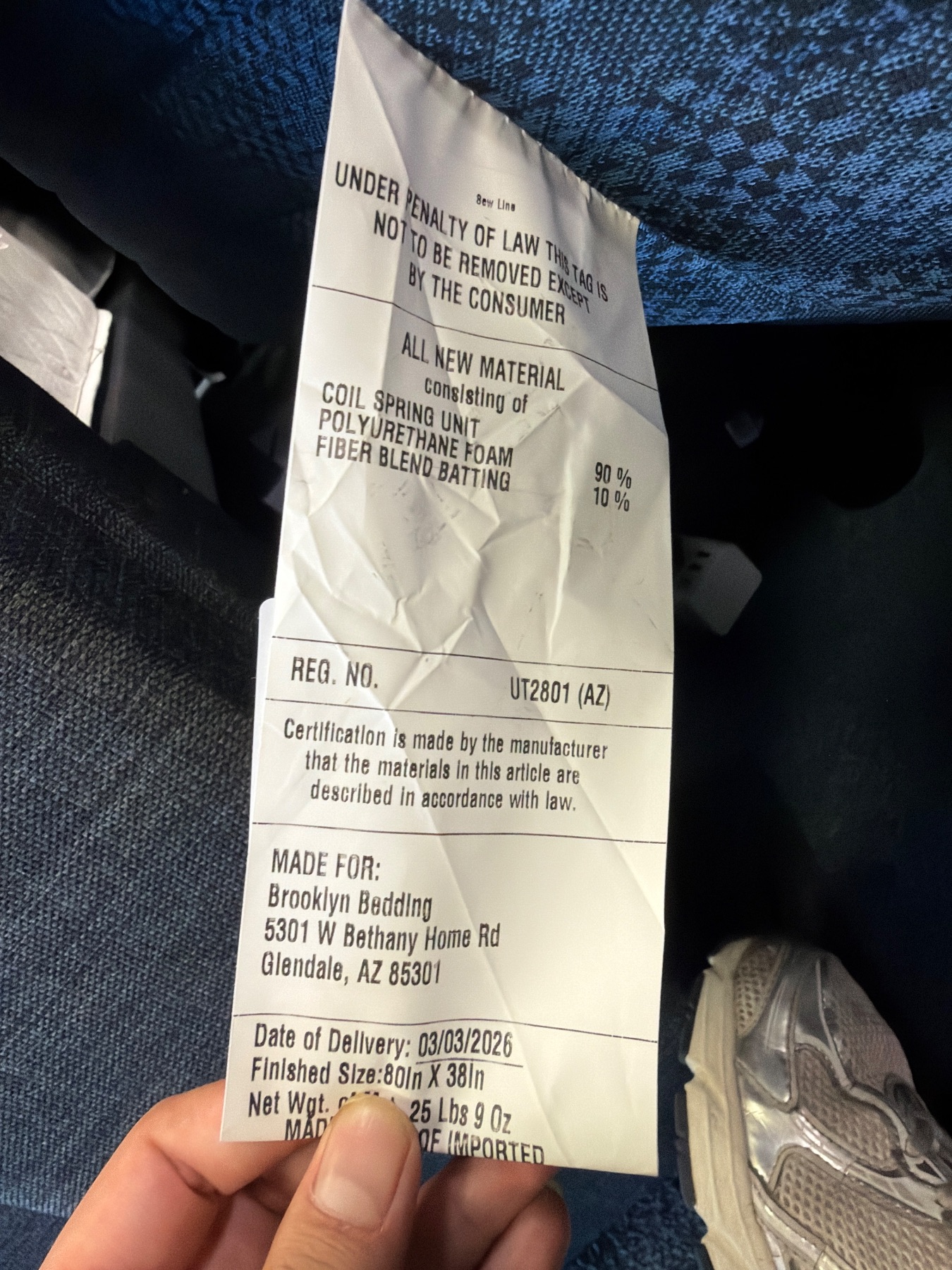
Law tag / spec photo
Mattress law label by Brooklyn Bedding detailing materials, dimensions, and registration number.
Law tag reads — Materials: COIL SPRING UNIT, POLYURETHANE FOAM 90 %, FIBER BLEND BATTING 10 % · Made for: Brooklyn Bedding 5301 W Bethany Home Rd Glendale, AZ 85301 · Finished size: 80In X 38In · Net weight: 25 Lbs 9 Oz · Date of manufacture: 03/03/2026 · Reg. no.: UT2801 (AZ).
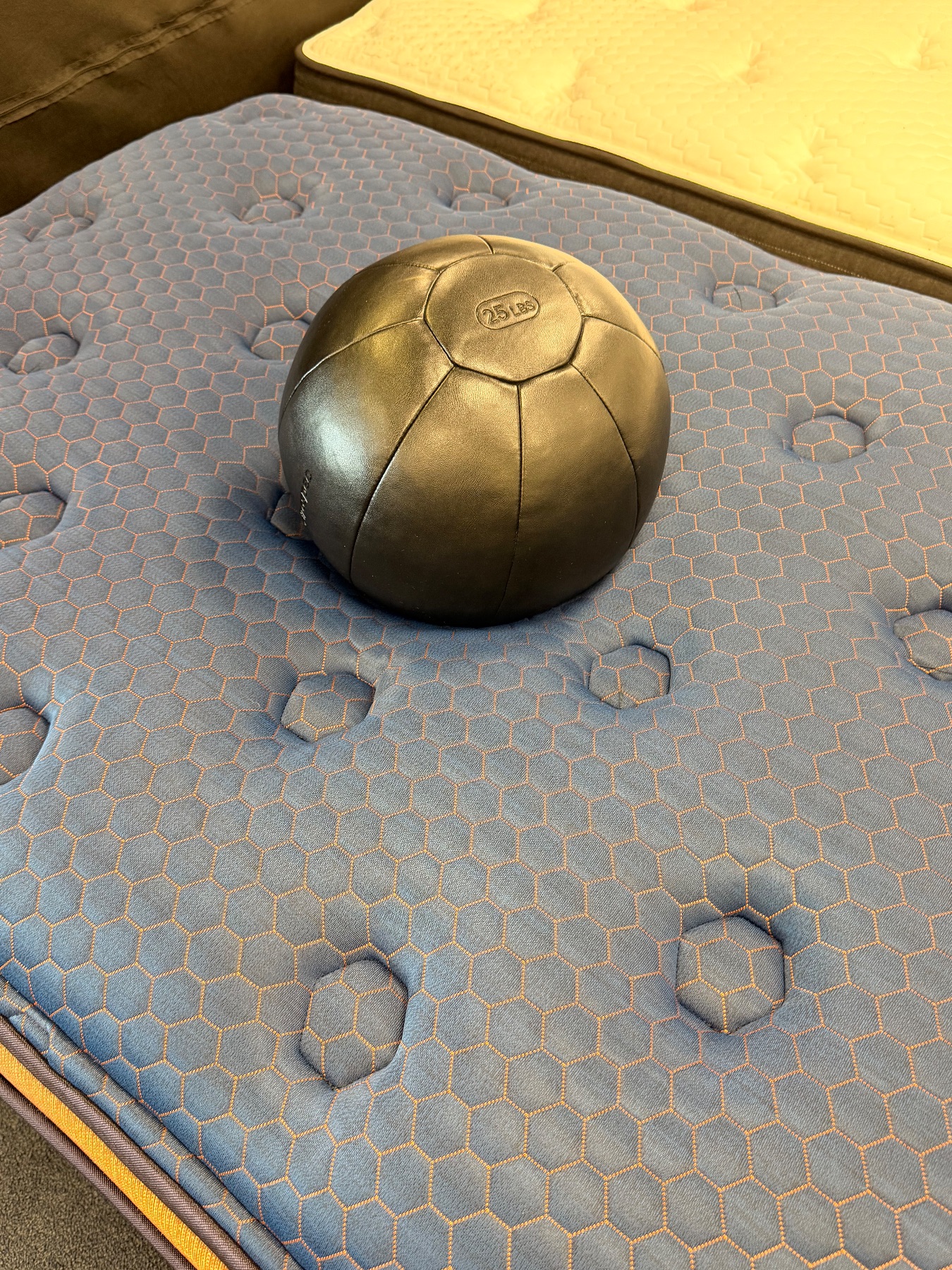
Sinkage test
A black 25 lb weight resting on a blue honeycomb-patterned quilted mattress to test sinkage.
Sinkage test using a 25 lb weighted ball on the tufted mattress surface. We placed a 25-pound weighted ball on the quilted mattress surface to evaluate pressure distribution and initial sinkage. The surface exhibits a moderate contour around the weight, conforming gently without letting the load collapse deeply into the lower layers. This indicates a balanced blend of plush surface cushioning and sturdy underlying support for back and side sleepers.
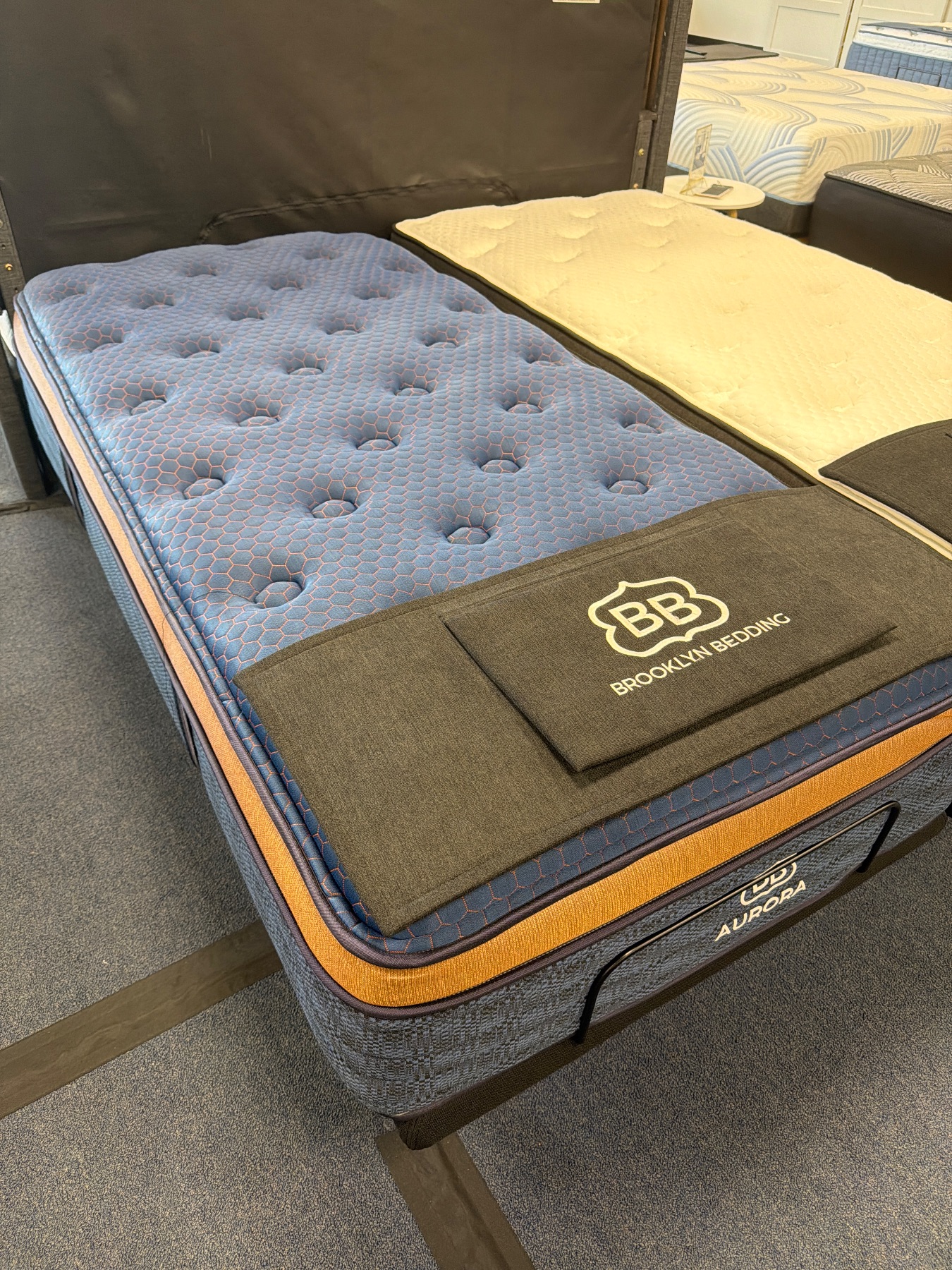
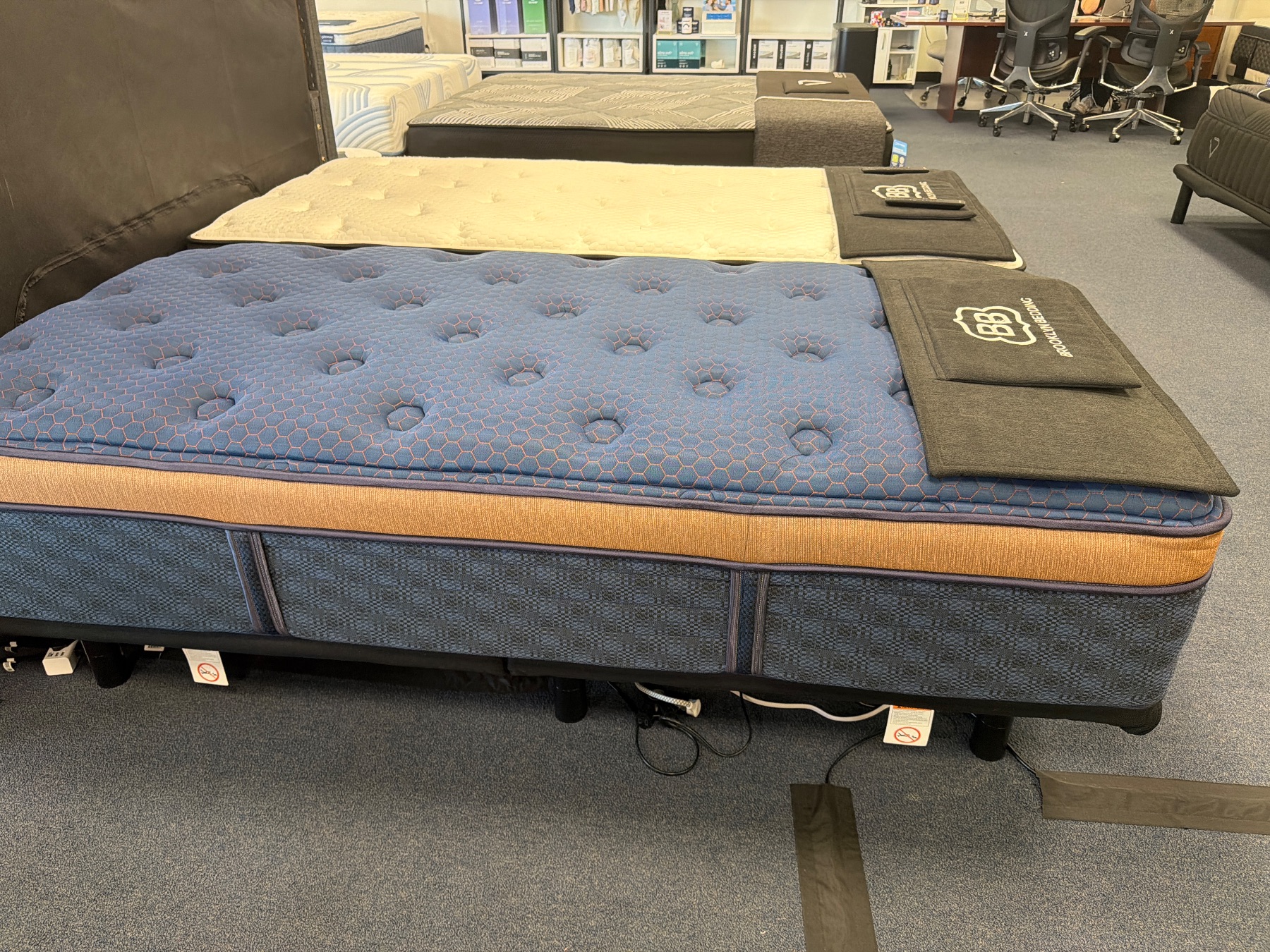
Featured photo (bare mattress on a base)
Brooklyn Bedding Aurora Luxe (Medium) Featured photo — bare mattress on a base
Brooklyn Bedding Aurora Luxe (Medium) — Featured photo — bare mattress on a base
Edge support test
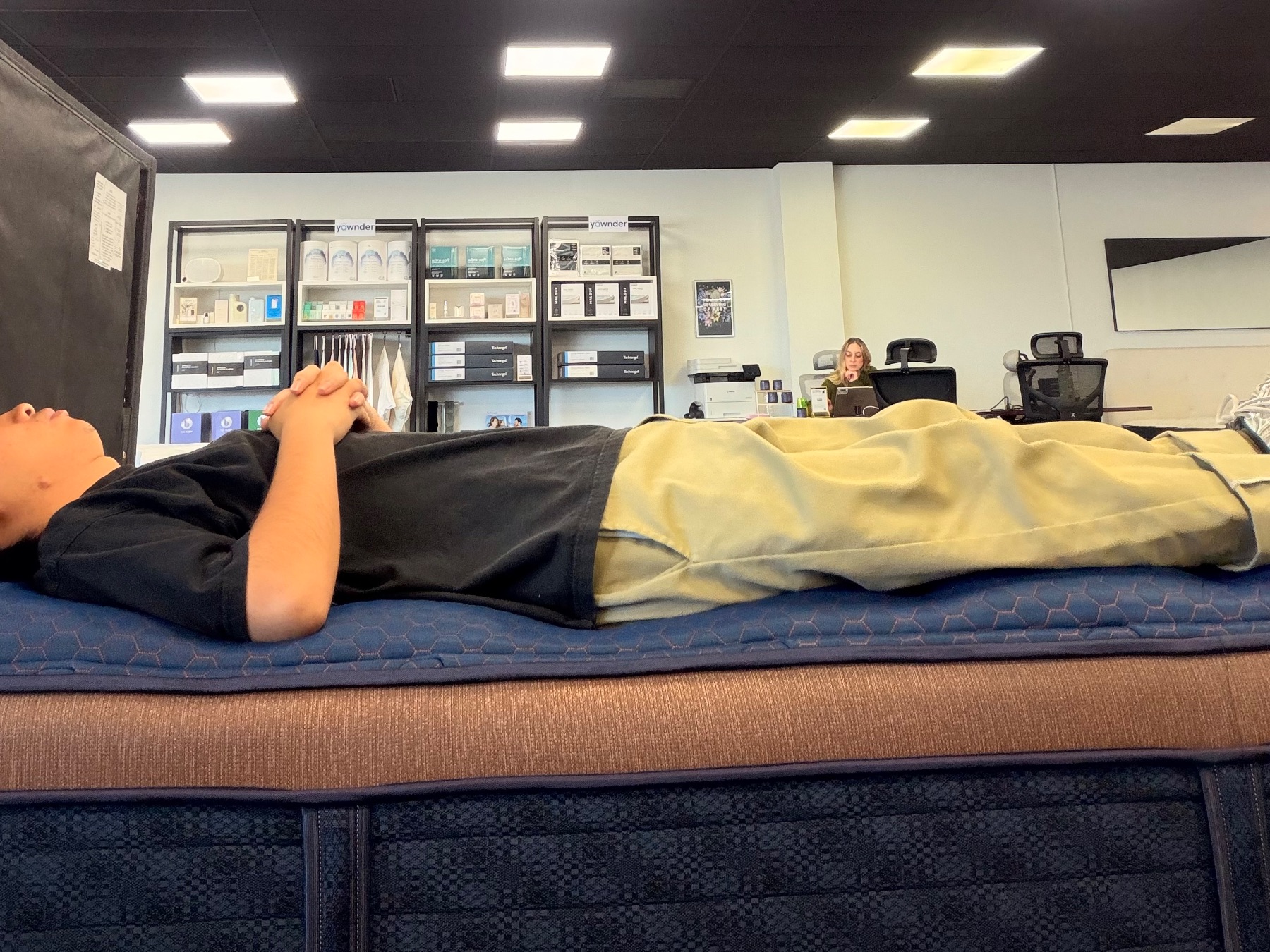
Tester lying on their back directly along the edge of a blue and brown mattress to test edge support.
Testing edge support while lying flat along the outer perimeter of the mattress. During our edge-support testing, we had our tester lie directly along the outer perimeter to check for sagging and roll-off sensation. The edge shows minimal sinkage beneath the torso and hips, keeping the body level and well supported. This allows sleepers to use the entire width of the mattress without feeling like they might slide off.
Featured photo (bare mattress on a base)
Brooklyn Bedding Aurora Luxe (Medium) Additional mattress views
Brooklyn Bedding Aurora Luxe (Medium) — Additional mattress views
Edge support test
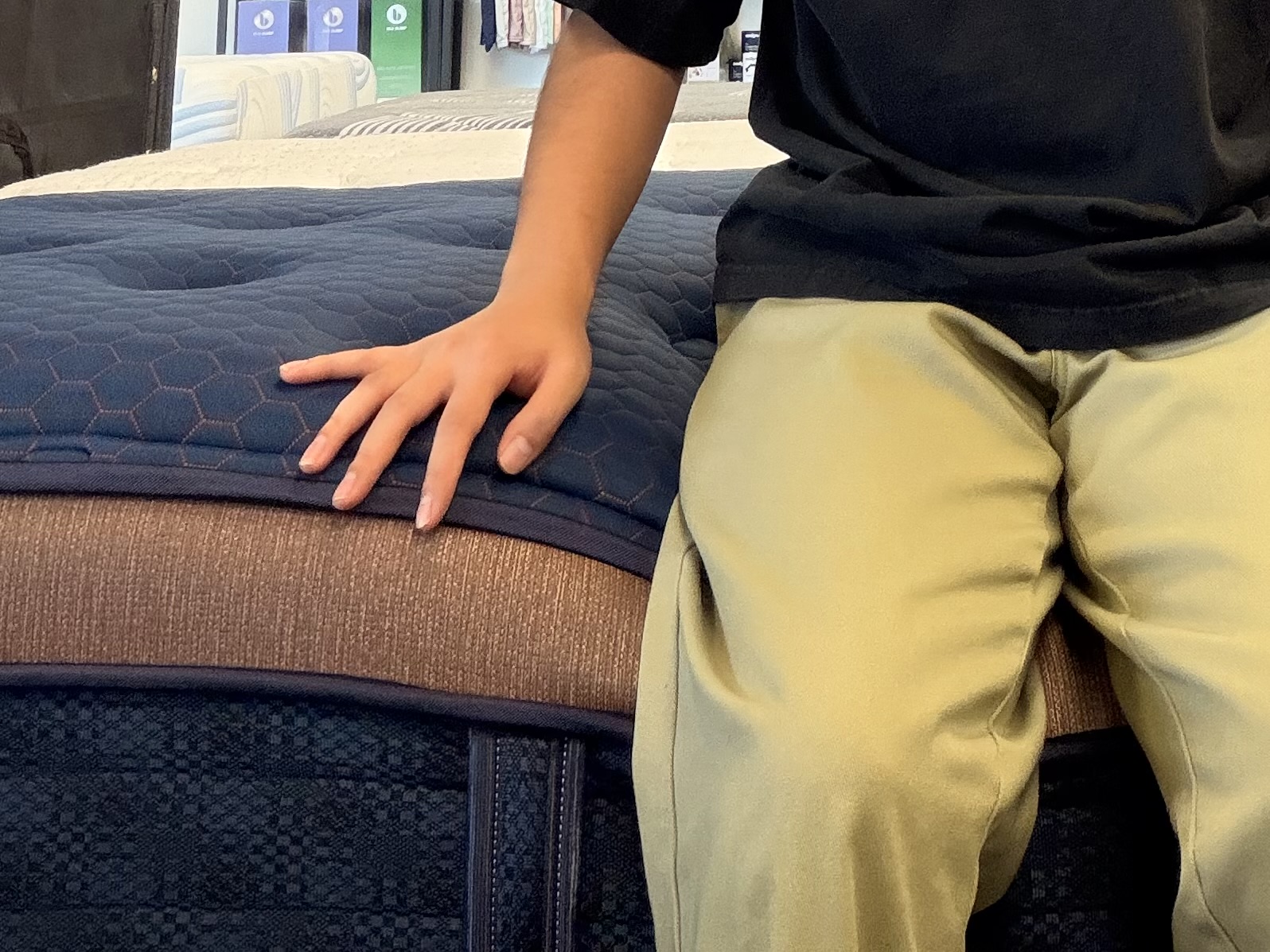
A person sitting on the edge of a mattress testing perimeter support and sinkage.
Evaluating sitting edge compression along the perimeter of the mattress. When sitting directly on the perimeter, we observed moderate sinkage through the upper comfort and pillow-top layers under concentrated body weight. The lower support core remains stable and resists bottoming out, preventing severe slope or roll-off sensation. This level of edge reinforcement provides dependable perimeter support for getting in and out of bed or sleeping close to the side.
Motion transfer / isolation
Three-axis accelerometer graph showing motion transfer spikes over 66 seconds.
Motion transfer accelerometer trace showing peak vibrations up to 3.0 m/s² settling in roughly 2.0 seconds. During our motion isolation testing, we recorded noticeable motion transfer across multiple drop events, with horizontal movement peaking near 1.65 m/s² and vertical displacement reaching roughly 3.0 m/s². The vibrations took about 2.0 seconds to fully settle back to baseline after an impact. Light sleepers are likely to feel a partner shifting positions or getting in and out of bed. This performance closely mirrors the Technogel 3D Pro Hybrid (which peaked at 1.9 m/s² horizontal and 2.8 m/s² vertical with a 2-second settle time). It transfers considerably more motion than hybrids like the Helix Midnight Luxe, which held vertical peaks down to 0.4 m/s².

What the Aurora Luxe feels like

The tested configuration landed at 6/10, which is a true medium feel. It has enough foam on top to relieve pressure at the shoulders and hips, but the coil unit keeps the mattress lively rather than slow and deeply conforming. That combination is why it works well for combination sleepers and couples who want motion control without giving up responsiveness.

What it does well

  • 9.2/10 cooling is one of its strongest results
  • 9.2/10 motion isolation is excellent for a hybrid
  • 9.2/10 expected durability supports the premium positioning
  • Soft, Medium and Firm options make it easier to match sleep position
  • 8.3/10 edge support gives couples more usable mattress surface

Where it is limited

  • Off-gassing was its weakest test category at 7.1/10
  • People who want a slow, dense memory-foam hug may find it too responsive
  • The premium cooling build costs more than Brooklyn Bedding's Signature Hybrid
  • The 365-night brand-direct trial has a 30-night minimum; confirm any return charges on your order
Brooklyn Bedding Aurora Luxe mattress construction
Aurora construction image from Yawnder's original hands-on review archive.

Current Aurora Luxe specs and policies

Brooklyn Bedding currently lists the Aurora Luxe Cooling at about 13.25 inches tall with Soft, Medium and Firm options. The current Queen reference price is $1,865 before promotions. Brooklyn Bedding offers a 365-night (brand-direct) trial; returns can begin after a 30-night break-in period and carry a $99 return fee. Mattresses purchased after February 1, 2025 are covered by Brooklyn Bedding's limited lifetime warranty.

TypeCooling hybrid
ProfileAbout 13.25 inches
Firmness choicesSoft, Medium, Firm
Queen reference price$1,865 before current promotion
Trial365 nights (brand-direct)
Break-in30 nights before return
Return fee$99
WarrantyLimited lifetime

Manufacturer terms checked September 22, 2026. Prices and promotions can change.

Brooklyn Bedding Aurora mattress sink test with bowling ball
Original Yawnder sink demonstration from our Aurora testing archive.

Which firmness should you choose?

Soft is the natural starting point for side sleepers who want more shoulder and hip cushioning. Medium is the broadest fit for combination and many back sleepers. Firm is the better choice for stomach sleepers and people who prefer less sink. Our standardized test record corresponds to a medium-feeling configuration, so the exact score profile should not be assumed to apply identically to every firmness.

Aurora Luxe vs Signature Hybrid

The Signature Hybrid is Brooklyn Bedding's value-oriented hybrid, while the Aurora Luxe adds a more aggressive cooling package and more premium comfort construction. If cooling is a top priority, the Aurora earns the upgrade more clearly. If price matters more than maximizing surface cooling, the Signature is the value play.

Who should buy it

The Aurora Luxe is best suited to hot sleepers, couples and combination sleepers who want a premium hybrid with strong motion isolation. It is also a good option for shoppers who want a choice of firmness levels rather than being locked into one universal feel.

Common questions

Does the Aurora Luxe sleep cool? Yes. Cooling scored 9.2/10 in our standardized test.

Is it good for couples? Yes. It scored 9.2/10 for motion isolation and 8.3/10 for edge support.

How firm is it? Brooklyn Bedding sells Soft, Medium and Firm options. Our tested configuration measured 6/10.

How long is the trial? Brooklyn Bedding currently offers a 365-night (brand-direct) trial, with returns beginning after 30 nights.

Is there a return fee? Yes. Brooklyn Bedding currently charges a $99 fee on mattress returns.

What is the warranty? Aurora Luxe mattresses purchased after February 1, 2025 are covered by Brooklyn Bedding's limited lifetime mattress warranty.

Check today's Aurora Luxe price and promotion →

Yawnder Reviews · Disclosure: Links to Brooklyn Bedding on this page may be affiliate links. If you buy through them, Yawnder may earn a commission at no additional cost to you. Test scores above come from Yawnder's standardized 2026 mattress-testing record; current pricing, trial, return and warranty information are manufacturer-provided.

Allswell Supreme Mattress Review

allswell featured image scaled

Yawnder Reviews · Original review material restored September 2026

Allswell Supreme Mattress Review: Original Luxury-Budget Hybrid Testing Restored

The Supreme page had lost the hands-on testing that explained why Yawnder viewed it as unusually premium for its price tier.

Luxury-budget construction

The reviewed Supreme used a Euro-top, responsive Energex foam, graphite/copper-infused memory foam and a reinforced pocket-coil unit.

Foam-forward hybrid feel

Although it contained coils, the mattress felt more like a substantial foam mattress with added deep support than a springy traditional innerspring.

Sinkage and recovery

Our 16-pound bowling ball sank a meaningful amount into the comfort system, but the responsive foam recovered quickly enough that the mattress remained easy to move on.

Inside the mattress

Yawnder removed the cover and photographed how the foam stack interacted with the spring system. The coils did not dominate the feel; they mainly supplied deeper support and pressure relief.

Sleep-position versatility

The reviewer moved between stomach and side sleeping and found the mattress soft enough for pressure relief but supportive enough to avoid feeling unstable.

Allswell Supreme sinkage
Original 16-pound bowling-ball test.
Allswell Supreme profile
Original mattress profile image.
Inside Allswell Supreme
Original interior photo.

Watch original review video →

Current-shopping note

Allswell’s lineup has changed substantially. The Supreme may be discontinued or retailer-specific, so treat this as a historical hands-on review of the original model.

Yawnder Reviews · Disclosure: Some links may be affiliate links. Current specifications and policies can change.

Anime Body Pillows: Best Comfort Solution & Buying Guide

best Dakimakura Pillow
Amazon alternatives: Compare full-length body pillows on Amazon. Similar products, not necessarily the same cover or pillow described here.

[Tagline]

What Are Anime Pillows?

Pillows are an essential part of the sleeping process. Just like your mattress, your pillows also define the quality of sleep you get. The pillow you sleep on makes all the difference between a comfortable, relaxing night’s rest and waking up with aches and pains all over.

Most times, people tend to concentrate solely on their mattresses and forget all about their pillows. This is a big mistake, and it can also be a costly mistake since you might just be replacing your mattress when the problem can be easily solved with a pillow replacement. Pillows, just like mattresses, aid in comfort and support. They align your head, neck, upper shoulders with your spine. Body pillows are even better at support.

This article will focus on the newest trend in the pillow market, the highly popular Japanese Dakimakura pillows also known as Anime Pillows in America. It will take you through all the finer points of the Dakimakura pillow, making it a breeze to buy the perfect one for yourself. Anime Pillows are a big trend in Japan and growing in popularity in the United States. 

What is An Anime Pillow?

An Anime Pillow or Dakimakura pillow is a relatively new addition to the world of pillows. It has been around for quite some time in Japan but has only recently made its way into the mainstream USA market. Since its “discovery,” the Anime pillows have been steadily rising in popularity worldwide. In Japan, Dakimakura pillows have a dedicated pillow market share since the 1990s. This is fast catching up in the USA markets as well. Along with the rise of Anime cartoons in the 90s anime pillows caught on as well.

Dakimakura pillow was first manufactured by the Japanese company “Cospa.” In the early ’90s, Cospa created a pillowcase for body pillows with the popular anime characters printed on it. With the anime culture already spiraling out of control in Japan, these pillowcases with anime characters took off instantly. Before you knew it, the market was flooded with all types, shapes, and patterns of Dakimakura pillows. And Anime body pillows became a viral success.

To keep it simple, Anime pillows are usually pillowcases with anime prints or themes on them. They are a long body pillow meaning that the length is long enough to cover the average human adult with special Japanese cartoon or “anime” printed on it.  Even though they are called Dakimakura pillows, they are generally pillowcases only. The inner pillow needs to be purchased separately. Some company’s especially in the west, tend to sell the pillowcase with the pillow in it, but originally Dakimakura pillows were just anime-themed pillowcases.

Dakimakura Anime Body Pillows Vs. Body Pillows

While body pillows are used to define and explain the Dakimakura pillow concept, there is a very basic difference between these two products. They both tend to look very similar in their sizes and shapes, but the basic difference lies in their uses. Where body pillows are typically used more for physical support and comfort, Dakimakura pillows are emotional tools.

Body pillows, in the conventional sense, are orthopedic pillows or specialized pillows that are recommended by a healthcare practitioner to provide you with better spinal support. They are used after a physical injury to maintain correct posture during sleep or under special medical conditions like pregnancy. The basic aim of body pillows is physical support.

The Dakimakura anime body pillows, on the other hand, are purely for emotional support. They were started as anime spin-offs and have since taken over as comfort products just like your safety blanket or the plush comforter you like to sink into in the evenings. They are a different spin to your oversized teddy bear that you like to hug to sleep.

Apart from the obvious difference in the usage intention of body pillows and anime body pillows, they also differ in their sizes. Body pillows have no hard and fast rule for size. They can come in a variety of different sizes. But, Dakimakura pillows are traditionally only available in three sizes:

  • 150x 50 cm
  • 160x 50 cm
  • 100x 35 cm

The sizing matters with Dakimakura pillows since they are meant to correspond and relate to the anime theme and anime charachter it sports. So make sure that the anime body pillow has a properly sized body pillow case.

Reason Behind 100, 150, and 160 cm Anime Body Pillow and Dakimakura Pillow

The difference in the size of the Dakimakura pillow is largely to service the demand for Dakimakura pillows outside of Japan. Traditionally Dakimakura pillows were only manufactured in 160 cm. However, this meant almost double the shipping costs as compared to a slightly smaller dimension of 150 and 100 cm. Hence to accommodate the anime and manga “Otaku” culture and to remain cost-effective, the smaller size of Dakimakura pillows was created and hence the wide selection of anime pillows you see today.

These two standard sizes are Dakimakura pillows are strictly adhered to because given that the nature of these pillows, they tend to appeal to a segment of the population that are into Japanese anime, which would like uniformity in the collections they acquire. Also, not everyone buys a Dakimakura sized inner pillow with every pillow cover change. Given that Dakimakura pillows are essentially pillow covers, it makes sense to keep them in a uniform size.

Features of Dakimakura Pillow

It is easy to spot a Dakimakura pillow. Some telltale features are:

  • Only available in three sizes
  • Printed with anime, manga, video game characters. Sometimes they sport real people photos as well. Chances are you will find your favorite character
  • Sport double sides of the character. You will have both the front and backside of the character on the two sides of the pillow.

Why Should You Buy a Dakimakura Pillow?

There are a few reasons that might convince you to buy a Dakimakura pillow, even if you are not necessarily an anime or manga fan. If you are one of the many anime lovers, then the chances are you already own a Dakimakura pillow. The benefits of having this pillow handy are:

Physical Benefits

  • Ideal body support for a good knee, back, and neck alignment
  • Relieves body pains and pressure point aches
  • Good spinal alignment
  • Helps in medical conditions like “Fibromyalgia.”
  • Provides good support during pregnancy by taking the weight off the back and belly
  • Helps improve blood circulation, especially in the legs and ankle during sleep

Other Benefits

  • Comfort: Just like you hugged a doll to sleep while growing up and clutched your favorite blanket tight, these Dakimakura pillows can provide emotional comfort while sleeping. They are soft and cuddly with an anime character printed on it. Hugging these pillows gives the illusion of hugging the character on it, giving you the much-needed comfort you require
  • Aesthetic Appeal: Dakimakura pillows are great at adding the extra level of cuteness to your bedroom decor. There is nothing more adorable than having a soft and cute anime character staring up at you.

Anime Fans Buying Guide for Dakimakura Pillows

It always helps to keep a few practical points in mind when you purchase any product. When looking at your next Dakimakura pillow, you should bear in mind the following factors:

  • Size: Anime pillows come in three sizes. Pick the one that fits your existing pillow or collection. It is always better to have a uniform sized pillow cover set than one that is all sized unless, of course, you have all three sizes of “inner pillows” with you. This ensures you get the perfect choice for your needs.
  • Fabric: Dakimakura is available in four types of fabric. These are discussed below:
    • Smooth Knit: Dakimakura pillows in smooth knit are, as the name suggests, incredibly smooth and fine to touch and feel. They are made with 100% polyester fabric that lends it the smoothness factor. The polyester also ensures that the graphics and design printed on the fabric remains true even after several washes. The only flip point is that the material can only be stretched one way.
    • Peach Skin: This is a toned-down version of the smooth knit material. It is also the most budget-friendly option in the Dakimakura pillows. Just like smooth knit, peach skin is also made of 100% polyester. However, the quality of the polyester differs. The peach skin Dakimakura pillow is soft and smooth to touch as well, but the fabric is not elastic at all. The prints come out well and stay true after continual use as well.
    • Soft Velvet: This is one of the lesser preferred options for Dakimakura pillows. This because even though the velvet feels gorgeous, it also does not make for a good base for life-like prints. The Dakimakura pillow in soft velvet looks somewhat blurry and also tends to retain heat. So, unless you are headed into the winters and don’t mind a blurry print, it is better to skip this material.
    • Twill: This is another budget-friendly option that is only made by Cospa, the original Japanese manufacturers of Dakimakura pillows. It is not a very attractive option since twill tends to result in washed-out prints and does not retain its shape either. It is also an option you will have to import from Japan, so do take into consideration the additional shipping costs.
    • Two-Way Tricot: This is hands down the most preferred option by the Dakimakura community. The fabric used is extremely soft, silky, and smooth to the touch with a slight sheen and an excellent finish. It brings out the character printed on it very vividly with high contrast making it a favorite amidst all the other fabrics. It is also very elastic and can be pulled in all directions.
  • Print: This is an extremely personal choice. You can have any print you desire. The prints can also be custom designed to suit your individual preference. Apart from the usual prints, you will also get loads of adult options as well since Dakimakura is associated with the “love pillow” concept as well.
  • Cover: Given the adult element that is associated with Dakimakura pillows, it is a good idea to buy a cover for the pillows well in advance. This way, you can always zip them up in the cover and keep it away from censure and prying eyes.
  • Price: These days, you don’t necessarily have to buy from Japan. There are lots of onshore sites that offer Dakimakura pillows. You should look at these options first since they will save you the shipping costs.

Caring for Your Dakimakura Pillow

It is simple to care for your Dakimakura pillows. Most don’t need any special attention. Just bear these points in mind:

  • Wash in normal or cold water to preserve the print colors. Avoid warm or hot water unless you are looking to shorten the lifespan of your pillow.
  • Avoid cloth whitening and stain removal chemicals since they will strip the vibrancy of the print.
  • It is best to hand wash Dakimakura pillows since the machine cycle might be hard on these gentle covers.
  • Soak the Dakimakura pillow in water and a gentle detergent for about 15 minutes. Then gently remove the detergent by keeping it under running normal temperature water. Hang to dry in shade

Dakimakura Pillow Buying Sites

You are spoilt for choice when it comes to buying a Dakimakura pillow online. Some things you should be on the lookout for when looking at any site are:

  • Shipping Support: It is best to look for a site that supports shipping to your address. There is no point in going through the many options and selecting the one you want only to realize that they do not ship to your zip code. So, before you start selecting, make sure they support shipping to your location.
  • Payment: When you are looking to buy objects that have a strong adult theme, it is best to pay through channels that are safe and secure. Choose PayPal, especially with offshore sites. This way, your financials are protected, and you will not have divulged important personal information to some fraud site.
  • Design and Variety: Look for an authentic site that offers original designs. This way, you will not be cheated and disappointed with the final result. It is best to look at sites that promote authentic Japanese artists since they are your best bet at a replica.
  • Custom Style Service: Many Dakimakura pillow sites offer custom design services for those looking for a personal touch on their pillows.
  • Money-Back Options: It is always best to go with sites that offer a trial period. Since you have no way of knowing if the quality will be as promised, it is a good idea to have a money-back guarantee. It also gives you confidence in the site.

Where to Buy Dakimakura Pillow?

There are two parts to a Dakimakura pillow:

  • Dakimakura inner pillow
  • Dakimakura pillow cover

These two parts are generally sold separately, much like your usual conventional pillows. You do not have to buy from Japanese manufacturers anymore since there are plenty of onshore options available these days. Most people prefer to buy their Dakimakura inner pillow from Japan to retain the authenticity of the pillow. However, with so many onshore options that are no longer necessary unless you are extremely particular. You can easily get an original inner Dakimakura pillow from one of the regional manufacturers as well. The top options for Dakimakura pillow shopping are:

Dakimakura Inner Pillow

The top Dakimakura inner pillow options are as follows:

A&J Original DHR 6000

This is a high quality Japanese kawaii body pillow that feels 100% authentic Japanese. It contours to the body well and maintains the right level of plush and comfort you want from a Dakimakura pillow. It is only available in 160x 50 cm size.

Anime Dakimakura Pillow

Available in 150x 50 cm dimension, this is another high-quality Dakimakura pillow that you can get in the USA. It is covered with cotton cover and comes in a vacuum compressed packaging for easy handling and transport.

Full Body Pillow by Zituop 

You can buy this pillow in both sizes of 160x 50 cm and 150x 50 cm. It is made of PP cotton and features a hypoallergenic cover. It has a medium softness that allows it to conform to your body shape for maximum comfort.’

Dakimakura Pillow Cover

The Dakimakura pillow cover is the main part of a Dakimakura pillow. It is an extremely personal choice. Below is a list of the top sites where you can buy the covers.

Amazon Anime Love Pillow

Amazon always tops the lists when it comes to online shopping. There are few more reliable shopping sites than Amazon. However, Amazon also has very limited options. So if you are happy with the options available to you, then Amazon is a good place to shop from. Key features of Amazon:

  • Limited designs and variety
  • Good for inner Dakimakura pillows
  • No custom option available
  • High reliability
  • Safe payment options

Cuddly Octopus Anme Pillow

This is one of the most popular sites for Dakimakura pillows. They sell the most original and authentic products with their “Cuddly Octopus” logo. Some of the key highlights of this site are:

  • Only two-way tricot fabric pillows available
  • They only offer two sizes of 150x 50 cm and 160x 50 cm.
  • High-quality zip that runs along the full length of the pillow
  • Both normal and adult versions available
  • Fabric features high elasticity that stretches well on all sides.
  • Good quality prints with high contrast level

Amiami Waifu Pillow

This is a Japanese site that caters to all things anime and manga. They offer worldwide shipping but do check out their shipping costs. Their Dakimakura pillow collection is expensive, and you will not be disappointed with their quality. The key highlights are:

  • Most designs are in 150x 50 cm and 160x 50 cm sizes
  • Two-way tricot fabric used.
  • Caters to all sections from adult to the safe for work
  • Ships to the USA, but it is a lengthy process
  • Inner pillows are available for order as well.

Mandarake Waifu Pillows

This site is like Amazon. It is an online retail platform for other vendors to sell their products. The good thing about this is that you get a lot of different brands and vendors all in one site. Also, Mandarake is very efficient and conscious of providing only the originals, so you won’t be coming across any knock offs here. The key highlights are:

  • Ships to the USA even those products that the original companies don’t offer shipping for
  • Protection against knock offs and substitutes. Only original Dakimakura pillows are sold.
  • All versions, including adult versions, are available.
  • Second-hand products are also available for a cheaper rate.

Wrapping Up

There are many reasons to buy a Dakimakura pillow. You don’t have to be an anime fan to own one or even be looking for a love pillow. There are many benefits to having a Dakimakura pillow, right from a good comfort level to a haven feeling. So, go ahead and indulge in one of these cute and cuddly sleep companions.

Frequently Asked Questions About Anime Body Pillows: Best Comfort Solution & Buying Guide

Is a Dakimakura pillow worth it even if I'm not a huge anime fan?

Yes, a Dakimakura pillow can be worth it even if you're not a die-hard anime enthusiast, as they offer significant physical support for comfortable sleep. They provide essential back, neck, and shoulder alignment, which can benefit anyone seeking better sleep posture.

Who are Dakimakura pillows best for?

Dakimakura pillows are best for anime enthusiasts and casual fans looking for both an emotional companion and physical support during sleep. They are also suitable for individuals seeking extra comfort and alignment while sleeping.

How do Dakimakura pillows compare to traditional body pillows?

Dakimakura pillows primarily serve as emotional companions with character prints, while traditional body pillows are designed for physical support and alignment. Although similar in size and shape, Dakimakura adhere to standard sizes like 150x50 cm, whereas body pillows vary more widely and often target specific physical issues.

What are the downsides of Dakimakura pillows?

One potential downside is that traditionally, Dakimakura pillows consist only of the pillowcase, meaning the inner pillow often needs to be purchased separately. While some Western retailers offer bundled options, this can be an additional consideration for new buyers.

Are Dakimakura pillows good for side sleepers?

Yes, Dakimakura pillows can be beneficial for side sleepers due to the physical support they offer for back, neck, and shoulders. Their long shape helps maintain proper body alignment, which is crucial for comfortable side sleeping.

Where can I try a Dakimakura pillow in person in the San Diego area?

While the article focuses on online availability, for general pillow and mattress testing, you can visit Yawnder's showroom located in Encinitas, CA. Although they specialize in mattresses, experiencing different comfort levels in person could help inform your pillow choice.

Want to test this in person? Visit our Encinitas showroom or call 858-232-5760.

Ready to buy?
See today’s best sleep deals

Live pricing and current promotions on the mattresses, bases, and sleep tech we recommend.

Shop current deals
Where to buy

The dakimakura inserts and covers we recommend:

Check price on Amazon

As an Amazon Associate, Yawnder earns from qualifying purchases.

Dreams and Predicting the Future: Insights & Analysis

dreams future

Dreams and Predicting the Future

Dreams are of two kinds: the kind we see when we sleep and the ones we see when we are awake. The dreams that we see when we are asleep have always been fascinating to humans. They are sometimes weird, sometimes funny, and sometimes frightening. The dreams that we remember often make for very interesting and entertaining stories, even if they don’t make sense at all. We do not dream every single night, and there are people who get dreams more frequently than others. Even animals have been found to dream sometimes. Dreams can leave us puzzled, disturbed, or frightened. But can they predict the future?

Whether or not dreams can predict the future has been a topic of debate forever. In ancient times, people were known to have prophetic dreams, which could tell a lot about the future. Perhaps the most famous prophetic dream is in the Bible, where Pharaoh dreams that he stands by the river Nile, from where seven plump cows emerge followed by seven ugly ones. Joseph deciphers the dream as seven years of abundance followed by seven years of drought, and that’s exactly what happens.

In recent times, filmmaker Christopher Nolan made a successful movie about dreams and the subconscious called Inception. In the movie, the lead character Dominick Cobb (played by Leonardo DiCaprio) is an extractor, who works as a corporate spy and uses experimental military technology to enter the subconscious of his targets and steal valuable information. In the movie, Cobb tells Ariadne, a member of his team and a young architecture student, that we never see the beginning or the end of dreams. This is one of the defining features of dreams: we never see how we got there in the first place. We don’t even see how the dream ends.

Although our dreams are never prophetic, they do have a psychological connection and a certain predictive power. But why do dreams happen? Before we learn more about the predictive power of dreams, you must understand what causes dreams and the process behind them.

What Are Dreams?

dreams

While we sleep, dreams are a kind of conscious state characterized by cognitive, sensory and emotional occurrences. Dreams occur during the final stage of sleep called the rapid eye movement (REM) phase. There are five distinct stages of sleep. During the first four stages of sleep, it is the body that recharges and rejuvenates. But in the fifth stage, it is the brain that recharges. The REM stage is right before a person wakes up when the brain is active, heartbeats begin to rise, and body temperature comes back to normal. This is also when the eyes move rapidly behind closed eyelids. The REM stage is thought to be responsible for boosting concentration, memory, and cognitive functioning.

Dreams occur in the REM stage because the brain becomes active, even though the body is still in deep sleep and inactive. This prevents the person from acting out the dreams. In the other four stages of sleep, dreams do not occur because the brain remains inactive.

Dreams can be described as lifelike visual images, full of color, themes, voices, and objects that have close resemblance with waking life. If a person wakes up from a dream, it can seem real even though it was nothing. Dreams often involve people, places, and objects that we know, or they can also involve strange people and unknown places and objects.  Sometimes dreams are so profound that the person remembers them for a long time. Some people have even written books and painted pictures based on their dreams. In some cases, people may move around and talk in their sleep while they dream.

What Causes Dreams?

Over the years, there have been several studies on explanations regarding dreams and the meaning behind them. Possible causes of dreams include:

  • Representation of unconscious or hidden wishes and desires
  • Consolidation and processing of all the information collected over the course of the day
  • Interpretation of various signals on the brain and the body during sleep
  • Helping in the development of cognitive capabilities
  • Reflecting the mental state of the person
  • Consolidation and reprocessing of learning and memory tasks
  • Cognitive simulation of real-life experiences and events, because dreaming is part of the waking consciousness

Unlike other elements of sleep, dreams are hard to study in a laboratory setting. That is the reason why they remain such a big mystery even to scientists. It is hoped that in future new technologies will help scientist learn more about the process of dreaming and the meaning behind them.

Dreams Vs. Nightmares

Nightmares are dreams that are disturbing or frightening. They occur in both children and adults and are thought to be a result of stress, illness, trauma, emotional difficulties, and medications.

Compared to dreams, nightmares are more vivid and are more likely to remember them. Nightmares are often confused with night terrors, but night terrors mostly occur in children, and they mostly have no recollection of the experience in the morning. Unknown the major difference between the tools that nightmares occur during the final stage of sleep where is night terrors occur in the transition between stages of 3 and 4 of sleep. Nightmares are not forgotten in a hurry. Not only does the person remember them the next morning but sometimes also for months and years after that.

Are Dreams Predictive?

There is no definite proof that dreams are predictive in nature. Of course, they can be an indication of the person’s current mental state or a reflection of recent events, but there is no evidence to prove that they can predict the future. However, what dreams can do is spot remote associations with possible events in the future. The human brain is great at spotting associations and repetitive patterns when it is awake. For instance, we know that night will follow day, and the sun will follow the rain. We also know that traffic is worst during peak hours and better at night. These are all logical patterns that we are used to experiencing on a regular basis. The brain does not need to be awake to be able to spot such patterns. The best example is the REM stage of sleep when the brain is just as active. That is why it dreams and tries to spot obvious patterns that tend to reoccur.

Dreams that seem to predict the future are also called precognitive dreams. There are some very famous precognitive dreams in history, including one involving Abraham Lincoln, the former President of the United States. Two weeks before he was shot dead in 1865, Abraham Lincoln had a dream about a funeral in the White House. In the dream when he asked someone about who had died, he was told that it was the president of the United States. Today the dream might seem very predictive, but at the time neither Lincoln nor his wife paid any importance to it because the day that he was shot dead, Lincoln had given the night off to his bodyguard

Even though most people would think of such dreams as predictive or precognitive, but they can also be mere coincidences. In another famous example, when the Titanic sank in 1912, hundreds of people reported having dreamed of it in the recent past. About 19 such claims could also be validated, but did that mean their dreams were precognitive? Unfortunately, the answer is no, because there are billions of people on this planet and each person can have around five dreams every night. It is possible that thousands of people dream of a sinking ship or a crashing aircraft on any given night.

The Power of Lucid Dreams

As mentioned earlier in this post, dreams don’t have a beginning or an end. They are usually too scattered to make any sense. Therefore, to believe in the existence of psychic dreams it requires blind faith.

However, the human mind can be trained at lucid dreaming. Lucid dreams are when the person is conscious of the dream and has some amount of control over what they experience in the dream. For instance, when a person is conscious that he is dreaming, he can use the opportunity to learn about future events. Examples include mundane things like the weather next day or if traffic will be worse than usual, or bigger things like the flight number of the next big plane crash or the winning lottery numbers of next week. With the power of lucid dreaming, it might even be possible to stick to only one dream theme per night and experience the dream in detail. It might also be possible to visit distant places and meet different people in lucid dreams.

Until people have such control over their dreams, it is impossible to conclude that dreams have any connection with future events. However, dreams remain as mysterious and as fascinating as ever, and it goes without saying that they will be studied for years to come for better understanding.


Historical Examples of Dreams Predicting the Future

  1. Abraham Lincoln’s Dream: It’s said that Abraham Lincoln had a dream about his own assassination just a few days before it happened. In the dream, he walked into the East Room of the White House to find a covered corpse guarded by soldiers and surrounded by a crowd of mourners. When he asked one of the soldiers who had died, the soldier reportedly responded, “The President. He was killed by an assassin.”

  2. The Titanic: There are multiple accounts of people who cancelled their trip on the Titanic because of bad dreams or premonitions. One notable case is that of a woman named Jessy Sayre, who reportedly had a dream that caused her to cancel her voyage on the ill-fated ship.

  3. 9/11 Attacks: A number of people have reported having dreams or premonitions about the attacks on the World Trade Center in New York City on September 11, 2001, before they occurred.

  4. Mark Twain’s Dream: The famous author Mark Twain (Samuel Clemens) claimed to have dreamed about his brother’s death a few weeks before it happened. In the dream, he saw his brother lying in a metallic coffin in his sister’s living room. When his brother died suddenly, Twain discovered that his brother was indeed put in a metallic coffin, due to the high summer heat.

  5. Einstein’s Theory of Relativity: Albert Einstein reportedly had a dream about cows surrounded by an electric fence. The farmer created a new fence, but the cows continued to react as if the previous fence was still there. This dream allegedly led Einstein to a breakthrough about the speed of light being the only constant and helped him formulate the theory of relativity.

  6. James Watson and DNA: While not exactly predicting the future, James Watson, one of the scientists credited with the discovery of the structure of DNA, claimed to have visualized the double helix structure in a dream. After this dream, he woke and immediately started to sketch what he had seen. The final model of the DNA molecule changed the course of science and confirmed his dream image.

  7. Dunne’s Dream of Volcanic Eruption: J.W. Dunne, a British engineer and author, had a vivid dream of a volcanic eruption. The next day, he read about a similar eruption that occurred at Martinique, matching the details of his dream. This led him to theorize about precognitive dreams, which he wrote about in his book, “An Experiment with Time”.

  8. Paul McCartney’s “Yesterday”: While not a prophetic dream in the sense of predicting a future event, Paul McCartney, a member of the Beatles, claimed that the melody for the iconic song “Yesterday” came to him in a dream. He woke up and immediately played the tune on the piano so he wouldn’t forget it.

  9. Niels Bohr’s Dream of the Atom: Nobel laureate Niels Bohr reportedly had a dream about the structure of the atom. In his dream, the atom was a solar system-like structure, with the electrons orbiting the nucleus much like planets orbit the sun. This dream helped him develop the Bohr model of the atom.

Frequently Asked Questions About Dreams and Predicting the Future: Insights & Analysis

Can dreams actually predict the future?

The article discusses historical beliefs and examples, such as Pharaoh's dream, but does not definitively state that dreams can predict the future, presenting it as a long-debated enigma.

What is the science behind why we dream?

Dreams occur during the REM phase of sleep, when the brain is highly active, and scientists believe they serve various functions like processing emotions, consolidating memories, and responding to internal stimuli.

What's the difference between a dream and a nightmare?

Nightmares are defined as intense and often disturbing dreams, in contrast to ordinary dreams which can be bizarre, humorous, or terrifying but not necessarily distressing.

Where can I learn more about dreams in a physical location?

While the article itself focuses on the nature of dreams, Yawnder's San Diego showroom, an Encinitas, CA location, is available for in-person visits to discuss sleep-related topics.

Are there common reasons why people dream?

Possible causes for dreams include representing unconscious desires, processing daily information, aiding cognitive growth, reflecting mental states, and reinforcing learning and memory.

Do animals experience dreams like humans do?

Yes, the article mentions that even animals are known to dream from time to time, indicating that dreaming is not exclusive to humans.

Keep exploring
More sleep guidance

Browse Yawnder’s sleep education, research explainers, and practical guides.
Explore sleep guides

Signs of Sleep Apnea in Women

Woman with sleep apnea

Sleep apnea, a chronic sleep disorder that affects millions worldwide, has been extensively studied over the years. Traditionally, it has been seen as primarily a men’s disorder. However, emerging research suggests that it affects a significant number of women, too, often undiagnosed due to different symptoms that are misinterpreted (1). As such, the importance of recognizing sleep apnea symptoms in women is increasingly highlighted within the medical community.

The most common type of sleep apnea, Obstructive Sleep Apnea (OSA), is characterized by repeated episodes of complete or partial obstructions of the upper airway during sleep, often resulting in reduced or completely halted airflow (2). While snoring, choking, or gasping for air during sleep, symptoms typically associated with OSA, are also seen in women, they may not always be as pronounced. These differences, coupled with the stereotyping of sleep apnea as a male disorder, contribute to underdiagnosis in women (3).

In women, the symptoms often manifest more subtly and may include insomnia, headaches, daytime fatigue, mood changes, depression, and difficulty in concentrating (4). These less overt symptoms make it more challenging to diagnose sleep apnea in women.

A critical symptom to watch for in women is insomnia, characterized by trouble falling asleep or staying asleep. While insomnia has various causes, it can also be a symptom of sleep apnea. Women with sleep apnea frequently report awakening in the night and difficulty returning to sleep (5).

Women with sleep apnea often experience morning headaches. These headaches result from decreased oxygen levels during sleep caused by the repeated cessation of breathing, leading to widened blood vessels in the brain (6).

One of the most significant signs of sleep apnea in women is excessive daytime sleepiness. Despite a full night’s sleep, women suffering from sleep apnea often wake up feeling tired and experience fatigue throughout the day. This daytime sleepiness is due to the interrupted sleep cycle caused by apnea episodes (7).

A study published in the European Respiratory Journal observed that mood changes and depression were more common in women with sleep apnea than in men (8). The constant interruption of deep sleep due to sleep apnea can have an impact on mood, leading to irritability, anxiety, and depression.

Lastly, cognitive issues like difficulty concentrating or memory loss can also be indicative of sleep apnea in women. As observed in a study published in the Journal of Clinical Sleep Medicine, these cognitive impairments result from repeated disruptions in the sleep cycle, preventing women from achieving restful, deep sleep (9).

Recognizing these symptoms is crucial, as untreated sleep apnea can lead to serious health complications like hypertension, heart disease, stroke, and diabetes (10). Early diagnosis in women, therefore, could significantly improve quality of life and reduce the risk of these comorbid conditions.

Despite the increased awareness and research, sleep apnea in women remains underdiagnosed. Raising consciousness about these less-recognized symptoms is essential to improve detection and treatment. Medical professionals should be vigilant about the possible symptoms of sleep apnea in women to facilitate early diagnosis and effective treatment.

Sources:

  1. Valipour, A. (2012). Gender-related differences in symptoms of patients with suspected breathing disorders in sleep: a clinical population study using the sleep disorders questionnaire. Sleep, 35(3), 363-373.
  2. Punjabi, N. M. (2008). The epidemiology of adult obstructive sleep apnea. Proceedings of the American Thoracic Society, 5(2), 136-143.
  3. Lin, C. M., Davidson, T. M., & Ancoli-Israel, S. (2008). Gender differences in obstructive sleep apnea and treatment implications. Sleep Medicine Reviews, 12(6), 481-496.
  4. Young, T., Finn, L., Austin, D., & Peterson, A. (2003). Menopausal status and sleep-disordered breathing in the Wisconsin Sleep Cohort Study. American Journal of Respiratory and Critical Care Medicine, 167(9), 1181-1185.
  5. O’Connor, C., Thornley, K. S., & Hanly, P. J. (2000). Gender differences in the polysomnographic features of obstructive sleep apnea. American Journal of Respiratory and Critical Care Medicine, 161(5), 1465-1472.
  6. Gelaye, B., Lohsoonthorn, V., Lertmeharit, S., Pensuksan, W. C., Sanchez, S. E., Lemma, S., … & Williams, M. A. (2015). Construct validity and factor structure of the Pittsburgh Sleep Quality Index and Epworth Sleepiness Scale in a multi-national study of African, South East Asian and South American college students. PloS one, 10(12), e0140208.
  7. Antic, N. A., Catcheside, P., Buchan, C., Hensley, M., Naughton, M. T., Rowland, S., … & McEvoy, R. D. (2011). The effect of CPAP in normalizing daytime sleepiness, quality of life, and neurocognitive function in patients with moderate to severe OSA. Sleep, 34(1), 111-119.
  8. Bixler, E. O., Vgontzas, A. N., Lin, H. M., Ten Have, T., Rein, J., Vela-Bueno, A., & Kales, A. (2001). Prevalence of sleep-disordered breathing in women: effects of gender. American Journal of Respiratory and Critical Care Medicine, 163(3), 608-613.
  9. Twigg, G. L., Papaioannou, I., Jackson, M., Ghiassi, R., Shaikh, Z., Jaye, J., … & Morrell, M. J. (2010). Obstructive sleep apnea syndrome is associated with deficits in verbal but not visual memory. American Journal of Respiratory and Critical Care Medicine, 182(1), 98-103.
  10. Peppard, P. E., Young, T., Palta, M., & Skatrud, J. (2000). Prospective study of the association between sleep-disordered breathing and hypertension. New England Journal of Medicine, 342(19), 1378-1384.

Sleep Apnea Treatment Options for Women

Sleep apnea, a condition that results in interrupted breathing during sleep, has been identified as a major health concern affecting an increasing number of women. Left untreated, sleep apnea can lead to severe health complications, including cardiovascular diseases, stroke, and diabetes (1). Fortunately, a number of effective treatments are available that can significantly improve the quality of life for women suffering from this sleep disorder.

The first line of treatment for Obstructive Sleep Apnea (OSA), the most common type of sleep apnea, often involves lifestyle modifications. These include weight management, reducing alcohol consumption, cessation of smoking, and avoidance of sedative medications. Obesity is a significant risk factor for OSA, and weight reduction has been found to alleviate the symptoms significantly in numerous studies (2).

Sleep position can also influence OSA severity. It’s been reported that sleep apnea is often worse when sleeping on the back (supine position) due to the effect of gravity on the airway. Therefore, positional therapy, which encourages sleeping on the side, could be beneficial for some women (3).

For moderate to severe sleep apnea, Continuous Positive Airway Pressure (CPAP) therapy is commonly prescribed. This involves wearing a mask over the nose and/or mouth during sleep. The device gently blows air into the airway to keep it open and prevent apneas (4). Although it can take some time to adjust to the treatment, it is highly effective when used consistently.

Beyond CPAP, there are other types of positive airway pressure devices such as BiPAP (Bilevel Positive Airway Pressure) or ASV (Adaptive Servo-Ventilation), which can be used depending on the patient’s needs and how they respond to therapy (5).

Oral appliances designed to keep the throat open, such as mandibular advancement devices, can also be an effective treatment option for some women. These devices, which look like sports mouth guards, help to keep the airway open by holding the tongue or jaw forward to ease airflow during sleep (6).

In certain cases, surgical options may be explored. A variety of procedures can be done depending on the cause of the sleep apnea, including nasal surgery, throat surgery, or oral surgery. In some cases, more than one procedure may be performed (7).

New treatments are continually being developed and tested. Hypoglossal nerve stimulation is a newer surgical treatment that stimulates a nerve in the chest to keep the airway open during sleep. Clinical trials have shown promising results in reducing the symptoms of sleep apnea (8).

Finally, it is crucial to remember that regular follow-ups with healthcare professionals and sleep specialists are necessary once treatment is initiated. This will ensure the most effective treatment is being used and adjusted as necessary for each individual.

Treating sleep apnea is essential to prevent long-term health problems. Women with sleep apnea symptoms should consult their healthcare provider for a thorough evaluation and to discuss the best treatment options for their individual situation.

Sources:

  1. Peppard, P. E., Young, T., Palta, M., & Skatrud, J. (2000). Prospective study of the association between sleep-disordered breathing and hypertension. New England Journal of Medicine, 342(19), 1378-1384.
  2. Tuomilehto, H., Seppä, J., Uusitupa, M., Peltonen, M., Martikainen, T., Sahlman, J., … & Gylling, H. (2013). The impact of weight reduction in the prevention of the progression of obstructive sleep apnea: an explanatory analysis of a 5-year observational follow-up trial. Sleep Medicine, 14(8), 769-775.
  3. Cartwright, R. D. (1984). Effect of sleep position on sleep apnea severity. Sleep, 7(2), 110-114.
  4. Sullivan, C. E., Issa, F. G., Berthon-Jones, M., & Eves, L. (1981). Reversal of obstructive sleep apnoea by continuous positive airway pressure applied through the nares. The Lancet, 317(8225), 862-865.
  5. Morgenthaler, T. I., Kagramanov, V., Hanak, V., & Decker, P. A. (2006). Complex sleep apnea syndrome: is it a unique clinical syndrome?. Sleep, 29(9), 1203-1209.
  6. Marklund, M., Verbraecken, J., & Randerath, W. (2020). Non-CPAP therapies in obstructive sleep apnoea: mandibular advancement device therapy. European Respiratory Journal, 55(4).
  7. Sher, A. E., Schechtman, K. B., & Piccirillo, J. F. (1996). The efficacy of surgical modifications of the upper airway in adults with obstructive sleep apnea syndrome. Sleep, 19(2), 156-177.
  8. Schwartz, A. R., Bennett, M. L., Smith, P. L., De Backer, W., Hedner, J., Boudewyns, A., … & Anderson, P. (2001). Therapeutic electrical stimulation of the hypoglossal nerve in obstructive sleep apnea. Archives of Otolaryngology–Head & Neck Surgery, 127(10), 1216-1223.
 

Sleep Apnea in Transgender Women: Recognizing the Risk and Seeking Effective Solutions

Recent research suggests that transgender women may be particularly vulnerable to this condition. Understanding the unique challenges and risk factors faced by transgender women in relation to sleep apnea is essential for healthcare professionals to provide appropriate diagnosis, treatment, and support. In this article, we delve into the topic, shedding light on the connection between sleep apnea and transgender women while emphasizing the importance of early detection and tailored interventions.

Exploring the Risk Factors:

Transgender women, individuals assigned male at birth but identifying and living as women, face a range of factors that can contribute to their increased susceptibility to sleep apnea. While not exclusive to this population, these factors may include hormonal therapies, obesity, and anatomical variations. It is crucial for medical practitioners to recognize these risk factors and be aware of the potential impact they may have on a transgender woman’s sleep health.

Hormonal Therapies and Sleep Apnea:

Hormonal therapy, a common aspect of gender-affirming care for transgender women, involves the use of estrogen and anti-androgen medications to promote feminization and suppress male characteristics. While these therapies are crucial for gender affirmation, they can potentially affect sleep patterns and contribute to sleep apnea development. Studies suggest that hormonal therapies may lead to changes in upper airway muscle function, increasing the risk of airway collapse during sleep and subsequent apnea episodes.

Obesity and Sleep Apnea:

Obesity, a well-known risk factor for sleep apnea, is prevalent among both cisgender and transgender populations. However, transgender women may face additional challenges due to factors such as hormonal therapies, which can contribute to weight gain or make it more difficult to lose weight. Obesity can exacerbate sleep apnea symptoms, as excess weight around the neck and throat can narrow the airway and obstruct breathing during sleep. Addressing obesity and promoting healthy lifestyle choices should be a crucial part of comprehensive care for transgender women with sleep apnea.

Anatomical Variations and Sleep Apnea:

Another consideration is the potential impact of anatomical variations on the development and severity of sleep apnea in transgender women. While research in this specific area is limited, studies have shown that transgender women may have anatomical differences in their upper airway compared to cisgender individuals. These differences may increase the risk of airway collapse and subsequent apnea episodes during sleep. Further investigation is needed to fully understand the extent to which anatomical variations contribute to sleep apnea in this population.

Sleep Apnea in Men vs. Women

According to the American sleep apnea Association, men are two to three times more likely to have sleep apnea than women. However, researchers believe that the actual disparity may be smaller due to underdiagnosis in women. Indeed, the symptoms exhibited by women often diverge from the ‘classic’ signs of sleep apnea – loud snoring, gasping or choking during sleep, and excessive daytime sleepiness – which are more commonly observed in men.

In contrast to men, women with sleep apnea may present with less noticeable symptoms such as insomnia, morning headaches, mood disturbances, and fatigue, which can often be mistaken for signs of other health issues like depression, menopause, or chronic fatigue syndrome. This discrepancy in symptoms can lead to a significant delay in diagnosis and treatment for women, with potential implications for their long-term health.

A man’s risk of developing sleep apnea rises with age, particularly after 40, and is further increased if he is overweight or has a family history of the disorder. Conversely, premenopausal women have a lower risk, likely due to the protective hormonal effects of estrogen and progesterone. However, this risk escalates after menopause, equalizing the odds between the sexes in later life.

The outcomes and consequences of sleep apnea also differ between men and women. Men with untreated sleep apnea have been found to be at a higher risk of heart problems and strokes. On the other hand, women with untreated sleep apnea are more likely to suffer from depression and anxiety, reduced quality of life, and poor cognitive function. Alarmingly, women with sleep apnea also show a faster cognitive decline than their male counterparts.

These gender-based differences in sleep apnea are not merely academic curiosities; they are vital clues that can guide personalized treatment strategies. They underline the importance of gender-specific research and tailored approaches to diagnosis, which can help to bridge the gap in care and offer effective treatment for all patients.

When to Speak to a Doctor About Sleep Apnea

Sleep apnea is a serious sleep disorder that can have profound implications on your health if left untreated. With potential effects ranging from diminished quality of life to heightened risk of cardiovascular diseases, it’s critical to seek medical help if you suspect you might be suffering from this condition. But when exactly should you raise your concerns with a doctor? Here are the key signs to watch out for.

The most characteristic sign of sleep apnea is chronic and loud snoring punctuated by pauses, followed by choking or gasping sounds. However, it’s important to remember not everyone who snores has sleep apnea. It’s the pattern of interrupted breathing that raises the red flag.

Daytime symptoms are equally significant. Do you often wake up feeling unrefreshed despite getting a full night’s sleep? Excessive daytime sleepiness, despite adequate sleep time, is a common symptom of sleep apnea. It can leave you feeling chronically fatigued and unable to concentrate, impacting your daily activities and overall productivity.

In line with this, if you frequently wake up with a headache, it might be more than just a poor night’s sleep. Morning headaches are common in individuals with sleep apnea due to the repeated drops in oxygen levels during the night that cause blood vessels to expand.

Pay attention to your mood as well. Mood changes, such as irritability, depression, or anxiety, can also be indicative of sleep apnea. The ongoing lack of restful sleep can severely affect your mood and emotional well-being.

The presence of risk factors should also prompt a conversation with your doctor. If you are male, overweight, over the age of 40, have a neck circumference greater than 17 inches, or a family history of sleep apnea, you are at a higher risk. For women, the risk increases after menopause.

Moreover, if you have been told by your partner that you have periods of stopped breathing during your sleep, it’s crucial to discuss this with your doctor. This sign is perhaps the most indicative of sleep apnea and should not be overlooked.

Sleep apnea is not a condition to be taken lightly. If you’re experiencing any of these symptoms or have multiple risk factors, you should schedule a consultation with your doctor. They can refer you to a sleep specialist or order a sleep study to confirm the diagnosis. Remember, the sooner you seek help, the sooner you can get on the path to better sleep and improved health.

Frequently Asked Questions About Signs of Sleep Apnea in Women: Must-Have Awareness Today

What are the common signs of sleep apnea in women?

Women often experience less obvious signs of sleep apnea compared to men, including insomnia, morning headaches, excessive daytime sleepiness, mood changes, and cognitive impairments. These symptoms can be subtle and different from the more commonly recognized loud snoring or gasping.

Why is it important to recognize sleep apnea symptoms early in women?

Early recognition of sleep apnea symptoms in women is crucial because untreated cases can lead to serious health complications like hypertension, cardiovascular diseases, strokes, and diabetes. Timely diagnosis and treatment can significantly improve quality of life and reduce health risks.

Is insomnia a sign of sleep apnea in women?

Yes, insomnia, characterized by difficulty falling or staying asleep, is a key indication of sleep apnea in women. Women often report frequent nighttime awakenings and struggles returning to sleep, which can be linked to sleep apnea episodes.

How does sleep apnea affect women's mental health?

Sleep apnea can significantly impact women's mental health, leading to increased instances of depression and anxiety. The cyclical nature of sleep disruptions and mood disturbances can severely affect emotional well-being.

What cognitive issues might indicate sleep apnea in women?

Cognitive issues such as difficulty concentrating and memory loss can indicate undiagnosed sleep apnea in women. These impairments are thought to be linked to interrupted deep sleep, which prevents restorative rest.

Where can I learn more about sleep health and related solutions?

You can explore various resources on sleep health and suitable sleep solutions to address concerns like sleep apnea. Visiting a specialized retailer like Yawnder in Encinitas, CA, can provide opportunities to discuss sleep disorders and find relevant products.

Ready to buy?
See today’s best sleep deals

Live pricing and current promotions on the mattresses, bases, and sleep tech we recommend.

Explore sleep guides

Wildfire Smoke and Sleep: How to Reduce Exposure

Wildfire Smoke and Sleep

Climate change has rendered us susceptible to an increasing number of environmental hazards, one of which is the ever-increasing incidences of wildfires. We’re acutely aware of their threat to our homes, properties, and the environment. However, it’s crucial to understand that these fires also pose a serious risk to our health, particularly our sleep patterns.

Unraveling the Perils of Wildfire Smoke

Wildfires instigate a significant threat to our respiratory system. Smoke from these fires comprises various respiratory irritants, including particulate matter, hydrocarbons, and thousands of airborne chemicals, many of which are toxic.

However, the most significant risk emerges from ultrafine particles we inhale during a fire. These microscopic particles can cause nasal congestion and eye irritation. Even if you’re not proximal to the fire, these chemicals can travel hundreds of miles, wreaking havoc on your health.

Health Impacts and Risks

Everyone’s reaction to wildfire smoke will vary. However, the Centers for Disease Control and Prevention (CDC) identifies several groups likely to be at a higher risk:

  • Individuals with preexisting heart or lung conditions
  • Elderly people
  • Children, who are still developing their airways and breathe more air per pound of body weight than adults
  • Pregnant women

Wildfire Smoke and Its Influence on Sleep

The Global Burden of Diseases, Injuries, and Risk Factors Study 2015 highlighted air pollution as a leading global disease burden and a significant mortality risk factor. The World Health Organization attributes 4.2 million premature deaths globally to ambient air pollution.

Smoke from wildfires can intensify air pollution to perilous levels. Long-term exposure to such dense air pollution can inflict damage on our central nervous system. The particles can infiltrate various brain regions integral to good sleep, including the frontal cortex and cerebellum.

When these brain regions are compromised, inflammation is a common response, resulting in constricted airways in both the throat and nose. Higher levels of air pollution have also been associated with an increase in feelings of depression and anxiety, which are known to disrupt sleep.

For communities living in high-risk areas, the stress of ongoing fires could have as much of a mental toll as a physical one. Recognizing the symptoms of smoke exposure is a crucial preventive measure:

  • Burning eyes
  • Wheezing or difficulty breathing
  • Chest pain
  • Fatigue

While these symptoms could be indicative of other conditions or illnesses, it’s vital to be aware of them, especially if you’re living in a high-risk area.

Shielding Yourself from Wildfire Smoke

In addition to maintaining the ideal bedroom environment for sleep, it’s crucial to understand how the external environment, particularly wildfire smoke, can influence your indoor air quality. Below are some steps to protect your home from dangerous air pollution:

  • Keep windows closed and disable continuous ventilation systems: Air pollutants in wildfire smoke are gradually removed as the indoor air comes in contact with materials and surfaces. Slowing the air pollutant influx can accelerate this process.

  • Invest in a home filtration system: Whether it’s a forced air system or a standalone device, a home air filter can drastically improve air quality. The U.S. Environmental Protection Agency provides valuable information on air cleaning technologies for homes.

  • Operate your system in “fan on” mode: Modern forced air systems can function in “fan” mode, in which the system moves air through the ducts and filters without heating or cooling it.

Wildfires have expanded in size and frequency over the last decade, with more people than ever exposed to dangerous levels of smoke. If you live in an affected area, monitor your symptoms closely, adopt the necessary precautions at home, and seek immediate medical attention

The Nuanced Interplay of Sleep and Wildfire Smoke

The consequences of wildfire smoke extend beyond immediate physical symptoms. Emerging studies point towards the far-reaching impact on our sleep quality, an essential aspect of overall well-being.

Wildfire Smoke and Sleep Disruptions

Air pollution from wildfires infiltrates the central nervous system and compromises critical areas of the brain associated with sleep regulation, such as the frontal cortex and cerebellum. The resulting inflammation can constrict airways, further disrupting sleep.

Additionally, wildfire smoke exposure can exacerbate feelings of anxiety and depression, both known to contribute to sleep disruptions. These mental health stressors, coupled with the physical distress from wildfires, present a significant challenge to maintaining healthy sleep patterns.

Recognizing Sleep Disruptions

Understanding the link between wildfire smoke and sleep requires awareness of potential sleep disruption signs. These include:

  • Frequent awakenings
  • Difficulty falling asleep
  • Excessive daytime sleepiness
  • Changes in sleep duration

If you’re experiencing these symptoms and live in a wildfire-prone area, it might be due to the air quality. Consult with a healthcare provider to discuss potential remedies.

Enhancing Sleep Amidst Wildfire Threats

While the threat of wildfires and subsequent smoke pollution can be daunting, there are strategies to protect your sleep quality. These involve creating a safe indoor environment and practicing good sleep hygiene.

Creating a Safe Sleep Environment

Creating an environment conducive to sleep can play a crucial role in mitigating the impact of wildfire smoke. This involves:

  • Maintaining air quality: Use air purifiers and maintain the “fan on” mode in forced air systems to enhance indoor air quality.

  • Limiting exposure: Keep windows and doors closed to prevent smoke from entering. Utilize weather stripping to seal gaps and cracks.

  • Monitoring air quality: Regularly check air quality indices and adapt your routines accordingly.

Good Sleep Hygiene Practices

In addition to creating a safe sleep environment, practicing good sleep hygiene is essential:

  • Stick to a schedule: Go to bed and wake up at the same time every day, even on weekends. Consistency reinforces the body’s sleep-wake cycle.

  • Create a restful environment: Keep your bedroom dark, quiet, cool, and free from electronics. Consider using earplugs, an eye mask, or a white noise machine if needed.

  • Manage worries: Stress and anxiety can disrupt sleep. Try relaxation techniques, such as meditation or deep breathing, before bedtime.

Navigating the increasing wildfire threats is a challenge that we, as a society, are facing together. By understanding the risks and taking proactive measures, we can protect our health and preserve our sleep. Sleep, after all, is a cornerstone of our well-being, enabling us to face challenges with resilience and strength.

Understanding the multifaceted impacts of wildfire smoke on sleep and overall health is a crucial aspect of this battle. Let us strive to stay informed, adapt our environments, and protect ourselves from these environmental hazards, ensuring we can continue to enjoy the restorative powers of good sleep.

okaysou out of the box

What to Look for in an Air Purifier for Wildfire Smoke

Choosing the right air purifier can be challenging. Here are some factors to consider:

  • Filter type: The most effective filters for smoke are High Efficiency Particulate Air (HEPA) filters, which can remove 99.97% of particles as small as 0.3 microns.

  • Clean Air Delivery Rate (CADR): This measures how quickly an air purifier can clean the air within a specific room size. Higher CADR ratings indicate more efficient filtering of smoke, dust, and pollen.

  • Room size: Ensure the purifier is suitable for your room size. Manufacturers typically provide guidelines indicating the maximum room size the device can effectively purify.

  • Noise level: Since you may run your purifier for extended periods, especially during wildfire season, consider the noise level to ensure it doesn’t disrupt your sleep.

How to Use an Air Purifier Effectively

An air purifier can only make a difference if used correctly. Here are some tips:

  • Location matters: Place the purifier where you spend the most time, such as the bedroom or living room. Keep it at least a few feet away from walls and furniture for optimal air circulation.

  • Keep it running: During wildfire season, it’s best to keep the air purifier on continuously. Most modern air purifiers are energy-efficient, so they won’t significantly increase your electricity bill.

  • Regular maintenance: Change filters regularly according to the manufacturer’s instructions to ensure the purifier functions effectively. A clogged filter can’t properly clean the air and may even release captured pollutants back into the room.

Incorporating air purifiers into your wildfire smoke defense strategy can significantly improve your indoor air quality, providing a safer environment for you and your loved ones. It’s a practical investment for your health, enhancing your ability to sleep well amidst challenging wildfire seasons.

Read our air purifier reviews to get the best air purifier for wildfire smoke.

Frequently Asked Questions About Wildfire Smoke: Must-Have Tips to Protect Your Sleep

What are the common health issues caused by wildfire smoke?

Wildfire smoke can cause burning eyes, wheezing or difficulty breathing, chest pain, and extreme fatigue. It also contains harmful irritants and ultrafine particles that pose serious danger to respiratory health, even if you live far from the fire.

Who is most vulnerable to the effects of wildfire smoke?

Individuals with existing heart or lung conditions, older adults, children, and pregnant women are most susceptible to the harmful effects of wildfire smoke. Children's developing airways make them particularly vulnerable to the particulate matter and airborne toxins.

How does wildfire smoke affect sleep?

Wildfire smoke can significantly impact sleep quality by disrupting brain regions responsible for restful sleep and causing symptoms like frequent awakenings and difficulty falling asleep. The fine particulate matter can infiltrate the brain, while heightened anxiety and inflammation from poor air quality further detract from rest.

What are the signs that wildfire smoke is affecting my sleep?

Signs that wildfire smoke is affecting your sleep include frequent awakenings during the night, difficulty falling asleep, excessive daytime sleepiness, and variations in sleep duration. If you notice these symptoms in a wildfire-affected area, air quality could be a contributing factor.

Can long-term exposure to wildfire smoke have serious health consequences?

Yes, long-term exposure to dense air pollution, exacerbated by wildfire smoke, can adversely affect the central nervous system and is linked to approximately 4.2 million premature deaths annually. It can inflame or compromise brain areas crucial for regulating sleep, leading to constricted airways.

Where can I learn more about sleep health in wildfire-prone areas?

While Yawnder does not specialize in air quality, our team at the San Diego showroom in Encinitas, CA, can discuss how a supportive sleep environment can help mitigate stress that might be exacerbated by environmental concerns. We focus on creating a restful sleep space.

Ready to buy?
See today’s best sleep deals

Live pricing and current promotions on the mattresses, bases, and sleep tech we recommend.

Explore sleep guides

How to Wash Your Pillows: Guide for a Healthy Bedroom

Molecule Pillows

Keeping your pillows clean and fresh is essential for a good night’s sleep and overall hygiene. Regularly washing your pillows not only removes dirt, sweat, and allergens but also helps maintain their quality and prolong their lifespan. Follow these simple steps to effectively wash your pillows and ensure they remain comfortable and hygienic:

  1. Check the Care Label: Before proceeding, check the care label on your pillow for any specific instructions or restrictions regarding washing. Some pillows, such as memory foam or down-filled ones, may require special care or professional cleaning.

  2. Preparation: Gather the necessary supplies, including mild detergent, bleach (if applicable), a washing machine, dryer, and a couple of tennis balls or dryer balls. Tennis balls help fluff up the pillows during drying.

  3. Remove Pillowcases and Protectors: Start by removing any pillowcases or protective covers from the pillows. These items can usually be washed separately following their respective care instructions.

  4. Inspection: Take a moment to inspect the pillows for any signs of damage or excessive wear. If you notice tears, holes, or a significant loss of shape, it might be time to replace the pillows instead of washing them.

  5. Sorting: If you have multiple pillows to wash, sort them based on size, type, and washing instructions. It’s generally advisable to wash pillows of similar types together to ensure even cleaning.

  6. Pre-Treatment: Check for any stains or spots on the pillows and pre-treat them using a stain remover or a mixture of water and mild detergent. Gently dab the affected area with the cleaning solution and allow it to sit for a few minutes before moving on to the next step.

  7. Washing: Place two pillows (or as recommended) in the washing machine to maintain a balanced load. This prevents the pillows from getting lumpy or unevenly washed. Add a small amount of mild detergent and set the machine to a gentle or delicate cycle with warm water.

  8. Rinse and Repeat: After the initial wash cycle is complete, run an additional rinse cycle to ensure all the detergent is thoroughly removed from the pillows. This step is crucial to prevent any residue that may cause skin irritation or affect the pillow’s texture.

  9. Drying: Once the pillows are rinsed, carefully remove them from the washing machine and gently squeeze out any excess water. Place the pillows in the dryer along with a couple of tennis balls or dryer balls to aid in fluffing and preventing clumping. Set the dryer to a low heat or air-dry cycle to avoid damaging the pillows.

  10. Fluffing and Monitoring: During the drying process, periodically check the pillows and fluff them by hand to redistribute the filling evenly. This ensures that the pillows maintain their shape and loft. Continue drying until the pillows are completely dry, as any remaining moisture can lead to mold or mildew growth.

  11. Final Inspection: Once the pillows are dry, give them a thorough inspection. Ensure they are odor-free, completely dry, and have regained their original shape. If you notice any dampness or lingering odors, return them to the dryer for further drying.

  12. Pillowcases and Protectors: Finally, once the pillows are clean and dry, reinsert them into clean pillowcases or protective covers. This step adds an extra layer of cleanliness and keeps the pillows protected from dirt and oils.

By following these steps, you can effectively wash your pillows and maintain their cleanliness, comfort, and longevity. Remember to check the care label for specific instructions, and consider replacing pillows that are heavily worn or damaged. A clean and fresh pillow will not only enhance your sleep experience but also contribute to a healthier and more hygienic sleeping environment.

Pillow Cleaning FAQ

Q: How often should I clean my pillows? A: It is recommended to clean your pillows every 3 to 6 months to maintain cleanliness and hygiene.

Q: Can I wash all types of pillows? A: Most pillows, such as polyester, cotton, or synthetic-filled, can be washed. However, some types like memory foam or down-filled pillows may require special care or professional cleaning.

Q: Can I machine wash my pillows? A: Yes, many pillows can be machine washed. However, always check the care label for specific instructions and follow them accordingly.

Q: How do I remove stains from my pillows? A: Pre-treat stains with a stain remover or a mixture of water and mild detergent. Gently dab the affected area and let it sit for a few minutes before washing.

Q: Can I put pillows in the dryer? A: Yes, most pillows can be dried in the dryer. Use a low heat or air-dry setting and add a couple of tennis balls or dryer balls to help fluff the pillows and prevent clumping.

Q: Can I use bleach to whiten my pillows? A: Some pillows can withstand bleach, but it’s crucial to check the care label first. If allowed, use a mild bleach solution and follow the recommended measurements.

Q: How do I maintain the shape of my pillows? A: During the drying process, periodically fluff the pillows by hand to distribute the filling evenly. This helps them maintain their shape and loft.

Q: How do I know if my pillows are dry? A: Ensure that the pillows are completely dry by checking for any remaining moisture or dampness. Lingering dampness can lead to mold or mildew growth.

Q: When should I replace my pillows? A: Consider replacing pillows that have lost their shape, show signs of wear or tear, or no longer provide adequate support. On average, pillows should be replaced every 1 to 2 years.

Q: Can I wash decorative pillow covers? A: Yes, most decorative pillow covers can be washed following their specific care instructions. Remove the cover before washing and clean it separately.

Remember, always refer to the care label and manufacturer’s instructions for your specific pillow type. By following proper cleaning techniques, you can enjoy fresh, clean, and comfortable pillows for a restful night’s sleep.

brooklinen down pillows

When to replace your pillow

Knowing when to replace your pillow is essential for maintaining sleep quality and hygiene. While the lifespan of a pillow can vary depending on its quality and usage, it is generally recommended to replace your pillow every 1 to 2 years.

Over time, pillows accumulate dirt, sweat, allergens, and body oils, which can affect their comfort and hygiene. Additionally, pillows lose their shape and supportiveness as the filling compresses with regular use. These factors can lead to discomfort, poor sleep, and potential allergenic reactions.

To determine if it’s time to replace your pillow, consider the following indicators:

  1. Loss of Shape: If your pillow has visibly lost its shape and fails to provide proper support, it’s a clear sign that it needs replacement. A flat or lumpy pillow can cause neck and shoulder discomfort.

  2. Wear and Tear: Examine your pillow for any signs of wear and tear, such as frayed edges, holes, or excessive fluffiness. Damaged pillows not only compromise comfort but may also result in loose filling or potential allergen exposure.

  3. Hygiene Concerns: If your pillow emits a persistent odor even after washing, it may indicate a buildup of bacteria, sweat, or oils. An unpleasant smell is a strong indication that it’s time to invest in a new pillow for improved hygiene.

  4. Allergies or Respiratory Issues: If you suffer from allergies or respiratory problems, an old pillow can exacerbate symptoms. Dust mites and allergens tend to accumulate over time, triggering allergies or asthma. Replacing your pillow regularly can help alleviate these issues.

  5. Personal Preference: Ultimately, your personal comfort and sleep quality are paramount. If you find yourself consistently dissatisfied with the support or comfort of your pillow, it may be time to explore new options that better suit your needs.

Remember, pillow quality and maintenance also play a role in its longevity. Opt for high-quality pillows made from durable materials, and follow proper cleaning instructions to maximize their lifespan. Investing in a new pillow at the appropriate time ensures you continue to enjoy a comfortable and supportive sleep experience.

 
Ready to buy?
See today’s best sleep deals

Live pricing and current promotions on the mattresses, bases, and sleep tech we recommend.

Explore sleep guides

White Noise for Sleep: Does It Help?

Marpac white noise machine

White noise is a fundamental concept in acoustics and signal processing that plays a crucial role in various scientific, technological, and everyday applications. Characterized by its flat frequency spectrum, white noise is a random signal possessing equal intensity at all frequencies within a given range. Its name originates from the analogy to white light, which is composed of a combination of all visible colors.

In acoustics, white noise is an auditory sensation produced by a random mixture of sound waves across the entire audible frequency range. This uniform distribution of energy across frequencies creates a sonic environment that is neutral and lacking in any discernible patterns or tonal qualities. It is often described as a hissing, static-like sound, comparable to the audio output of a poorly tuned radio or television set when no station is received.

White noise has found extensive applications in various fields. In audio engineering, it serves as a reference signal for testing and calibrating audio equipment, ensuring accurate reproduction and measurement capabilities. It is also employed as a masking tool to block out unwanted sounds, aiding in concentration, relaxation, and sleep by creating a soothing background ambience.

Additionally, white noise is utilized in scientific research, particularly in studies involving auditory perception and cognitive processes. Its uniform properties make it an ideal baseline for investigating how humans perceive and discriminate sounds in different contexts, enabling researchers to better understand hearing mechanisms and develop effective noise reduction strategies.

The concept of white noise extends beyond acoustics, transcending into the realm of signal processing. In this domain, white noise is a crucial element for various applications such as data analysis, communications, and cryptography. By superimposing white noise onto a signal, researchers can extract valuable information, enhance signal-to-noise ratios, and improve the security of encrypted data.

Furthermore, white noise has proven to be beneficial in everyday life. Its application in sound masking systems helps create more privacy in offices, healthcare facilities, and other environments where confidentiality is crucial. Moreover, it has gained popularity among individuals seeking improved sleep quality by blocking out disruptive sounds and promoting relaxation.

In conclusion, white noise represents a ubiquitous and versatile concept in acoustics and signal processing. Its equal energy distribution across frequencies and characteristic auditory properties make it an indispensable tool in various scientific, technological, and practical applications. From audio engineering to scientific research, white noise continues to shape our understanding of sound perception while providing benefits in fields as diverse as communications, cryptography, and personal well-being.

Types of White Noise

White noise, in its various forms, provides distinct benefits across different domains. Understanding these advantages is key to harnessing the power of white noise effectively. Let’s explore further:

  1. Gaussian White Noise:

    • Signal Processing: Gaussian white noise aids in extracting weak signals from background noise, enhancing signal detection and analysis in fields such as wireless communications, radar systems, and astronomy.
    • Statistical Modeling: Its predictable statistical properties make it an invaluable tool for modeling complex systems in physics, finance, and engineering.
  2. Pink Noise:

    • Sleep and Relaxation: Pink noise, with its balanced energy distribution, promotes relaxation, masks disruptive sounds, and improves sleep quality. It is beneficial for those struggling with insomnia or seeking a calming environment.
    • Cognitive Performance: Research suggests that pink noise can enhance cognitive functioning, concentration, and creativity, making it useful for studying, working, and boosting productivity.
  3. Brownian Noise:

    • Audio Engineering: Brownian noise finds applications in audio equipment testing, calibration, and quality assurance. It helps evaluate frequency response, identify audio system flaws, and ensure accurate sound reproduction.
    • Hearing Research: Brownian noise aids in studying auditory perception, psychoacoustics, and hearing disorders. It facilitates advancements in hearing aids, cochlear implants, and noise reduction techniques.

By understanding the specific benefits of each type of white noise, professionals and individuals can apply them strategically. Whether it’s improving signal processing, enhancing sleep and relaxation, or advancing audio engineering and hearing research, white noise proves to be a valuable tool across diverse fields.

Studies on the Benefits of White Noise

White noise has garnered significant attention in the realm of sleep quality studies, with researchers investigating its impact on individuals’ sleep patterns and overall well-being. Several notable studies shed light on the subject, highlighting the potential benefits of white noise for a restful night’s sleep.

One study published in the journal Sleep Medicine examined the effects of white noise on sleep quality among a group of participants. The researchers found that white noise played during sleep significantly improved sleep efficiency, reduced the time it took to fall asleep, and minimized sleep disruptions caused by external noises. The study suggested that white noise creates a masking effect, drowning out background sounds and promoting a more serene sleeping environment.

Another study, published in the Journal of Caring Sciences, explored the use of white noise in hospital settings to enhance sleep quality for patients. The researchers discovered that white noise effectively masked disruptive sounds, such as alarms and hallway noises, resulting in improved sleep duration and quality. The findings indicated that implementing white noise interventions in healthcare environments can contribute to patients’ overall well-being and recovery.

Furthermore, a comprehensive review published in the journal Noise and Health examined multiple studies on the effects of white noise on sleep. The review concluded that white noise interventions demonstrated positive effects on sleep quality, reducing the time it takes to fall asleep, minimizing awakenings during the night, and increasing overall sleep duration. The findings indicated that white noise can be particularly beneficial for individuals who experience difficulty falling asleep or are sensitive to environmental noises.

While these studies showcase the potential benefits of white noise for sleep quality, it is important to note that individual responses may vary. Factors such as personal preference, sensitivity to noise, and specific sleep disorders can influence the effectiveness of white noise interventions. It is advisable for individuals to experiment with different types and intensities of white noise to find what works best for their unique sleep needs.

In conclusion, scientific studies have provided compelling evidence supporting the positive impact of white noise on sleep quality. By reducing disruptions, promoting relaxation, and creating a consistent auditory environment, white noise has the potential to enhance sleep efficiency and contribute to overall well-being. As further research continues to unravel the intricacies of white noise’s effects on sleep, it offers a promising avenue for individuals seeking to improve their sleep patterns and enjoy a more restful night.

Digital vs. Analog White Noise

The debate between digital and analog white noise has long intrigued experts in the field. Both approaches have their unique characteristics and applications, contributing to the diverse landscape of white noise generation. Let’s delve into the differences and benefits of digital and analog white noise:

Digital White Noise: Digital white noise refers to a synthesized form of white noise generated using digital signal processing techniques. It involves algorithms that produce random numbers, which are then converted into audio signals. Key aspects and benefits of digital white noise include:

  1. Precision and Control: Digital methods offer precise control over the properties of white noise, allowing for customization of its frequency spectrum, intensity, and temporal patterns. This flexibility is advantageous in various applications, such as audio engineering, scientific research, and electronic music production.

  2. Reproducibility: Digital white noise can be reproduced accurately, ensuring consistency in its characteristics across multiple instances. This quality is particularly valuable in scientific experiments, where reproducibility is crucial for obtaining reliable results.

  3. Versatility: Digital white noise can be easily integrated into modern technologies, including computer software, mobile apps, and electronic devices. Its accessibility and adaptability make it widely available to individuals seeking its benefits in everyday life, such as sleep enhancement or concentration improvement.

Analog White Noise: Analog white noise originates from physical processes and natural sources rather than digital algorithms. It is generated by electrical circuits or devices that produce random fluctuations in voltage or current. Analog white noise possesses certain distinctive features and advantages, including:

  1. Authenticity and Organic Nature: Analog white noise is often regarded for its organic, “raw” quality, closely resembling the random fluctuations found in natural environments. This characteristic can be desirable in applications where a more authentic, unprocessed sound is preferred, such as in audio recording or musical performances.

  2. Warmth and Texture: Analog circuitry imparts a unique warmth and texture to the white noise signal, which some individuals find aesthetically pleasing. This quality has led to its use in vintage audio equipment and synthesizers, contributing to a distinct sonic character.

  3. Simplicity and Reliability: Analog white noise generation typically involves simpler circuitry compared to digital methods. This simplicity often translates to robustness and reliability, as analog circuits are generally less prone to digital artifacts or malfunctions.

White Noise Machine Shopping Tips

When considering a white noise machine, several key factors warrant attention to ensure an optimal choice that suits your needs. Here are essential features to look for:

  1. Sound Quality: A crucial aspect of a white noise machine is its ability to produce high-quality sound. Look for machines that offer crisp, clear, and natural-sounding white noise without noticeable distortions or looping artifacts. Testing the sound output before purchasing can help gauge its fidelity.

  2. Sound Options: While white noise is the fundamental sound, a versatile machine should offer a variety of other soothing sounds such as nature sounds, gentle melodies, or fan noises. Having a range of options allows you to customize the sound to your preferences and create a more personalized auditory environment.

  3. Adjustable Volume and Intensity: Look for a machine that provides adjustable volume controls to suit your desired sound level. The ability to fine-tune the intensity of the white noise ensures it effectively masks external disturbances while remaining comfortable for your ears.

  4. Timer and Continuous Playback: A desirable feature is a timer function that allows you to set the duration for which the white noise machine will play. This feature can be useful for those who prefer falling asleep to white noise but don’t want it to play throughout the entire night. Conversely, the option for continuous playback is beneficial for extended use, such as during work or study sessions.

  5. Portability and Size: Consider the portability and size of the white noise machine, particularly if you plan to use it while traveling or on the go. Compact, lightweight designs are easier to carry and fit into various environments, while still delivering the desired sound quality.

  6. Power Options: Evaluate the power options available for the white noise machine. Some models operate on batteries, while others rely on a power outlet. Battery-powered machines offer flexibility for use in areas without access to electricity, while AC-powered ones eliminate the need for battery replacement.

  7. Additional Features: Some white noise machines include additional features like nightlights, USB charging ports, or built-in alarms. Assess whether these features align with your preferences and enhance the overall functionality of the device.

  8. User Reviews and Reputation: Before making a purchase, read user reviews and consider the reputation of the brand and product. Genuine feedback from other customers can provide insights into the machine’s reliability, durability, and overall satisfaction.

By considering these factors, you can make an informed decision when selecting a white noise machine that meets your requirements for sound quality, versatility, adjustability, and portability. A reliable and well-suited white noise machine can contribute significantly to creating a soothing and tranquil environment, promoting better sleep, concentration, and relaxation.


Frequently Asked Questions About White Noise: Discover the Must-Have Sleep Solution!

Is white noise worth it for improving sleep?

Yes, white noise can be a highly effective tool for improving sleep quality, especially by masking disruptive noises. Research indicates it can lead to improved sleep efficiency and reduce the time it takes to fall asleep, even helping light sleepers achieve deeper rest.

Who is white noise best for?

White noise is particularly beneficial for light sleepers or individuals living in noisy environments, such as bustling urban areas. It's also useful for anyone whose sleep is often disturbed by sudden sounds like barking dogs or late-night traffic.

How does white noise compare to other noise types like pink or brown noise for sleep?

While white noise provides an even distribution of sound across all frequencies, pink noise is often considered more soothing for sleep due to its balanced energy distribution. Brownian noise offers deeper frequencies and is another calming option for those who prefer a richer, textured sound for relaxation and sleep.

What are the downsides of using white noise for sleep?

The article primarily focuses on the benefits of white noise, but some users might find certain sound qualities unpleasant or struggle to find a machine with satisfactory sound clarity. It's important to choose a machine with good sound quality to avoid undesirable effects on sleep.

Is white noise good for people trying to concentrate while working?

Yes, white noise can be excellent for enhancing concentration by acting as a buffer against distracting background noises like traffic or conversations. It creates a more tranquil environment, making it easier to focus on tasks.

Where can I try out a white noise machine in person?

The article suggests exploring sound quality when choosing a white noise machine, but does not specify a location where you can try one in person. However, if you are in the San Diego area, you might find similar sleep solutions or guidance on creating a peaceful sleep environment by visiting our Yawnder showroom in Encinitas, CA.

Ready to buy?
See today’s best sleep deals

Live pricing and current promotions on the mattresses, bases, and sleep tech we recommend.

Explore sleep guides

What is a Mattress Pad? Do You Need One?

Pure Parima Mattress Pad 03 1800x1800

A mattress pad, also commonly known as a mattress topper, is a specialized bedding accessory designed to enhance the comfort and support of a mattress. It is a thin layer of cushioning material that is placed on top of a mattress, providing an additional barrier between the sleeper and the mattress surface. This extra layer is intended to improve the overall sleep experience by offering enhanced softness, support, and temperature regulation.

The primary purpose of a mattress pad is to modify the feel of a mattress to better suit the preferences and needs of the sleeper. It can transform a firm mattress into a softer and more comfortable surface, or provide additional firmness to a mattress that is too soft. By adjusting the level of firmness, a mattress pad can help alleviate pressure points and promote spinal alignment, leading to a more restful and rejuvenating sleep.

Mattress pads are typically made from various materials, including memory foam, latex, down alternative, or cotton. Each material offers distinct advantages and characteristics. Memory foam mattress pads, for instance, conform to the body’s contours, providing exceptional pressure relief and reducing motion transfer. Latex mattress pads, on the other hand, offer excellent support, breathability, and durability. Down alternative and cotton pads are often sought after for their hypoallergenic properties and breathability.

In addition to enhancing comfort, mattress pads can also serve as a protective barrier for the underlying mattress. They help safeguard the mattress against spills, stains, allergens, and general wear and tear, extending the lifespan of the mattress itself. Some mattress pads also feature waterproof or moisture-wicking properties, making them especially useful for individuals with children, pets, or those prone to nighttime accidents.

When selecting a mattress pad, factors such as thickness, density, and materials should be carefully considered. Thicker pads generally offer more significant cushioning, while denser materials provide enhanced support. It is crucial to choose a mattress pad that complements the existing mattress and caters to individual sleep preferences.

In conclusion, a mattress pad is a valuable bedding accessory that can elevate the sleeping experience by adding an extra layer of comfort and support. It allows sleepers to customize the feel of their mattress while providing protection and longevity. Whether seeking enhanced softness, support, or temperature regulation, a well-chosen mattress pad can contribute to a night of restful and revitalizing sleep.

Mattress Pads Can Breathe New Life Into an Old Mattress

Furthermore, mattress pads offer a cost-effective alternative to purchasing an entirely new mattress. Instead of investing in a brand-new bed, individuals can opt for a mattress pad to address specific comfort concerns or revitalize an aging mattress. This not only saves money but also reduces waste by extending the lifespan of the existing mattress.

When it comes to maintenance, mattress pads are generally easy to care for. Most pads can be conveniently removed and machine-washed, allowing for effortless cleaning and maintenance of a fresh sleeping surface. It is advisable to follow the manufacturer’s instructions for cleaning and care to ensure the longevity and performance of the mattress pad.

In recent years, the mattress pad market has witnessed significant innovation and diversification. Manufacturers have introduced advanced features such as temperature-regulating technologies, moisture-wicking properties, and hypoallergenic materials. These advancements cater to the evolving needs and preferences of consumers, providing solutions for issues like night sweats, allergies, and sleep disturbances.

Before purchasing a mattress pad, it is essential to research and consider various factors. These include the desired level of comfort and support, the specific features required, and compatibility with the existing mattress. Reading customer reviews and seeking expert advice can also help in making an informed decision.

In conclusion, a mattress pad is a valuable addition to any sleep environment, offering an array of benefits such as enhanced comfort, support, and mattress protection. With their versatility, affordability, and ease of maintenance, mattress pads have become a popular choice among individuals seeking to optimize their sleep experience without the expense of replacing their entire mattress. By selecting a suitable mattress pad that aligns with personal preferences and needs, individuals can enjoy a rejuvenating and restful sleep night after night.

Mattress Pads for Increased Comfort

Moreover, the benefits of using a mattress pad extend beyond personal comfort and mattress protection. Studies have shown that a good night’s sleep plays a crucial role in overall health and well-being. By improving the quality of sleep, a mattress pad can have a positive impact on various aspects of life.

One of the key advantages of a mattress pad is its ability to alleviate pressure points on the body. A well-designed pad can distribute body weight evenly, reducing the strain on joints and muscles. This can be especially beneficial for individuals who suffer from conditions such as arthritis or back pain. By providing targeted support and cushioning, a mattress pad promotes proper spinal alignment and relieves discomfort, enabling sleepers to wake up feeling refreshed and rejuvenated.

Additionally, mattress pads can enhance the sleep environment by regulating temperature. Many pads incorporate advanced technologies that help dissipate heat and moisture, preventing the build-up of sweat and creating a cool and comfortable sleeping surface. This is particularly advantageous for individuals who tend to sleep hot or experience night sweats, as it helps maintain a more optimal sleep temperature throughout the night.

Furthermore, mattress pads can contribute to improved hygiene and allergy control. They act as a barrier against allergens such as dust mites, dander, and pollen, minimizing the potential triggers for allergies or asthma. Individuals with sensitivities or respiratory conditions can benefit from a mattress pad that is specifically designed to be hypoallergenic and resistant to common allergens. This promotes a cleaner and healthier sleep environment, reducing the risk of allergic reactions and ensuring a more restful night’s sleep.

In conclusion, the mattress pad is an invaluable accessory that enhances the sleep experience in numerous ways. By providing customized comfort, support, and temperature regulation, it aids in relieving pressure points and promoting proper spinal alignment. Furthermore, it serves as a protective barrier for the mattress, prolonging its lifespan and reducing the need for premature replacement. The benefits extend beyond personal comfort, as mattress pads contribute to overall health and well-being by improving the quality of sleep and creating a cleaner, allergen-resistant sleep environment. For individuals seeking to optimize their sleep and wake up feeling revitalized, a well-chosen mattress pad is a wise investment.

Puffy Mattress Protector

Mattress Pad vs. Mattress Protector

When it comes to safeguarding your mattress and ensuring its longevity, both a mattress pad and a mattress protector play distinct roles. While they serve similar purposes, understanding the differences between the two can help determine if you need both for your specific needs.

A mattress pad, as mentioned earlier, primarily focuses on enhancing comfort and modifying the feel of the mattress. It acts as an additional layer of cushioning, providing softness or support depending on your preferences. While some mattress pads may offer limited protection against spills and stains, their primary function is to enhance your sleep experience rather than act as a robust protective barrier.

On the other hand, a mattress protector is specifically designed to shield your mattress from a wide range of potential threats. Its primary objective is to provide comprehensive protection against spills, stains, allergens, dust mites, bed bugs, and other potential contaminants. A mattress protector acts as a physical barrier, preventing liquids and particles from seeping into the mattress and compromising its cleanliness and structural integrity. It is typically made of waterproof or water-resistant materials, providing an extra layer of defense against accidents or spills.

Considering the distinct functions of both accessories, it is beneficial to have both a mattress pad and a mattress protector. By using a mattress pad, you can customize the comfort and support of your mattress to suit your needs, enhancing the overall sleep experience. Simultaneously, a mattress protector ensures the long-term protection and cleanliness of your mattress, safeguarding it against stains, spills, allergens, and other potential contaminants.

While it is possible to find combination products that offer the features of both a mattress pad and a mattress protector, it is important to evaluate the specific features and qualities of each accessory. Investing in separate, specialized products ensures that you can optimize both the comfort and protection of your mattress.

In summary, a mattress pad and a mattress protector serve distinct purposes. A mattress pad enhances comfort and modifies the feel of your mattress, while a mattress protector provides comprehensive protection against spills, stains, allergens, and other contaminants. To ensure the best possible sleep experience and mattress longevity, it is advisable to use both accessories in combination, tailoring the comfort of your mattress with a pad while safeguarding its cleanliness and integrity with a protector.

Frequently Asked Questions About What is a Mattress Pad? Do You Need One?

Is a mattress pad really worth it, or should I just buy a new mattress?

A mattress pad can be a smart, cost-effective alternative to purchasing a brand-new mattress, offering a way to address specific comfort issues and extend the life of an aging mattress. It allows you to customize the feel of your current mattress without the significant expense of a full replacement. You can explore various options and feel the difference firsthand at our San Diego showroom in Encinitas, CA.

Who is a mattress pad best for?

A mattress pad is best for anyone looking to enhance comfort, add support, or protect their existing mattress without buying a new one. It is ideal for individuals whose current mattress feels too firm or too plush, or those needing improved temperature regulation, pressure relief, or spinal alignment.

How does a mattress pad compare to a mattress topper?

The terms mattress pad and mattress topper are often used interchangeably to refer to a bedding accessory that enhances mattress comfort and support. Both types of products act as a slim cushioning layer placed atop your mattress, providing softness, support, and temperature regulation. Our Yawnder team has hands-on experience with many options and can clarify any distinctions in person.

What are the downsides of using a mattress pad?

The main downside of a mattress pad is that a poorly chosen one might not provide the desired comfort or support improvement. It is also an additional bedding layer that requires occasional cleaning, though most are designed for easy maintenance like machine washing. Careful consideration of material, thickness, and density is crucial for optimal results.

Is a mattress pad good for hot sleepers?

Yes, some mattress pads are good for hot sleepers, as many now incorporate advanced features like temperature-regulating technology and moisture-wicking capabilities. Latex pads are also known for their breathability, offering a cooler sleep surface. Our Yawnder experts have thoroughly tested these innovations to ensure effective cooling for a comfortable sleep environment.

Where can I try mattress pads in person in San Diego?

You can try a variety of mattress pads in person at the Yawnder showroom located in Encinitas, CA. Our Sleep Experts can help you compare different materials, thicknesses, and densities to find the perfect match for your sleep needs. Visiting our showroom allows you to experience the comfort and feel firsthand.

Want to test this in person? Visit our Encinitas showroom or call 858-232-5760.

Ready to buy?
See today’s best sleep deals

Live pricing and current promotions on the mattresses, bases, and sleep tech we recommend.

Shop current deals

How to Sleep on Your Back: Benefits, Risks & Tips

best mattress for back sleepers scaled

Adopting a new sleep position, like sleeping on your back, can be a great way to improve your overall sleep quality and health. Back sleeping is often recommended for alleviating certain types of pain and preventing wrinkles. However, it can seem a daunting task if you’re habitually a side or stomach sleeper. Here are a few steps to guide you towards comfortably sleeping on your back.

1. Invest in the Right Equipment

Quality, supportive pillows and mattresses are key when it comes to adopting a new sleep position. Opt for a firm, supportive mattress that contours to the natural curvature of your spine. A pillow that supports your neck without elevating your head too much will also help. Remember, comfort is subjective, so trial different options to see what works best for you.

2. Position Yourself Correctly

Start by lying flat on your back, with your legs extended and your arms down by your sides. Avoid crossing your arms or legs, as this can lead to discomfort and restless sleep. Place a small, rolled towel under your knees to maintain the natural curve of your spine and relieve any pressure. Your neck and lower back should be comfortable and not strained.

3. Build a Pillow Barricade

If you find yourself constantly rolling onto your side during the night, try building a pillow barricade around your body. Surrounding yourself with pillows can act as a gentle reminder to stay on your back when you’re half asleep.

4. Practice a Regular Sleep Schedule

A consistent sleep schedule can enhance your overall sleep quality and make it easier to adjust to a new sleep position. Aim for 7-9 hours of sleep each night and try to go to bed and wake up at the same time each day.

5. Adopt Relaxation Techniques

Before bedtime, practice relaxation techniques to help your body get ready for sleep. Deep breathing, progressive muscle relaxation, or even a warm bath can help prepare your body for sleep. The more relaxed you are before bed, the easier it will be to fall asleep on your back.

6. Be Patient and Consistent

Shifting your sleep position isn’t an overnight change. It can take time for your body to adjust and feel comfortable. Be patient with yourself and consistent in your efforts.

By following these steps, you’ll be on your way to a healthier sleep posture. As with any significant change, listen to your body. If back sleeping causes discomfort or exacerbates sleep problems, it might not be the right sleep position for you. Always consult with a healthcare provider if you have persistent sleep problems or if you have other health conditions, like sleep apnea, that might affect your sleep position.

Benefits of Back Sleeping

After mastering the basic steps to sleeping on your back, it’s important to understand some of the reasons behind this sleep position’s touted benefits.

Reduced Neck and Back Pain

By sleeping on your back, your spine remains in a neutral alignment which reduces the chance of experiencing neck and back pain. This position can relieve pressure points throughout your body, aiding in overall pain reduction.

Fewer Wrinkles

When you sleep on your side or stomach, your face is often pressed against the pillow, causing potential sleep lines and wrinkles over time. Back sleeping eliminates this issue, as your face remains free from any direct pressure.

Decreased Acid Reflux

For those dealing with acid reflux or GERD, back sleeping can be beneficial as it prevents stomach acid from coming back up the esophagus. Keeping your head elevated above your stomach helps keep acid reflux at bay.

Improved Overall Health

Back sleeping can improve the health of your respiratory system and reduce the risk of developing certain types of sleep disorders like sleep apnea. In this position, your head is elevated and your airway remains more open, enabling better breathing.

To conclude, although sleeping on your back might take some getting used to, it holds the potential to enhance your sleep quality and overall health. And, while it may not be the most common sleep position, its benefits make it worth considering. Always remember that individual comfort levels vary, and it is essential to choose a sleep position that allows you to rest comfortably throughout the night. If you experience persistent sleep problems or if you’re unsure about the best sleep position for you, always seek advice from a healthcare professional.

Cons of Back Sleeping

With the benefits of back sleeping illuminated, it’s equally essential to highlight certain conditions where back sleeping might not be advisable.

Sleep Apnea and Snoring

While for some, back sleeping can alleviate sleep apnea, for others it might exacerbate the condition. Back sleeping can cause the tongue to block the windpipe, leading to snoring or dangerous pauses in breathing.

Late Pregnancy

Pregnant women, especially in their third trimester, are often advised against back sleeping. This position can put pressure on the vena cava – a major vein that returns blood to the heart, potentially reducing blood flow to the fetus.

Chronic Back Pain

Despite its potential to alleviate mild back pain, for those with chronic back issues, this position may not be ideal. It could put too much pressure on the spinal cord, worsening the pain.

As we delve deeper into the nuances of sleep positions, it becomes clear that back sleeping, while beneficial for many, is not a one-size-fits-all solution. Individual health circumstances play a vital role in determining the optimal sleep position. Thus, self-awareness and professional advice are integral to optimizing your sleep posture.

Adopting a new sleep position, particularly back sleeping, requires patience and commitment. It’s a change that is not easily made but could yield significant benefits for many people. As you embark on this journey towards better sleep health, remain patient with yourself. Allow your body the time to adjust and listen to it when it signals discomfort.

Sleep, a universally necessary act, has profound impacts on our wellbeing. By optimizing our sleep position, we can influence our sleep quality and, in turn, our overall health. From reducing pain to preventing wrinkles, back sleeping offers myriad potential benefits. The journey towards successful back sleeping can be a nuanced process, but with patience and the right guidance, it is within your reach.

Final Thoughts on Back Sleeping

In conclusion, the art of back sleeping holds promise for improved sleep quality and overall health. While it may not be suitable for everyone, those without underlying conditions that contraindicate this sleep position can benefit greatly. The key lies in understanding the proper techniques, investing in supportive equipment, and being consistent in your efforts.

Remember, quality sleep is a vital component of a healthy lifestyle, and the way you position your body during sleep plays a significant role. By adopting back sleeping, you can potentially alleviate neck and back pain, reduce the risk of wrinkles, and even improve respiratory function. However, it’s crucial to be aware of any pre-existing conditions that may require alternative sleep positions.

As with any lifestyle change, it’s advisable to consult with a healthcare professional for personalized guidance. They can assess your unique circumstances and provide tailored advice. By combining their expertise with your commitment, you can pave the way for a more restful and rejuvenating sleep experience.

So, embrace the challenge of back sleeping, and let it guide you towards enhanced well-being. Make the conscious choice to prioritize your sleep health, and may your nights be filled with deep, rejuvenating slumber.

Frequently Asked Questions About Back Sleeping: Must-Have Tips for Better Sleep Quality

Is back sleeping worth trying for better sleep quality?

Yes, transitioning to back sleeping can significantly enhance your sleep quality and general well-being due to benefits like reduced pain and better spinal alignment. While it might feel unfamiliar at first, the potential advantages make the effort worthwhile for many.

Who is back sleeping best for, based on common sleep issues?

Back sleeping is particularly beneficial for individuals experiencing neck or back pain, those concerned about facial wrinkles, or anyone prone to acid reflux. This position optimally aligns the spine and prevents pressure on the face and stomach contents.

How does investing in the right mattress compare to other tips for back sleeping?

Investing in a supportive, firm mattress that contours to your spine is foundational for successful back sleeping, as it directly impacts spinal alignment and comfort. While proper positioning and relaxation techniques are important, a good mattress provides the essential base for effective back sleeping.

What are the downsides of back sleeping that I should be aware of?

The primary downside of back sleeping is that it may take time and patience to adjust to, especially if you are accustomed to other positions. Some individuals might also find staying on their back challenging initially, requiring strategies like a pillow barrier or consistent sleep schedule to adapt.

Is back sleeping good for people with acid reflux?

Yes, back sleeping can be beneficial for individuals prone to acid reflux or GERD. This position helps keep your head elevated in relation to your stomach, which can prevent the upward flow of stomach acid.

Where can I try mattresses and pillows suitable for back sleeping in person?

You can try various supportive mattresses and pillows suitable for back sleeping at our Yawnder showroom in Encinitas, CA. Comfort is highly personal, and testing different options in person will help you discover what feels best for your needs.

Ready to buy?
See today’s best sleep deals

Live pricing and current promotions on the mattresses, bases, and sleep tech we recommend.

Explore sleep guides

Pillar Sleep Mattress Review (2026): Availability & Alternatives

Pillar Sleep

Yawnder Reviews · Restored September 2026

Pillar Sleep Mattress Review: Original Testing Restored

The live Pillar page had lost most of a much longer review. The original article contained actual sleep observations, construction details and performance notes, which are restored here without the stale promotional language.

Our original Pillar Sleep experience

Yawnder tested the medium-soft version of the Pillar hybrid. The mattress had a tall, plush profile with a quilted pillow top and several foam layers over an 8-inch pocketed-coil system.

The strongest impression was pressure relief. The top of the mattress had a noticeably cushioned, “poofy” feel, but the zoned coil system underneath kept it from collapsing excessively around the torso.

Support and zoning

The support unit used firmer zoning through the hip and lower-back area. In our testing, that helped the mattress maintain a more level sleeping position instead of allowing the midsection to dip too deeply.

Edge support was also helped by the underlying coil design and firmer support structure. The mattress felt easier to move around on than its plush surface suggested.

Cooling and motion

The original model used graphite-infused foam and a cool-to-the-touch cover material. We also found the multiple foam layers effective at damping motion transfer, which made the mattress feel calm even though the coil system gave it more resilience than an all-foam bed.

Why we stopped recommending it

The older article was later updated to say the mattress was no longer recommended, citing poor customer-service/value concerns. That warning is preserved rather than being erased from the review.

Pillar Sleep mattress construction
Original construction image from the review.

Watch original review video →

Current-shopping note

The original hands-on testing remains useful, but Yawnder’s later editorial stance was that shoppers should consider other options rather than treating Pillar as a current recommendation.

Yawnder Reviews · Disclosure: Some links may be affiliate links. Legacy observations are preserved for transparency and are not presented as current specifications.

1980s Mattress Trends: How Sleep Products Evolved

1980s

In the vast expanse of human history, no invention has been more intimately linked to our daily lives than the humble mattress. The evolution of the mattress has shaped not just how we sleep, but how we live, work, and interact with one another. One notable period in this evolution is the 1980s—a decade marked by significant change and advancement in the mattress industry. Let’s venture back to this time of neon colors and synth-pop to explore the crucial transformations in mattress technology, materials, and marketing.

Rising Foam Tides: Memory Foam’s Entry into the Market

One of the most substantial changes to the mattress industry in the 80s was the introduction of memory foam, developed by NASA in the 1970s for aircraft cushions. However, it wasn’t until the 1980s that the technology found its way into our bedrooms.

The company leading the charge was Tempur-Pedic, who licensed the foam technology from NASA in the early 1980s. The so-called “Tempur Foam” was marketed as a revolution in comfort and support, uniquely contouring to the body and offering unprecedented pressure relief. However, memory foam mattresses were prohibitively expensive at first, limiting their accessibility to most consumers throughout the decade.

A Bounce in Every Bedroom: The Waterbed Phenomenon

Perhaps no other piece of 80s furniture is as symbolic as the waterbed. Originally conceived in the late 60s by Charles Hall as a project for his master’s degree in design, waterbeds reached their peak popularity in the 1980s, comprising about 20% of the mattress market. These buoyant beds were seen as modern, even slightly rebellious, a distinctive blend of comfort and counterculture.

However, as time went on, the impracticalities of waterbeds became apparent. They were heavy, difficult to move, and prone to leaks. Moreover, the water’s constant motion could lead to sleep disruptions, contrary to Hall’s original intentions. By the end of the 80s, the waterbed fad began to wane, overtaken by emerging mattress technologies.

Marketing for the Masses: Strategic Branding in the Mattress Industry

A key aspect of the 1980s mattress industry was the increased focus on marketing and branding. Sealy‘s “Proud Supporter of You” and Serta‘s “We Make the World’s Best Mattress” campaigns reflected the decade’s spirit—catchy, bold, and consumer-focused. Mattress firms understood that they weren’t just selling a product; they were selling the promise of a better night’s sleep and improved well-being.

In the 80s, retailers also began bundling mattresses and box springs into a single purchase, branded as a “sleep system” or “bed set.” This practice, now a norm, was an innovative sales technique back then.

Regulation and Standardization: Setting the Industry’s Safety Standards

The 1980s also saw a significant move towards improved safety standards in the mattress industry. The United States Consumer Product Safety Commission (CPSC) issued regulations in 1987 requiring all mattresses to meet flammability standards. These measures, while seemingly commonplace now, greatly enhanced consumer safety, setting the stage for more stringent regulations to follow in subsequent decades.

The Art of Sleep Science: Research & Consumer Awareness

Research into sleep science became increasingly popular during the 80s, changing the way mattresses were marketed and sold. The public was becoming more educated about the importance of quality sleep, and companies responded accordingly. They started to promote features such as ergonomics, body contouring, and pressure relief, rather than simply

In the mid-80s, research began to shed light on conditions like sleep apnea and insomnia, sparking conversations about how mattresses could impact these issues. This newfound emphasis on health and sleep quality also marked the initial steps towards the creation of custom mattresses, designed to cater to specific health requirements.

The Rise of King-Sized Comfort: Size Does Matter

The 1980s saw an interesting shift in consumer preferences towards larger mattress sizes. The introduction of the king and queen-sized mattresses signaled a departure from the previously standard double bed, a change inspired by the burgeoning sense of individualism and personal space in society.

This expansion in mattress dimensions wasn’t merely a passing trend; it reflected the growing desire for personal comfort and luxury in the domestic sphere. The king-size mattress became synonymous with opulence and comfort, fostering a sense of the bedroom as a private sanctuary rather than a mere functional space.

In Conclusion: A Decade of Transformation

The 1980s was undoubtedly a period of tremendous change for the mattress industry. From the advent of memory foam and the rise and fall of waterbeds, to the new focus on marketing and branding, and the increased awareness of sleep science, these shifts had a profound impact on how we perceive and value our sleep.

The heightened emphasis on safety and health, the drive for personal comfort and luxury, and the remarkable innovations in technology have continued to shape the mattress industry well into the 21st century. Even as we now slumber on smart beds and eco-friendly mattresses, the echoes of the 1980s still reverberate in the bedrooms of today, reminding us of a decade that forever transformed the way we sleep.

Fostering Entrepreneurship: Small Business Boom in the Mattress Industry

The shift in societal values during the 80s, which prioritized consumer choice and individualism, gave rise to an unexpected boon in the mattress industry. Small businesses started to spring up nationwide, offering locally-made, custom mattresses that appealed to an increasingly discerning customer base. These local mattress stores served as an alternative to the dominant large manufacturers and tapped into the growing consumer appetite for specialized, personal products.

Mattresses as Status Symbols: The Luxury Market Emerges

As the decade progressed, mattresses started to be viewed not merely as utilitarian objects but also as status symbols. Luxury brands, such as Stearns & Foster and Aireloom, gained prominence, offering high-end mattresses that were marketed as the epitome of comfort and sophistication. Crafted with exotic materials like silk and cashmere, these mattresses were priced well beyond the reach of the average consumer, further establishing them as luxury items.

Advancements in Innerspring Technology: Towards Better Support

The 1980s also saw substantial improvements in innerspring technology, which had long been the cornerstone of the mattress industry. Manufacturers started experimenting with various coil configurations to optimize support and comfort. Innovations included the use of individually pocketed springs, which helped to reduce motion transfer and improve body contouring. Despite the introduction of memory foam, innerspring mattresses remained popular throughout the 80s due to their durability and familiarity among consumers.

The Beginning of the End for Flipping: The No-Flip Revolution

In a less celebrated but significant development, the late 80s marked the beginning of the “no-flip” mattress revolution. Until this point, it was standard advice to regularly flip and rotate your mattress to ensure even wear. However, with the advent of new construction methods and materials, manufacturers started to design one-sided mattresses that didn’t require flipping. This convenience appealed to consumers and started a trend that would gain traction in the following decades.

Wrapping Up: The Legacy of the 80s Mattress Industry

In examining the 1980s, it becomes evident that this was a decade of substantial change for the mattress industry. The intersection of technological advancements, changing societal values, increased emphasis on health and safety, and marketing innovations collectively forged a new path for the industry.

The period’s influence extends beyond the introduction of specific products or trends. The 80s fostered an environment that prompted consumers to reassess their relationship with sleep and the tools that facilitate it. The shift in perspective from viewing mattresses as a mere necessity to recognizing them as integral to our health and well-being has forever shaped the trajectory of the industry.

As we lie down on our beds tonight, let’s spare a thought for the 1980s — a decade that redefined the way we sleep and, in doing so, significantly impacted our overall quality of life.

Frequently Asked Questions About 1980s Mattress Evolution: Must-Have Trends and Comfort

Was a memory foam mattress from the 1980s worth it?

Initially, memory foam mattresses were largely cost-prohibitive for most consumers in the 1980s due to their high production costs. However, they offered groundbreaking comfort and pressure relief by contouring to the body, a significant advancement in sleep technology at the time. The early adoption by pioneering companies like Tempur-Pedic set the stage for memory foam's future accessibility and popularity.

Who was a waterbed from the 1980s best for?

Waterbeds in the 1980s appealed to individuals seeking a modern, counter-culture bedroom experience, merging comfort with a unique aesthetic. They offered a distinct floating sensation that some found very relaxing. However, their practical drawbacks like bulkiness, weight, and susceptibility to leaks ultimately limited their long-term appeal for many.

How did 1980s mattress marketing compare to today's strategies?

The 1980s saw mattress manufacturers shift towards bold, catchy, and consumer-focused branding, similar to how Yawnder focuses on consumer well-being today. Companies like Sealy and Serta used memorable taglines to promote health and restorative sleep, a direct contrast to earlier, more product-focused advertising. This era also introduced the concept of selling complete 'sleep systems' that included both mattresses and box springs.

What were the main downsides of a waterbed?

The primary downsides of waterbeds included their significant bulkiness and weight, making them difficult to move and set up. They also posed a risk of leaks, which could lead to significant inconvenience and damage. These practical issues ultimately overshadowed their initial appeal and led to their decline in popularity by the end of the decade.

Where could someone try a memory foam mattress in the 1980s?

In the 1980s, trying a memory foam mattress would have been limited to specialist retailers or early showrooms associated with companies such as Tempur-Pedic. Unlike today, where you can visit a place like the Yawnder Encinitas showroom to experience various mattress types, early memory foam was a new and exclusive product. Its high cost also meant it wasn't widely available for casual testing in every furniture store.

Were 1980s mattresses safe from a flammability standpoint?

The 1980s marked a significant step in mattress safety with the 1987 regulations from the United States Consumer Product Safety Commission (CPSC) requiring mattresses to meet flammability standards. Before these regulations, safety standards were less stringent, making the CPSC's intervention a crucial advancement. These mandates established a baseline for consumer protection that has continued to evolve.

Want to test this in person? Visit our Encinitas showroom or call 858-232-5760.

Ready to buy?
See today’s best sleep deals

Live pricing and current promotions on the mattresses, bases, and sleep tech we recommend.

Explore sleep guides
Do Not Sell or Share My Personal Information Privacy Policy
Y

Yawnder

We typically reply in a few minutes

👋 Hi there!

Have a question about mattresses, deliveries, or your order? We're here to help.