Cooling Mattresses for San Diego: Heat & Humidity Guide
From May Gray humidity to fall’s Santa Ana heat, your mattress needs to breathe. We break down the best choices.
For our national hot-sleeper mattress ranking, see Best Cooling Mattresses. This page stays local to San Diego coastal humidity and heat.
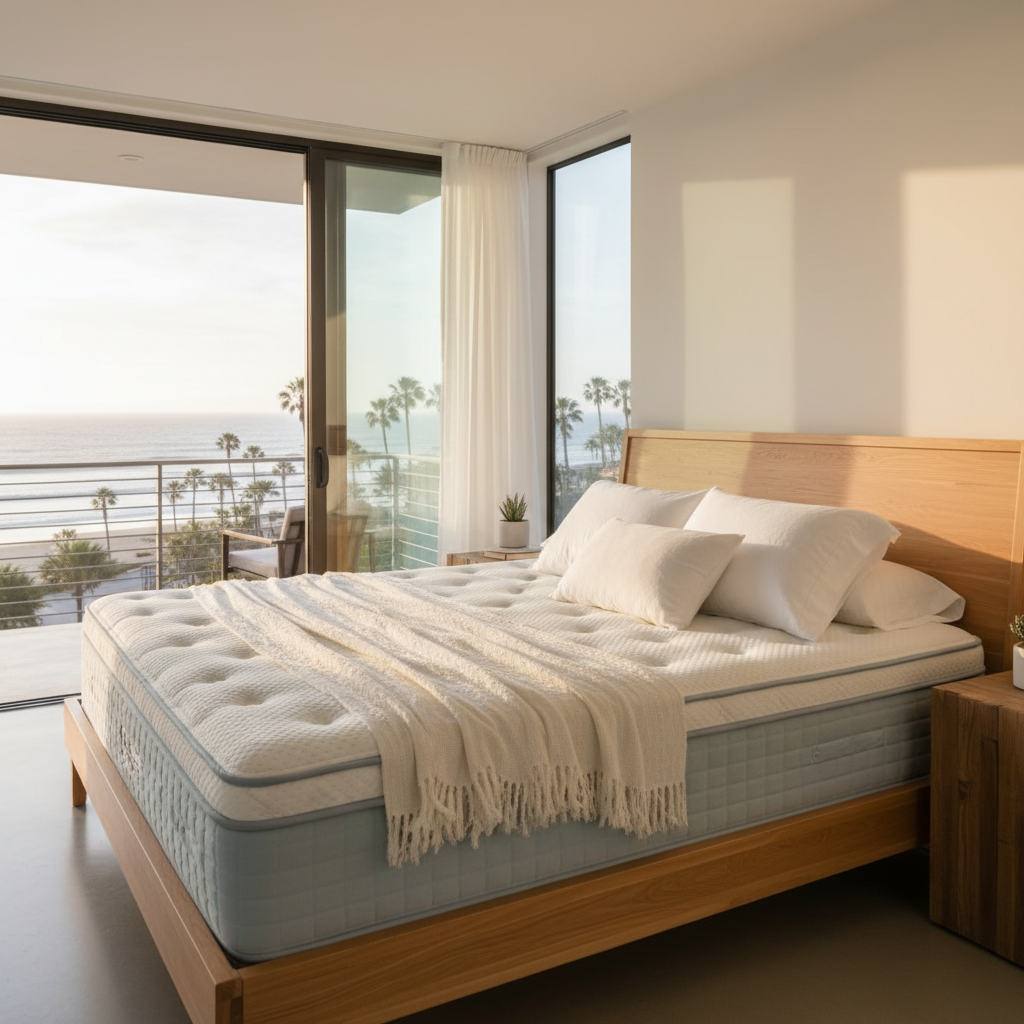
Living in San Diego feels like you’ve won the weather lottery. We get 72° and sunny more often than not. But when it comes to sleep, our coastal climate—from the beaches of La Jolla to the hills of San Marcos—presents a unique challenge. The same marine layer that gives us ‘May Gray’ and ‘June Gloom’ can make your bedroom feel damp, while the dry Santa Ana winds in the fall can make it feel like you’re sleeping in a convection oven.
Most people don’t think about climate when they buy a mattress. They focus on firmness or back pain. But here, with our specific blend of humidity and dry heat, your mattress’s ability to breathe is paramount. A bed that traps heat and moisture won’t just make you uncomfortable; it can wear out faster and even become a breeding ground for allergens in our coastal air.
This is where mattress materials become critical. The wrong choice, like a dense, traditional memory foam bed, can work against you year-round. The right one, typically a hybrid or latex model, works *with* our environment to regulate temperature and humidity, ensuring you sleep cool and dry. We’ll walk you through why this matters and which beds are built for the San Diego lifestyle.
The ‘San Diego Tax’ on Sleep: Why Our Climate is Unique
San Diegans happily pay the ‘sunshine tax’ for our idyllic beaches and pleasant weather. But there’s a lesser-known tax on our sleep, courtesy of our unique coastal microclimate. Unlike the dry desert heat of Phoenix or the consistent humidity of Miami, we fluctuate between two extremes. This puts a heavy performance burden on your mattress that residents of other cities just don’t face.
First, we have the marine layer. From roughly April through July, a thick blanket of cool, moist air rolls in from the Pacific. This raises the relative humidity in our homes, especially in coastal-adjacent neighborhoods like Encinitas, Carlsbad, and Solana Beach. A mattress that can’t breathe will feel clammy and heavy in this environment.
Then, in the fall, the script flips. Santa Ana winds bring hot, dry, gusty weather from the deserts. Temperatures can spike, and the air becomes incredibly arid. Now, that same mattress needs to be able to dissipate your body heat quickly to keep you from overheating. A bed that failed in the humidity is likely to fail in the heat, too. Most conventional mattresses are designed for a ‘standard’ climate, which simply doesn’t exist here. You need a mattress engineered for airflow and temperature neutrality to get consistently good sleep.
Humidity, Mold, and Mattresses: The ‘May Gray’ & ‘June Gloom’ Effect
When the marine layer is in full effect, the air feels thick with moisture. This humidity doesn’t just stay outside; it comes right into your bedroom. This is where traditional, dense memory foam mattresses show their weakness. Memory foam is made of polyurethane, which has a closed-cell structure. It’s not inherently breathable. It can act like a sponge, subtly absorbing airborne moisture and your own perspiration.
This creates two major problems. First, it compromises comfort. A damp-feeling mattress is simply unpleasant to sleep on. Second, it creates a potential hygiene issue. A mattress that consistently holds moisture becomes a welcoming environment for mold, mildew, and dust mites. We’ve spoken with many customers in our Encinitas showroom who live within a mile or two of the coast and complain about a persistent musty smell from their old foam mattress. It’s often the trapped moisture they’re smelling.
Furthermore, this humidity can amplify the off-gassing scent of a new memory foam mattress. Those volatile organic compounds (VOCs) that are released when the mattress is unboxed can linger longer and smell stronger in a damp room. A mattress with superior airflow and moisture-wicking properties isn’t a luxury in San Diego; it’s a necessity for a clean and comfortable sleep environment.
Santa Ana Winds and Dry Heat: When Your Bed Becomes an Oven
Just when you’ve gotten used to the coastal humidity, the Santa Ana winds arrive in September and October. Ask anyone who lives in East County, from El Cajon to Santee, and they’ll tell you how intense that dry heat can be. But it affects us on the coast, too, pushing temperatures well into the 80s and 90s. Even with fans and AC running, your mattress plays a huge role in how well you handle the heat.
The same dense memory foams that struggle with humidity also perform poorly in dry heat. These materials are known for absorbing and retaining your body heat. On a normal night, it might lead to mild discomfort. During a Santa Ana heatwave, it can feel like you’re sleeping on an electric blanket that’s stuck on ‘high.’ Your body becomes a furnace, and the mattress reflects all that heat right back at you.
This is because heat needs somewhere to go. It needs to move *away* from your body. A solid block of foam provides no channels for air to circulate and carry that heat away. From our delivery operations, we see a noticeable uptick in customers wanting to replace all-foam beds in the fall. They often tell us the heat was the final straw. A mattress built with airflow as a priority doesn’t just feel better; it’s fundamental to staying cool during our hottest months.

Hybrids: The All-Around Best Choice for San Diegans
The Power of Airflow
So, what’s the solution? For the vast majority of San Diegans, it’s a hybrid mattress. A hybrid bed combines the best of both worlds: a supportive core of individually wrapped steel coils and top comfort layers made of foam or latex. This construction directly solves the climate problems we face.
The key is the coil unit. Unlike a solid slab of foam, the pocketed coil support layer is mostly empty space. This creates an open, breathable foundation that allows air to move freely throughout the mattress. As you move during the night, you’re creating a gentle bellows effect, pushing warm, moist air out and pulling fresh, cooler air in. This constant, passive ventilation is incredibly effective at wicking away both humidity from the marine layer and the body heat generated during a Santa Ana-fueled night.
On top of this breathable base, you get the pressure relief and comfort of modern materials. Brands like WinkBed and Helix have perfected this design, offering various firmness levels to suit your sleep position while ensuring the core remains an airflow machine. Based on customer feedback at our Encinitas store, about 60-70% of sleepers find their ideal match in a hybrid, thanks to this perfect balance of climate control and universal comfort.
Natural Latex: The Coastal Champion for Cooling and Durability
If a hybrid is the best all-arounder, a natural latex mattress is the premium, specialized choice for our coastal environment. Latex foam, derived from the sap of rubber trees, has a fundamentally different structure from memory foam. It’s naturally an open-cell material, riddled with tiny air pockets. This structure creates a foam that is inherently breathable before any other cooling features are even added.
This makes latex exceptionally good at managing both heat and moisture. Heat doesn’t get trapped; it dissipates through the material. Moisture doesn’t get absorbed; it wicks away. Another significant advantage for life near the coast is that natural latex is inherently resistant to mold and mildew. For anyone concerned about allergens or the musty smells that can develop in a humid home, latex provides powerful peace of mind.
We prominently feature brands like Avocado in our showroom because they champion the benefits of natural latex. When you lie on a latex or latex-hybrid mattress, you’ll notice you sleep *on* the surface rather than sinking *into* it. This feeling of buoyancy not only aids in easy movement but also keeps more of your body’s surface area exposed to the air, further enhancing its cooling properties. It’s a fantastic, durable, and naturally effective material for San Diego’s climate.
The Problem With All-Foam Mattresses on the Coast
Given the benefits of hybrids and latex, it’s important to be specific about why most all-foam mattresses are a difficult choice for San Diego sleepers. While convenient and often affordable, a bed made entirely of foam layers—especially traditional, dense memory foam—is often a recipe for hot, sticky nights.
The core issue is heat retention. Memory foam works by softening in response to your body heat, contouring to your shape. But that heat has nowhere to go. It gets trapped in the foam surrounding your body. Customers often describe the feeling as being stuck in ‘warm quicksand.’ In our climate, this is a year-round problem. During a cool June night, it feels sweaty. During a hot October night, it’s unbearable.
From insights gathered in our showroom, we see a clear pattern: the number-one complaint from people replacing a 3-to-5-year-old online mattress is that it sleeps too hot. We estimate that roughly 7 out of 10 customers looking to upgrade from a bed-in-a-box are doing so specifically because of heat and temperature issues. While some newer all-foam beds incorporate gels or conduits, they are often fighting a losing battle against the fundamental physics of a solid, non-breathable support core. For San Diego, airflow from the bottom up is not just a feature; it’s a requirement.
Decoding ‘Cooling’ Tech: What Actually Works?
Separating Science from Marketing
Many mattresses today are marketed as ‘cooling,’ but the term can mean very different things. It’s crucial to understand what technology is being used. Some features are simple marketing, while others offer real, tangible benefits for our climate.
- Gel Infusions: Swirling gel into memory foam was the first generation of cooling tech. The idea is that gel acts as a heat sink. It works, but only temporarily. Once the gel warms up to your body temperature (which it will), it loses its effectiveness. It’s a minor improvement, but not a solution for a hot sleeper in a warm climate.
- Phase-Change Materials (PCM): This is where the real science comes in. PCMs are materials that actively absorb and release thermal energy to maintain a regulated temperature. The Brooklyn Bedding Aurora is a prime example of this. Its cover is cool to the touch not as a gimmick, but because it is actively pulling heat away from you. This is a dynamic process that works all night long, making it highly effective against both ambient heat and body heat.
- Airflow-Focused Designs: Ultimately, the most reliable cooling technology is airflow. This can come from a hybrid’s coil core, a latex foam’s open-cell structure, or convoluted ‘egg-crate’ foam layers that create channels for air to escape. True cooling isn’t just about feeling cool for a minute; it’s about the mattress’s ability to get rid of the heat and moisture your body produces all night.
A Note on Foundations: Don’t Suffocate Your New Mattress
You can invest in the most breathable mattress in the world, but if you put it on the wrong base, you’ll negate all of its benefits. A mattress needs airflow from underneath, especially in a place as humid as San Diego. Putting a high-performance hybrid or latex bed on a solid-surface platform or directly on the floor is like plugging its exhaust pipe.
A solid base traps air and, more importantly, moisture. Any humidity that the mattress wicks away from you can get trapped between the bed and the platform. In a worst-case scenario, this can lead to mildew growth on the bottom of your mattress. We’ve seen this happen with customers who were unaware of the need for ventilation. It’s a costly mistake that can ruin a great bed.
The ideal foundation is a slatted bed frame or a modern ‘box spring’ (which is technically a rigid, slatted foundation covered in fabric). For a slatted base, ensure the slats are no more than 3-4 inches apart to provide adequate support for the mattress. This spacing is wide enough for air to circulate freely but close enough to prevent the mattress from sagging. Giving your mattress room to breathe from below is a simple but non-negotiable step for healthy, long-lasting sleep in our coastal city.
Testing in Person: Why a 15-Minute Visit Beats Weeks of Guessing
In the age of buying everything online, it’s tempting to order a mattress based on reviews alone. But for a decision this important—and this climate-dependent—a brief in-person visit is invaluable. Feeling the difference between latex, a performance hybrid, and traditional foam is something you can’t understand from a webpage. You can physically touch the cool-to-the-touch cover of a Brooklyn Bedding Aurora or feel the buoyant support of an Avocado latex bed.
Our showroom at 1441 Encinitas Blvd is designed for this exact purpose. It’s a no-pressure environment where you can compare the materials that matter. A 15-minute drive from Carlsbad or a 25-minute trip from Del Mar can save you the multi-week hassle of returning a heavy, vacuum-sealed mattress that made you sweat. You can ask specific questions about your home’s environment—whether you’re on the water in the Marina District or in a hotter inland area like Poway—and get an answer based on real-world experience.
You can lie down and feel how quickly a mattress responds to your heat. Does it build up? Does it dissipate? This is the most important test you can run, and it only takes a few minutes. Don’t leave a decade of sleep quality up to online guesswork. Come feel for yourself what’s right for San Diego.
| Feature | All-Foam Mattress | Hybrid Mattress | Natural Latex Mattress |
|---|---|---|---|
| Airflow & Heat Dissipation | Low (Traps heat) | High (Coils create airflow) | Very High (Open-cell structure) |
| Moisture Management | Poor (Can absorb humidity) | Excellent (Airflow wicks moisture) | Excellent (Naturally moisture-resistant) |
| Support Core | Solid Foam Block | Individually Wrapped Coils | Dense Latex Foam |
| Feel | Sinking, contouring | Balanced, responsive, buoyant | Lifting, buoyant, responsive |
| Lifespan in Coastal Climate | Shorter (Heat/moisture can degrade foam) | Longer (Durable coils) | Longest (Resistant to mold/mildew) |
| Best For… | Sleepers who are always cold; budget shoppers | Most San Diegans; hot sleepers; all sleep positions | Eco-conscious shoppers; those with allergies; ultimate cooling |
Frequently Asked Questions
Is a memory foam mattress really that bad for San Diego?
A traditional, dense, all-foam mattress is a challenging choice for our climate. It tends to trap both body heat and the ambient humidity from our marine layer, which can lead to sleeping hot and sweaty. While some newer foam mattresses have cooling gels, the most effective solution for our area is a mattress with a coil-based core for airflow, like a hybrid.
Do I need a ‘cooling’ mattress if I have air conditioning?
Yes, it’s still highly recommended. Air conditioning cools the room, but it doesn’t cool the space between your body and the mattress surface. A mattress that retains heat will still build up a ‘hot spot’ directly underneath you, causing you to feel hot and kick off the covers, even in a 68°F room. A breathable mattress works with your AC to keep your actual sleep surface temperature-neutral.
What’s the main difference between a hybrid and a latex mattress?
Both are excellent choices for San Diego. The main difference is in their core materials and feel. A hybrid mattress uses a support core of steel coils (great for airflow) with top layers of foam or latex. A true latex mattress uses a support core made of dense latex foam. Hybrids often have more ‘bounce,’ while all-latex beds have a uniquely buoyant, lifting feel. Both dramatically outperform traditional memory foam in breathability.
How does the marine layer humidity affect a mattress?
The marine layer’s moisture can be absorbed by mattresses that lack airflow, particularly dense memory foam. This can make the bed feel slightly damp or clammy and can also foster a musty environment ideal for allergens. A breathable mattress (like a hybrid or latex) allows that moisture to pass through rather than collecting in the bed.
Will a mattress protector trap heat?
It depends on the protector. A cheap, plastic-y protector will act as a waterproof barrier but will also trap 100% of heat and moisture, negating the benefits of your breathable mattress. Look for a modern protector that is designed for breathability. These often use specialized materials that are waterproof but still allow for air and vapor to pass through, protecting your mattress without making you sleep hotter.
Is it worth visiting the Yawnder showroom in Encinitas?
Absolutely. While online research is great, you can’t feel breathability or cooling technology through a screen. A 15-20 minute visit allows you to physically compare a hybrid, latex, and a high-performance foam bed side-by-side. You can feel the coolness of a phase-change cover and talk to an expert about your specific needs. It’s the fastest way to make the right choice.
Try Before You Buy at Yawnder San Diego
Compare select mattresses at 1441 Encinitas Blvd. Contact us to confirm floor availability. Standard shipping is free; white-glove delivery and setup costs $200 per delivery. See our shipping policy for service and removal details.
Living in San Diego feels like you’ve won the weather lottery. We get 72° and sunny more often than not. But when it comes to sleep, our coastal climate—from the beaches of La Jolla to the hills of San Marcos—presents a unique challenge. The same marine layer that gives us ‘May Gray’ and ‘June Gloom’ can make your bedroom feel damp, while the dry Santa Ana winds in the fall can make it feel like you’re sleeping in a convection oven.
More San Diego mattress guides
Hand-written by the Yawnder San Diego showroom team.
San Diego mattress resources
Local guides from Yawnder, San Diego County’s independent mattress retailer.
-
Yawnder San Diego showroom
Address, hours and what is on the floor in Encinitas. -
San Diego mattress delivery
Delivery windows, white glove setup and removal options. -
Recycle a mattress in San Diego
Drop-off sites, county rules and recycling fees. -
Donate a mattress in San Diego
Charities that accept used mattresses and what they take. -
Current San Diego mattress deals
What is discounted right now across the brands we carry. -
Shop today’s sale prices
Every mattress currently marked down, sorted by popularity.
Compare these picks against 142 tested mattresses
Sort all 142 mattresses we have tested by pressure relief, support, cooling, motion isolation, edge support, price, trial and warranty, then filter by how you actually sleep. Of those, 86 hold a complete standardized record and 46 a partial standardized record.