Mattress Construction & Materials
How did these materials get here? Explore our interactive mattress history timeline, or use the source-linked mattress history quick reference.
Learn what is inside a mattress, which numbers actually mean something, and where a specification stops and measured performance begins.
Mattress Education · Certifications & Safety · Care & Ownership
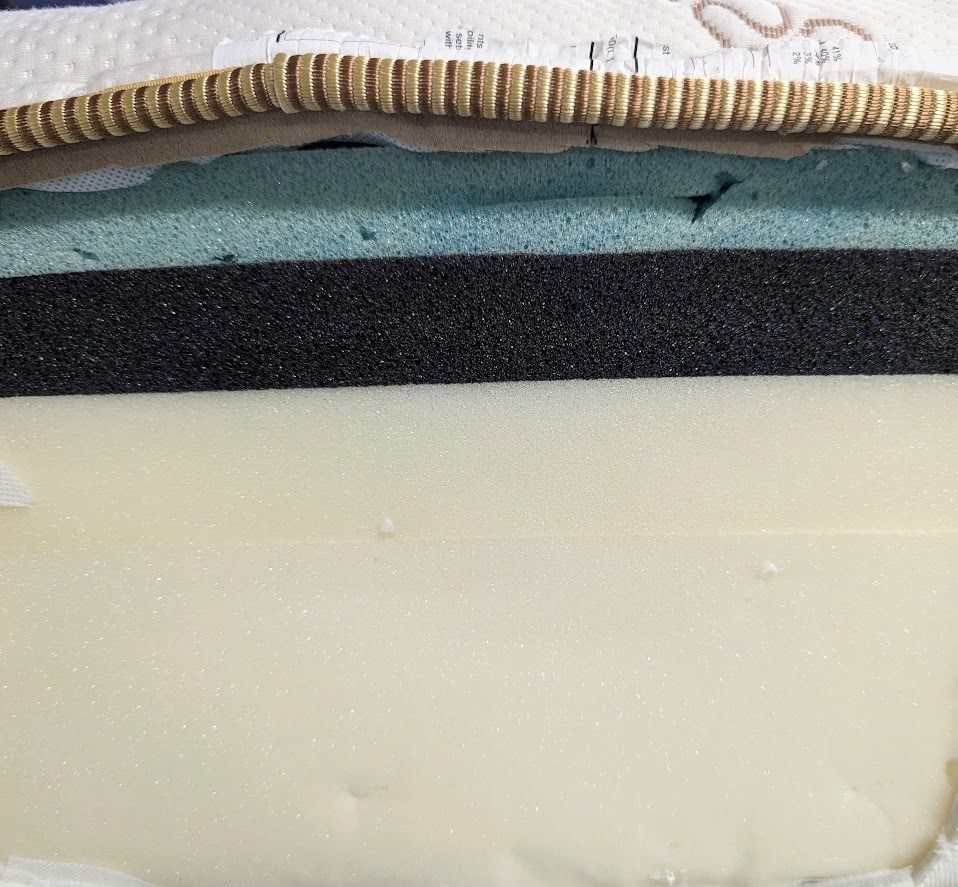
A mattress is a system: cover and quilting, comfort layers, transition layers, and a foam or coil support core. No single density, gauge, count or material name can grade that system. Use this center to decode each field, then compare the claim with Yawnder’s measured results.
Read a construction spec sheet
Decode a layer stack without confusing marketing with measurable specifications.
Foam density
Understand 1.5, 1.8, 3, 4 and 5 PCF—and why density is not firmness.
ILD / IFD firmness
Learn what indentation testing measures and why test conditions matter.
Coil gauge
Read 12–15 gauge correctly and understand mixed-gauge support systems.
Coil count
Put large coil-count claims in context.
Coil systems
Compare Bonnell, pocketed support coils and microcoils.
Zoned support
See how coil and foam zoning changes regional support.
Coil types
Compare Bonnell, offset, continuous, pocketed and microcoil systems.
Edge-support construction
Foam encasement versus reinforced perimeter coils—and how we test the edge.
Construction and durability
Turn density, thickness, coil design and warranty terms into a durability risk read.
Talalay vs Dunlop latex
Compare two latex manufacturing processes without the myths.
Memory foam vs polyfoam
Separate viscoelastic memory foam from conventional polyurethane foam.
Quilting and comfort layers
Understand the layers that create surface feel and often wear first.
Construction and durability
Use construction as a durability risk assessment—not a fake lifespan promise.
A specification decoder
| If you see | It means | Read next |
|---|---|---|
| 2.5 in foam | Layer thickness only | Material, density and IFD |
| 3.5 PCF | Foam mass per cubic foot | Material family and layer role |
| 14.5 gauge | Wire thickness | Coil type, zone and placement |
| 1,000 coils | Count for an unstated or stated size | Size, diameter, gauge and included layers |
| Five zones | Five named resistance regions | Mechanism and zone map |
How this connects to Yawnder reviews
Where reliable specifications exist, a review’s “What’s inside” table lists each layer from the sleep surface down. It can include thickness, material, density, IFD/ILD, coil gauge, zoning and edge construction. These are manufacturer-published or sourced specifications, not Yawnder measurements. Conflicting sources stay visible.
Measured firmness, motion, cooling, pressure relief, edge support and alignment remain in the separate testing record. Read how Yawnder tests and scores or compare scored beds in the mattress comparison tool.
Standards behind the terms
ASTM D3574 covers standardized physical tests for flexible polyurethane foam, including density and indentation force. ASTM F1566 covers mattress and support-system evaluation. A standard explains how a property can be measured; it does not mean every brand-published number was independently verified.