Yawnder / The sleep time machine

200,000 years.
One very long search for comfort.

From grass beds to memory foam: pick an era, peek inside the layers, and discover how humans learned to sleep a little softer.

The history, at a glance

Who invented the mattress?

The mattress has no single inventor. Prepared plant bedding, crafted bed frames, spring systems, foam materials, and adjustable air beds developed at different times. A patent documents a particular invention; it does not establish the invention of every kind of mattress.

Selected milestones and the evidence behind them
DateMilestoneWhat the evidence establishesSource
At least 200,000 years agoGrass bedding at Border Cave, South AfricaPrepared bedding and activity areas, not a modern manufactured mattress.Wadley et al., Science (2020)
1901James Marshall’s pocket-spring patentUS685160A was granted October 22, 1901, after a 1900 filing.Original US patent
1905Bent’s mattress-tufting machineA patented manufacturing improvement, not the origin of tufting itself.Original US patent
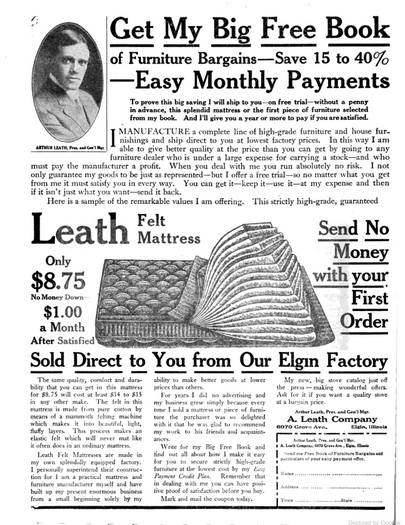
1909A Leath mattress free-trial advertisementMattress trial offers existed long before online shopping.Contemporary advertisement
1925Beautyrest launchA branded product launch, distinct from Marshall’s earlier patent.Smithsonian company archive
2006BedInABox begins its businessThe company dates its start to 2006, before the better-known 2014 online-brand wave.Company anniversary account

How this timeline is researched: archaeological studies, museum records, original patents, historical advertisements, and company archives. Company accounts are labeled. Dates refer to the event described, and modern illustrations are distinguished from period artifacts.

Publisher: Yawnder. Page expanded: September 25, 2026. Permanent link to this reference. Follow the original source for each historical claim.

A visual tour

Start with something that catches your eye.

Six doorways into the history of sleep. Tap a picture to follow its story.
Choose your stop in mattress history

Select an era below. Keyboard: Tab to the era choices, then use the arrow keys.

01 / 09 · 200,000 years ago

The original all-natural mattress

Long before bedrooms, people at Border Cave in South Africa arranged grass bedding over layers of ash. Researchers identified sleeping and working areas dating back at least 200,000 years. This is evidence of thoughtfully prepared bedding—not a modern mattress.

Wait, really? Reveal a fact

The ash may have helped discourage crawling insects. Some ash layers also came from burning old bedding during cleanup.

The idea that survivesPrepare a sleeping surface in layers. The materials have changed dramatically, but separating the sleeper from the ground remains a recognizable part of the story.

Source: Wadley and colleagues, Science (2020) ↗
Grass bedding

Plant material created a more comfortable surface above the ground.

Ash layer

Researchers suggest ash helped deter insects; some layers were remains of burned bedding.

Cave floor

The foundation was the ground itself.

Explore the layers. Simplified schematic based on the Border Cave findings; not an archaeological reconstruction.
02 / 09 · c. 2960–2770 BCE

Even the bed legs had personality

Beds became crafted furniture. Surviving Egyptian objects show sophisticated woodwork, plant-fiber webbing, and animal-shaped supports. This ivory fragment imitates a bull’s hind leg; supports like it were used on elite chairs and beds.

Wait, really? Reveal a fact

The Met also holds an early Egyptian bed used as a burial bier, with remnants of the plant-fiber webbing that formed its surface. Furniture could have an afterlife, too.

Look closelyThe pictured object is a furniture support, not a pillow or mattress. It shows how craft and decoration became part of the bed’s story, while the surviving webbing on other objects tells us about the sleeping surface.

Source: The Metropolitan Museum of Art ↗
Ivory furniture leg shaped like a bull’s hind leg from ancient Egypt
Open full-size photo ↗
Bull’s leg, c. 2960–2770 BCE. The Met, Rogers Fund, 1906, 06.1162.2. Public domain. A furniture fragment, not a complete mattress.
03 / 09 · c.1590

King size? Think bigger.

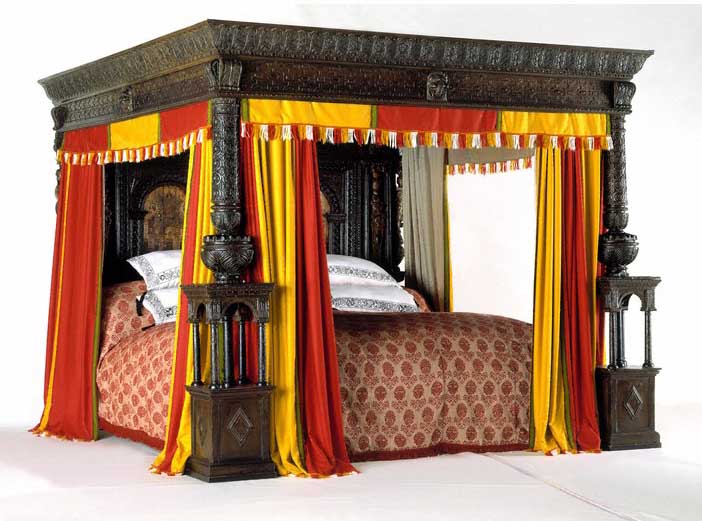
The Great Bed of Ware was more than three meters wide. Probably built to attract guests to an English inn, this enormous four-poster turned an overnight stay into a destination. It was famous enough to earn a mention in Shakespeare’s Twelfth Night.

Wait, really? Reveal a fact

Visitors left carved initials and red wax seals on the wood. Think of it as the Elizabethan version of leaving a review.

Try the size experimentThe bed’s extraordinary overall dimensions are easier to grasp next to a familiar queen or king. Use the comparison below; remember that outer furniture dimensions are not the same as usable sleeping space.

Source: Victoria and Albert Museum ↗
The Great Bed of Ware with ornate carved posts and red curtains
Open full-size photo ↗
Great Bed of Ware. © Victoria and Albert Museum / VAwebteam, via Wikimedia Commons, CC BY-SA 3.0. Image unaltered; displayed to fit. Hangings are modern reproductions.
04 / 09 · 1925

Springs get their own rooms

Simmons introduced the Beautyrest mattress with individually fabric-enclosed coils in 1925. Pocketed coils let individual springs compress more independently than an interconnected spring unit—a construction approach still widely used today.

Wait, really? Reveal a fact

This date marks the Beautyrest launch, not the invention of every spring mattress. Mattress development involved many inventors and manufacturers.

A change beneath the surfaceA fabric pocket surrounds an individual spring. That construction detail is more informative than simply calling a mattress “springy.” Today, coil design is one part of a much larger comfort system.

Source: Serta Simmons Bedding heritage ↗
A modern Beautyrest mattress in a bedroom
Open full-size photo ↗
Modern Beautyrest product photo from Yawnder’s media library. Shown as a contemporary descendant, not a 1925 mattress.
05 / 09 · 1929–1931

Rubber becomes a place to rest

Dunlop researchers developed latex foam in 1929. Dunlopillo’s company history dates its first mattress on sale in the UK to 1931. Instead of relying on loose stuffing or a steel spring unit, a foam core could cushion a sleeper.

Wait, really? Reveal a fact

The company’s account describes a household mixer helping inspire the manufacturing process. Latex foam and memory foam have different material histories; they are not interchangeable names.

Follow the materialThe milestone here is a manufacturing process: making a cushioning foam from latex. “Latex” and “memory foam” identify different materials, even though both can appear inside a modern mattress.

Source: Dunlopillo’s material history ↗
1 · Liquid latex

Latex is the starting material for this foam-making process.

2 · Foam and mold

The material is foamed and shaped in a mold.

3 · Cure into cushioning

Curing turns the formed material into resilient foam.

Tap through the simplified process. A conceptual manufacturing diagram, not a factory photograph.
06 / 09 · Late 1960s

Your mattress has an aviation connection

Memory foam grew out of NASA-funded work to improve aircraft seat cushioning and crash protection. Its slow-response cushioning eventually found uses far beyond aviation, including mattresses, chairs, and footwear.

Wait, really? Reveal a fact

The original assignment was aircraft seating. The familiar claim that it was invented as an astronaut’s mattress gets the story wrong.

An idea changes jobsA cushioning material developed for aircraft seating later found a place in bedrooms. The transfer of a material between industries is the important connection; an origin story alone does not establish how any particular mattress performs.

Source: NASA Spinoff FAQ ↗
Modern Tempur-Pedic mattress using memory foam
Open full-size photo ↗
Modern TEMPUR-LuxeBreeze Medium Hybrid. A present-day example of memory foam in bedding, not the original NASA research material.
07 / 09 · 1968

A mattress makes waves

Charles Hall developed the modern waterbed in 1968 while studying design at San Francisco State. Water replaced conventional filling as the main support medium.

Wait, really? Reveal a fact

Hall experimented with flotation furniture before the waterbed. His early chair experiments included gelatin and cornstarch; water proved a better direction.

A different answer to supportThe support medium became a liquid inside a flexible container. Open the layer diagram to separate the envelope, the filling, and the base—three different parts of the design.

Source: SFGATE’s history of Charles Hall’s waterbed ↗
Flexible envelope

A flexible, sealed container holds the water.

Water chamber

The filling moves as weight changes position. Designs differ in how they control motion.

Supporting base

The water-filled mattress needs suitable support beneath it.

Tap a layer to see its role. Conceptual waterbed cross-section; construction varies by model.
08 / 09 · 2014

The bedroom arrives in a box

Casper launched in 2014 with a mattress sold online and delivered in compact packaging. Its launch is a milestone in the direct-to-consumer wave—not the invention date of the boxed mattress.

Wait, really? Reveal a fact

Boxed is a delivery method, not a comfort material. Both foam and some spring-containing mattresses can be compressed for shipping.

A change in the journey homeThis milestone concerns shopping and shipping as well as the bed itself. “Bed in a box” describes packaging; “foam” and “hybrid” describe what is inside. Those labels answer different questions.

Source: Casper’s shipping and company history ↗
1 · Compress

Industrial equipment reduces the mattress’s shipping volume.

2 · Roll and pack

The compressed mattress fits inside protective packaging and a shipping carton.

3 · Unpack and expand

After opening, the mattress expands. Follow the manufacturer’s instructions for the specific model.

Open each step to unpack the idea. Packaging process schematic; no fixed expansion time is implied.
09 / 09 · Today

Why choose just one material?

Today’s hybrid mattresses combine a spring support system with comfort materials such as foam or latex. Different constructions can feel very different, even when they share the same category name. Mattress history keeps evolving; there is no single finish line for comfort.

Wait, really? Reveal a fact

“Hybrid” describes a combination of materials. It does not guarantee a particular firmness, temperature, or level of motion isolation.

History does not pick the winnerNewer is not automatically better for every sleeper. A hybrid combines ideas from earlier chapters. The useful question is how its specific materials and construction suit the person using it.

Source: Yawnder mattress construction guide ↗
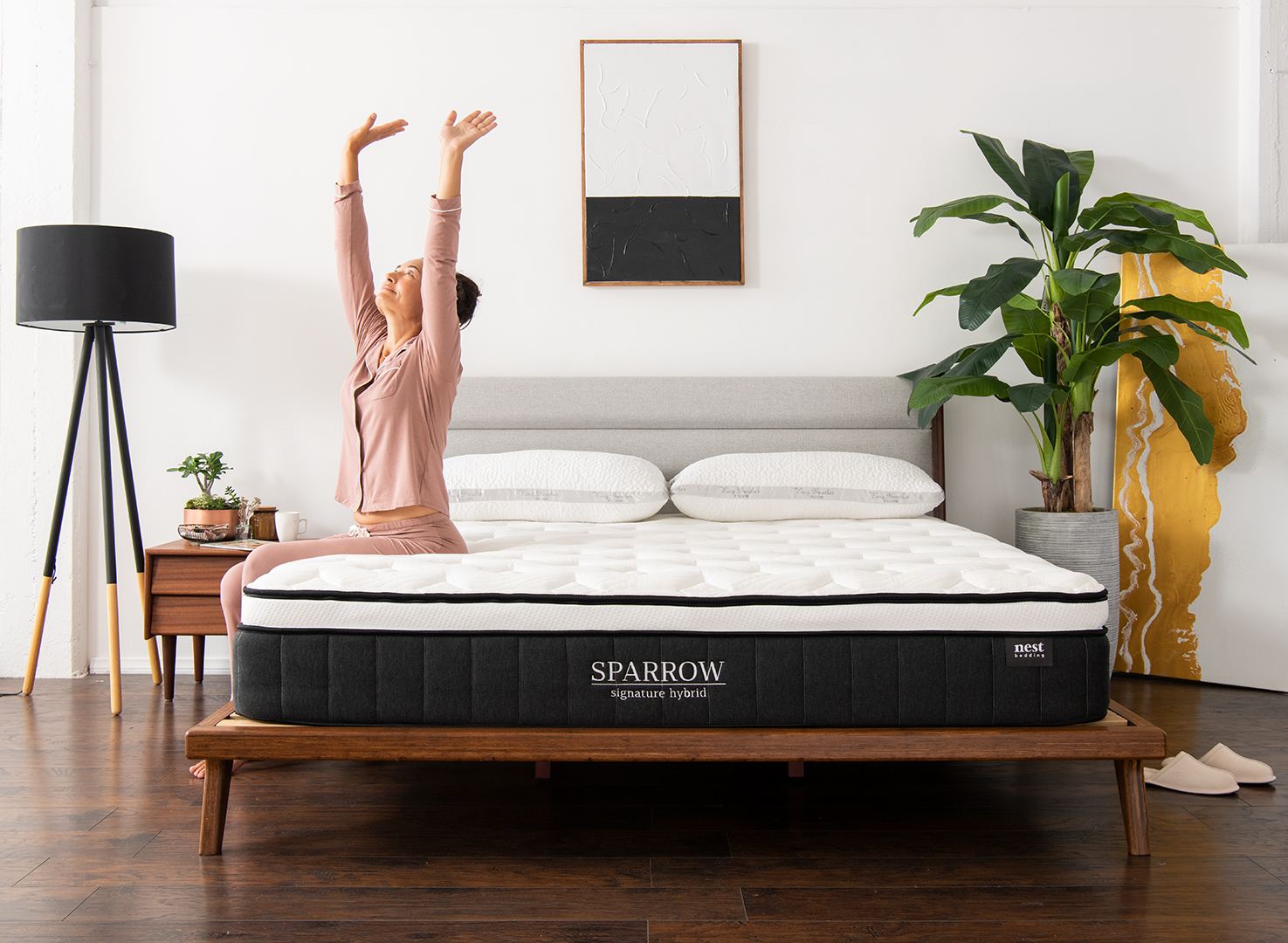
Nest Sparrow Signature Hybrid mattress in a modern bedroom
Open full-size photo ↗
Nest Sparrow Signature Hybrid, a contemporary mattress. Product photo from Yawnder’s media library.

Nine selected milestones, not an exhaustive world history. Stops are equally spaced for exploring, not proportional to elapsed time. Technologies overlap.

The little-things lab

Three details hiding inside the mattress.

Peel apart a spring unit, trace a tuft, and change an air chamber. These simplified illustrations explain the ideas; they are not engineering drawings or performance tests.

01 / POCKET SPRINGS

A room for every coil.

Marshall’s patent enclosed springs in individual fabric pockets, then joined them into strips.

Meet the 1901 patent →
02 / TUFTING

Follow the thread.

Bent’s 1905 machine sent multiple needles through at once. Operators still threaded the needles and tied the cord.

See the factory invention →
03 / ADJUSTABLE AIR

Change what is inside.

Adjustable air adds another way to change the feel of a bed, with separate settings possible on each side.

Follow the company story →
The mattress rabbit hole

Little inventions. Big personalities. Very good ads.

Go beyond the nine broad eras: explore 22 closer looks at the companies, factory tricks, campaigns, and odd turns that shaped the mattress business. Pick a trail, then open a story.

Choose your history trail
1846Stearns & Foster’s long runwaycompany

Stearns & Foster dates its brand history to 1846. Its roots stretch back well before memory foam, television commercials, or online checkout.

Brand history ↗

Link to this milestone
1871Before beds: cheese boxescompany · story

Simmons began with a factory making cheese boxes and wooden telegraph insulators. A woven-wire bedspring patent accepted as payment for a debt helped redirect the business.

Smithsonian company archive ↗

Link to this milestone
1881A cotton-filled beginning in Texascompany

Sealy traces its beginnings to Daniel Haynes making cotton-filled mattresses in Sealy, Texas. A local maker’s story eventually became a nationally recognized bedding name.

Sealy’s account ↗

Link to this milestone
1889The Simmons name takes overcompany

The business incorporated as Northwestern Wire Mattress Company in 1884 and became Simmons Manufacturing Company in 1889. Even familiar mattress names have earlier identities.

Smithsonian company archive ↗

Link to this milestone
1901The tiny fabric pocket with a big futureinvention

James Marshall’s US patent, filed in 1900 and granted October 22, 1901, describes coils enclosed in fabric pockets and joined in strips. Those enclosures keep springs positioned and reduce rubbing noise. Open the original drawings to see the construction.

Read patent US685160A ↗

Link to this milestone
1905Making the little dimples at scaleinvention

George W. Bent’s mattress-tufting machine patent describes adjustable rows of needles penetrating a mattress together. The needles carry cord through; an operator still ties it. This shows manufacturing getting faster, not that tufting began in 1905.

Read patent US787555A ↗

Link to this milestone
1909Free trial? They were doing that in 1909.advertising · story

This Leath felt-mattress ad offers a free trial and money back. It also pushes direct purchasing and price savings. The delivery channel changed dramatically; reassuring nervous mattress shoppers is a much older idea.

Original advertisement ↗

Link to this milestone
1909 Leath felt mattress advertisement offering a free trial
The Progressive Woman, 1909. Via Wikimedia Commons; public domain in the US. Tap the image to enlarge.
1925Celebrity endorsements before influencersadvertising

Beautyrest’s launch used testimonials associated with Henry Ford, George Bernard Shaw, and Thomas Edison. Familiar names helped turn hidden mattress construction into a public story.

Smithsonian company archive ↗

Link to this milestone
1927Eleanor Roosevelt appears in a mattress adadvertising · story

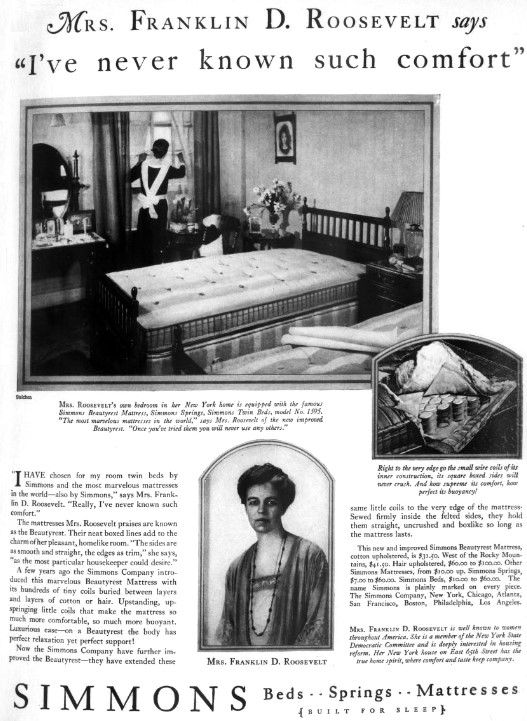
A May 1927 Vogue advertisement features Eleanor Roosevelt and a Beautyrest endorsement. Its letter-like presentation makes a personal recommendation the creative idea. This predates her years as First Lady.

View the historical ad ↗

Link to this milestone
1927 Simmons Beautyrest advertisement featuring Eleanor Roosevelt
Simmons advertisement, Vogue, May 15, 1927. Via Wikimedia Commons; public domain in the US. Tap the image to enlarge.
1940The living room becomes a bedroominvention · story

Simmons introduced the Hide-A-Bed in 1940. A fold-out spring-and-mattress assembly turned a sofa into a guest bed—an invention shaped by living space.

Smithsonian company archive ↗

Link to this milestone
1946Sleep research becomes part of the pitchstory · advertising

Simmons funded the Sleep Research Foundation in 1946, and its research center appeared in advertising. Scientific authority became part of the mattress story.

Smithsonian company archive ↗

Link to this milestone
1950sSupport becomes a brand identitycompany · advertising

Sealy describes working with orthopedic surgeons in the 1950s to develop Posturepedic. Support and posture became central selling ideas. This history does not independently establish the health benefits claimed in advertising.

Sealy’s account ↗

Link to this milestone
1964–65A mattress company at the World’s Fairstory · advertising

The Simmons archive includes material from the 1964–65 New York World’s Fair. Beds joined the era’s spectacle of modern living.

Explore the archive ↗

Link to this milestone
1987Adjust the air, change the feelcompany · invention

Select Comfort, later known as Sleep Number, was founded in 1987. Adjustable air chambers offered another approach to firmness, including separate settings for the two sides of a bed.

Company filing ↗

Link to this milestone
1992Tempur-Pedic starts its company storycompany

Tempur-Pedic gives 1992 as its founding year. Keep that separate from the earlier development of memory foam: inventing a material and building a consumer mattress brand are different milestones.

Tempur-Pedic’s account ↗

Link to this milestone
2000The sheep lose their jobsadvertising · story

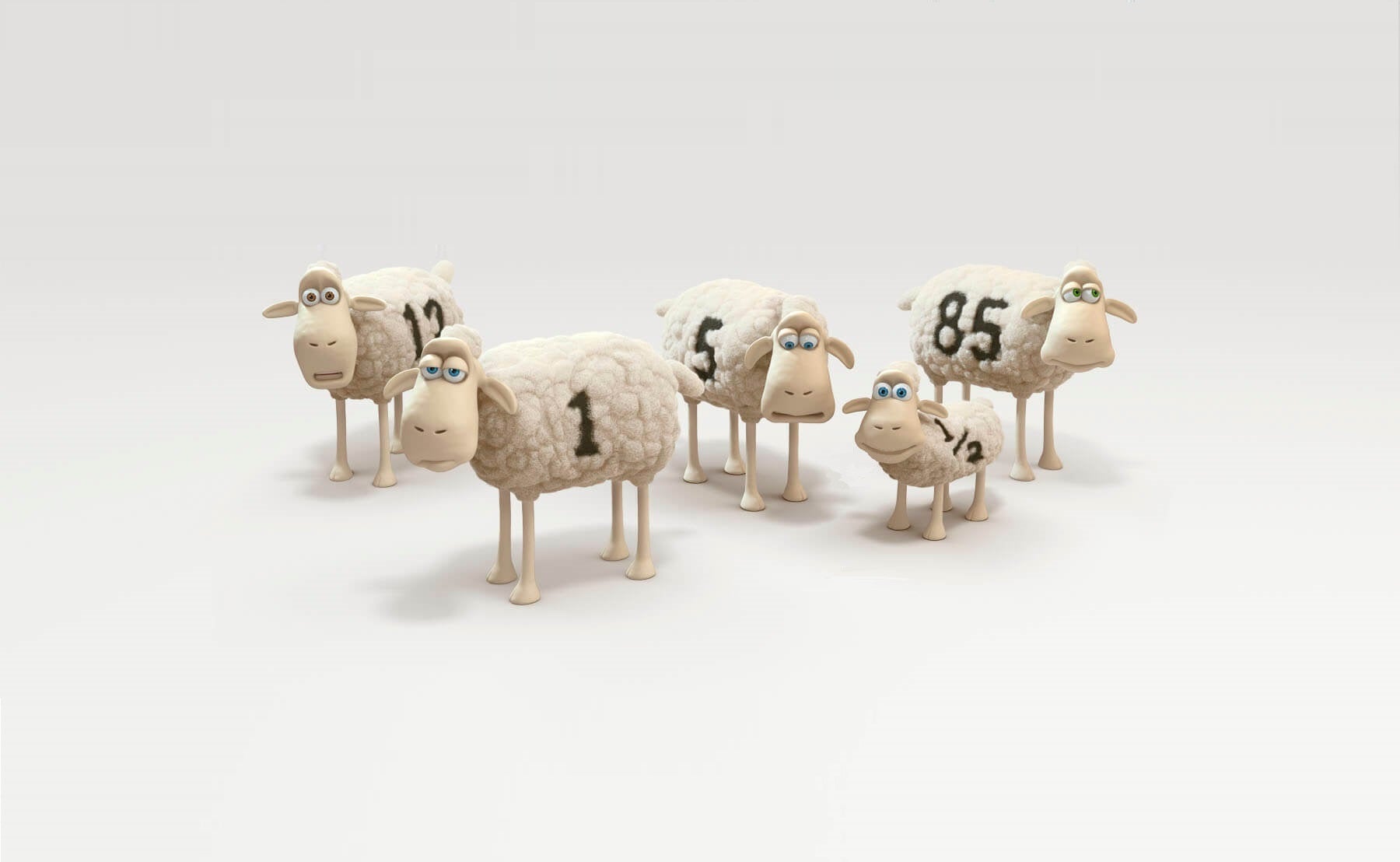
Serta’s Counting Sheep campaign turns the old bedtime ritual into a joke: if the mattress helps you fall asleep, what happens to the sheep? The characters became collectible mascots. This image is a later brand illustration, not an original 2000 ad frame.

Campaign history ↗

Link to this milestone
Serta Counting Sheep advertising characters
Contemporary campaign illustration © Serta. Shown for discussion of the campaign. Tap the image to enlarge.
2006The box story starts before the 2014 boomcompany · invention

BedInABox dates its business to 2006. The later wave of online mattress brands popularized an existing delivery approach. A brand launch date is not automatically an invention date.

Company anniversary account ↗

Link to this milestone
2010A wine glass makes motion visibleadvertising

A 2010 IndustryWeek profile describes Tempur-Pedic’s recognizable wine-glass demonstration. It translates motion transfer into something viewers immediately understand. This date marks the reporting, not the campaign’s debut; a staged demonstration is not a standardized comparison.

Read the 2010 profile ↗

Link to this milestone
2012A simpler online mattress pitchcompany

Tuft & Needle dates its founding to 2012. Its founders’ account centers on frustration with mattress shopping—a consumer-experience story that became part of the company’s identity.

Founders’ story ↗

Link to this milestone
2015Purple takes its pitch to Kickstartercompany

Purple’s corporate filing dates its Kickstarter launch to September 2015. Crowdfunding made the product demonstration part of the company’s public introduction before its broader launch.

Company filing ↗

Link to this milestone
2016Goldilocks gets an egg testadvertising

Purple’s filing dates its official launch and Goldilocks video to January 22, 2016. Humor and a memorable egg demonstration made an unfamiliar material easier to talk about—and easier to share.

Company filing ↗

Link to this milestone
2017The bed joins the connected homeinvention · company

Sleep Number introduced its 360 smart bed at CES in 2017. The story expanded beyond passive cushioning into sensing and automatic adjustment, adding electronics to the long history of comfort engineering.

Company annual report ↗

Link to this milestone

A growing collection of selected milestones, not every invention or company. Patent dates, product launches, and later historical accounts are distinguished above. Brand histories are identified as company accounts; historical advertising claims are presented as advertising.

Back to the big-picture timeline ↑ · Explore mattress construction today →

The advertising detective

Old ads. Surprisingly familiar tricks.

Inspect the pictures side by side. Make your guess, reveal the answer, then look for the idea doing the selling.

CASE 01Guess · reveal · inspect
Leath felt mattress ad offering a free trial and money back

A free trial, money back, and a direct-to-you pitch. Does that sound familiar?

How early was this trial offer advertised?

Reveal the answer
1909

This ad appeared in The Progressive Woman in 1909. The internet did not invent reassuring shoppers with a mattress trial.

Find it on the timeline →
The selling idea

Reduce the risk

Look for the trial offer and the money-back language. The promise makes an unfamiliar purchase feel easier to try.

The Progressive Woman, 1909 · Public domain in the US. Source & context ↗

CASE 02Guess · reveal · inspect
Simmons Beautyrest advertisement featuring a letter from Eleanor Roosevelt

A recognizable name, a personal letter, and a mattress endorsement.

Before or after Eleanor Roosevelt became First Lady?

Reveal the answer
1927 — before

The ad ran in Vogue in May 1927. Its personal-letter format makes the endorsement feel like a recommendation from someone you recognize.

Find it on the timeline →
The selling idea

Borrow familiar authority

Notice how much space the letter receives. The person doing the recommending is a major part of the sales pitch.

Simmons / Vogue, 1927 · Public domain in the US. Source & context ↗

CASE 03Guess · reveal · inspect
Serta Counting Sheep characters in a later campaign illustration

These characters have a problem: a good night’s sleep could put them out of work.

Which year did the Counting Sheep campaign begin?

Reveal the answer
2000

Serta introduced the campaign in 2000. The illustration shown here is a later brand asset, not a frame from the launch commercial.

Find it on the timeline →
The selling idea

Make the promise memorable

The joke builds a cast of characters around an old bedtime ritual. The mattress benefit becomes a story viewers can remember.

Later campaign illustration · © Serta. Source & context ↗

What changed? The medium.

Across these examples, sellers use reassurance, a familiar name, or a memorable character. That is a reading of the advertising—not evidence that the mattress delivers every promise in it.

The “how big?!” lab

Put your bed beside a legend.

The Great Bed of Ware measures 326 × 338 cm overall. Pick a modern US mattress and see its footprint against the historic bed.

Choose a mattress size

About 2.1× as wide

The historic bed’s overall width is roughly 2.1 times a queen mattress’s 152.4 cm width.

About 1.7× as wide

A US king mattress is 193.04 cm wide. The historic bed’s overall width is still about 1.7 times that.

Longer does not mean wider

A California king is 72 × 84 inches: narrower and longer than a standard king. Ware’s overall width is about 1.8 times its width.

What this diagram compares: the historic bed’s outer dimensions versus modern mattress dimensions. It does not measure Ware’s usable sleeping area.

Dimensions: V&A and Sleep Foundation. Rectangles share a scale; width ratios are rounded.

See every measurement
Width × length (Ware: overall width × depth)
Bed or mattressInchesCentimeters
Great Bed of Ware, overall128.3 × 133.1326 × 338
US queen mattress60 × 80152.4 × 203.2
US king mattress76 × 80193.04 × 203.2
California king mattress72 × 84182.88 × 213.36
Same bedtime. Different solutions.

Then versus now

Choose a question to follow one idea across the timeline.

What goes between you and the ground?

Then: Border Cave’s grass layers made a prepared surface on the cave floor.

Now: Comfort layers sit above a support core, with the entire mattress resting on a suitable base. The basic design question remains: what should each layer do?

Explore mattress layers and materials →

Does a famous name tell you how it feels?

Then: The Great Bed of Ware’s fame came from its unusual scale and the experience of staying in it.

Now: A brand name or impressive origin story still cannot tell you whether an individual model suits you. Its materials, construction, and firmness matter.

Learn how to choose a mattress →

Is “foam” just one material?

Then: Latex foam and memory foam entered this story through different research and manufacturing paths.

Now: Latex, memory foam, and other polyurethane foams are distinct material categories. Calling a mattress “foam” leaves a lot unexplained.

Decode mattress terminology →

Did the box change the mattress?

Then: The online boxed-mattress wave changed how many shoppers ordered and received a bed.

Now: Packaging still describes delivery, not a single construction or firmness. Compare what is inside, along with the trial and return terms.

Browse mattress buying guides →

The bedside museum

Small objects. Big bedtime stories.

Look at each artifact before opening its label. What would you guess it was for?

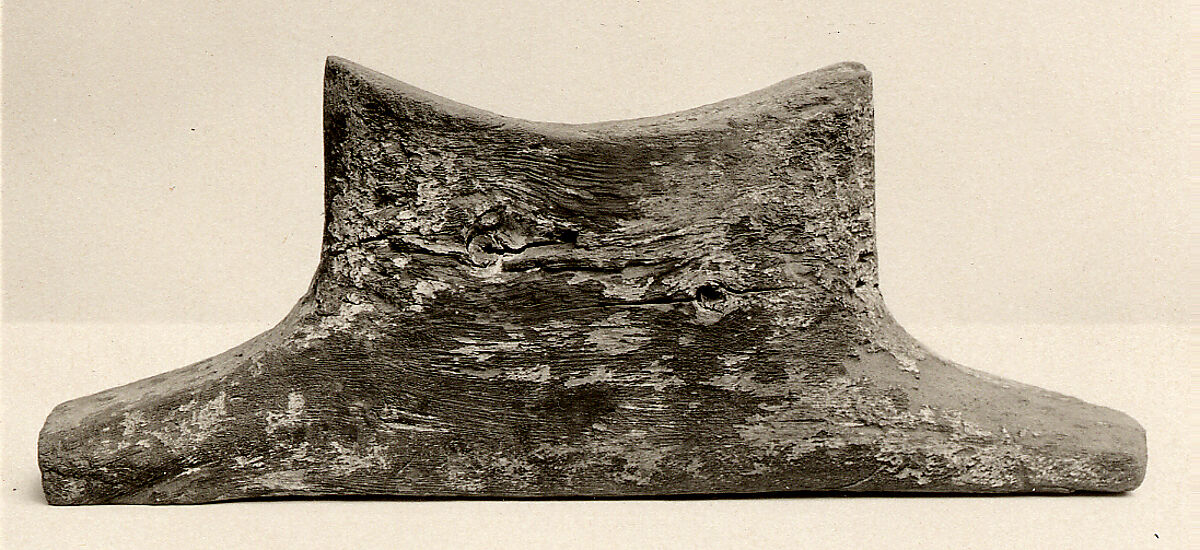
Ancient Egyptian wooden headrest with curved support
The Met, Rogers Fund, 1916. Object 16.10.329. Public domain.

A pillow made of… wood?

What am I looking at?

A wooden headrest from ancient Egypt, dated c. 2040–1802 BCE. Its curved upper section looks very different from a modern stuffed pillow.

Look closer: Look for the curved top, the central support, and the wide base. The Met records a height of 13 cm and a width of 32.8 cm.

Read the museum record ↗

Miniature maple four-poster bed model with an open frame
The Met, Rogers Fund, 1918. Object 18.11.1. Public domain.

A bed you cannot sleep in

Is this a full-size bed?

No. This maple bed model dates to 1770–1800 and measures only 34.3 × 31.8 × 20.3 cm. It is one of four similarly scaled models in the Met’s collection.

Look closer: Notice the four posts and exposed frame. This object shows furniture form, not what an eighteenth-century mattress felt like.

Read the museum record ↗

Ancient ivory furniture support carved like a bull’s hind leg
The Met, Rogers Fund, 1906. Object 06.1162.2. Public domain.

A bull in the bedroom

Animal bone or furniture?

Furniture. This ivory support was carved to resemble a bull’s hind leg. The Met dates it to c. 2960–2770 BCE and explains that elite chairs and beds could have animal-shaped legs.

Look closer: A surviving furniture fragment can reveal craftsmanship even when the rest of the object is gone. It is not enough to reconstruct an entire mattress.

Read the museum record ↗

Museum objects are individual examples, not a complete record of how everyone slept. Tap a photograph to open the full-size image.

Time traveler challenge

Which came first?

Choose the older object or earlier milestone in each pair. The dates appear after you answer.

Round 1 · Choose the earlier one
Correct! The headrest is older: c. 2040–1802 BCE, compared with 1770–1800 for the maple model.

Headrest record · Bed model record

Try the other one. The headrest is older: c. 2040–1802 BCE, compared with 1770–1800 for the maple model.

Headrest record · Bed model record

Round 2 · Choose the earlier one
Correct! The Great Bed of Ware came first, around 1590. The much smaller maple model dates to 1770–1800.

V&A history · Bed model record

Try the other one. The Great Bed of Ware came first, around 1590. The much smaller maple model dates to 1770–1800.

V&A history · Bed model record

Round 3 · Choose the earlier one
Correct! Dunlopillo dates its first UK mattress sale to 1931. NASA’s memory foam research belongs to the late 1960s.

Dunlopillo history · NASA FAQ

Try the other one. Dunlopillo dates its first UK mattress sale to 1931. NASA’s memory foam research belongs to the late 1960s.

Dunlopillo history · NASA FAQ

Three for three. You have your bedtime chronology down!

Photos: The Met, public domain. Great Bed of Ware: V&A / VAwebteam, Wikimedia Commons, CC BY-SA 3.0; image unaltered. Use “Start the journey again” below to reset all activities.

Before you snooze

Would you pass sleep-history class?

Make a guess. Each answer gives you instant feedback.

1. What lay beneath the grass at Border Cave?

Yes! Grass was laid on ash layers. Researchers suggest ash helped deter insects.

Not this time. Go back to Grass beds, or try another answer.

2. Memory foam began with research into…

Exactly. NASA-funded aircraft-seat research came before its familiar bedding uses.

A common mix-up! Check the Memory foam stop and try again.

3. What makes a mattress a hybrid?

You got it. Hybrids combine springs with materials such as foam or latex.

Try again. “Hybrid” refers to its combination of materials.

4. Which material reached mattresses in Dunlopillo’s early history?

Right. Dunlopillo dates its first UK mattress sale to 1931.

Try the Latex arrives stop for the answer.

5. A mattress in a box is defined by its…

Correct. A box tells you how it arrives, not exactly how it feels.

Try again. Foam and some hybrid mattresses can both ship compressed.

6. The Great Bed of Ware was probably built to…

Exactly. A very large bed made an overnight stay an attraction.

Try the giant-bed stop for a clue.

Your score:

Do Not Sell or Share My Personal Information Privacy Policy
Y

Yawnder

We typically reply in a few minutes

👋 Hi there!

Have a question about mattresses, deliveries, or your order? We're here to help.