How to choose a mattress
Almost every bad mattress purchase comes from the same mistake: shopping by brand, feel-in-the-store or discount instead of by firmness. Work through the six decisions below in order and the field narrows from thousands of models to a handful you can compare directly. Every number on this page comes from the beds we have actually scored.
- The six decisions
- Firmness and position
- Mattress types
- Budget
- Cooling, motion, edges
- Trial, warranty, base
- Next steps
- FAQ
The six decisions, in order
- Firmness first. Your sleep position sets what your spine needs; your body weight sets how firm the bed has to be to deliver it. Nothing else matters until this is right.
- Then construction. Hybrid, all-foam, latex, innerspring or airbed. This decides feel, temperature and how long the bed lasts.
- Then budget. Decide the number before you look at sale banners, so a discount cannot move you up a tier you did not need.
- Then the two or three things you personally care about. Sleeping hot, a restless partner, sitting on the edge, organic materials — pick your priorities rather than chasing every feature.
- Then size and room fit. Cheaper to get right now than after delivery. See the sizes guide.
- Then the fine print. Trial length, return fees, warranty terms and the base the warranty requires.
Step 1: match firmness to your position and weight
Firmness is not a property of the mattress alone — it is how far your body compresses the comfort layers. The same bed reads roughly one to two points softer to someone over 230 lb and one to two points firmer to someone under 130 lb. That is why a “medium” can feel plush to one person and like a board to another, and why weight belongs in this decision alongside position.
| You mostly sleep | Firmness range to shop (editorial fitting guidance) | Why |
|---|---|---|
| On your side | Soft to medium, about 3–6.5/10 depending on your weight | The shoulder and hip have to be allowed in, or the spine bends at the waist and the shoulder takes the load. |
| On your back | Medium to firm, about 5–7.5/10 | You want the lumbar curve filled without the hips dropping below the ribs. |
| On your stomach | Medium-firm to firm, about 6.5–8.5/10 | Any hip sink hyperextends the lower back. This is the position where too soft causes pain fastest. |
| You change position all night | Medium, about 5–6.5/10, with a responsive surface | Ease of movement matters more than contouring. Latex and coil-heavy hybrids beat deep memory foam here. |
Ranges above are editorial fitting guidance from matching customers to beds, not a measurement of your body. For a specific pick at your exact position and weight, use the position × body weight matrix.
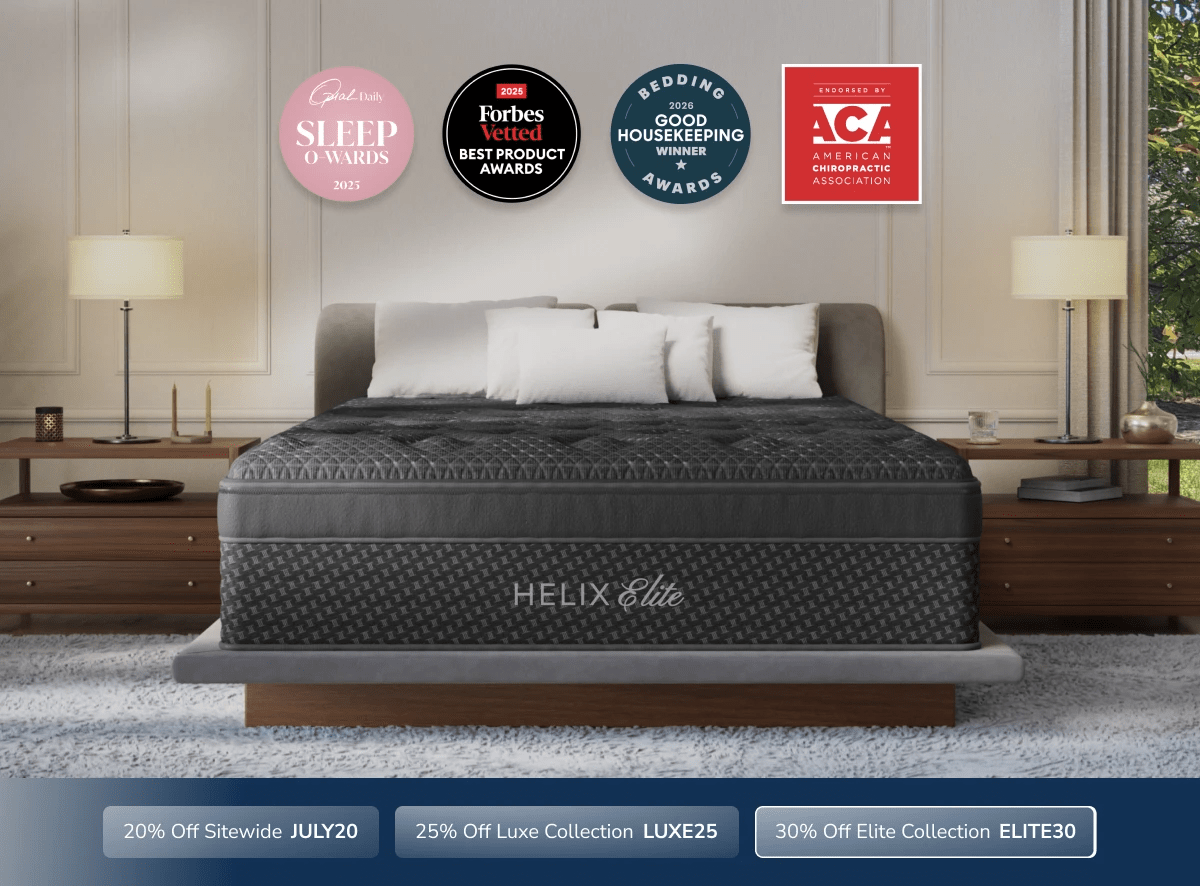
Check Helix pricesRead the review
Step 2: pick a construction
| Type | Queen price range we see | What it does well (and badly) | Examples we scored |
|---|---|---|---|
| Hybrid (coils + foam or latex comfort layers) | $300–$6,899 queen (most land $1,500–$2,500) | Support and bounce from the coils, pressure relief from the top layers. The default recommendation for most shoppers, and the most common construction in our review set. | Helix Midnight Elite (5.5/10, 9.6) · Big Fig (6/10, 9.0) |
| All-foam (memory foam or polyfoam) | $400–$3,399 queen (most land under $1,500) | Deep contouring and the best motion isolation. Sleeps warmer than coils and is the construction most likely to soften early in cheap builds. | Nectar · or add a topper to a firm foam bed |
| Latex and latex hybrid | $597–$10,000 queen (most land $1,900–$2,400) | Buoyant rather than sinking, cooler than memory foam, and the longest-lived material we track. Usually the pick for organic/natural shoppers and for combination sleepers who hate feeling stuck. | Avocado (6/10, 9.0) · Birch Natural (6/10, 9.0) |
| Innerspring (thin comfort layer over coils) | $1,995–$2,199 queen in our set | Traditional, firm, breathable, cheap to build. Weak on pressure relief for side sleepers unless there is a real pillow-top. | Saatva Classic (6.5/10, 9.3) |
| Airbed / adjustable firmness | $1,200–$5,499 queen | Each side dials in its own firmness, which solves partner mismatch. The trade-off is pumps, hoses and electronics that can fail after the warranty on the foam has been forgotten. | Sleep Number comparison |
Shortcut: if you have no strong preference, a medium hybrid in the $1,500–$2,500 range is the safest purchase for the widest range of sleepers. It is also where most of our top scores sit.

Check Avocado pricesCheck Birch prices
Step 3: set the budget before you shop
| Queen budget | What you can realistically expect | Where it usually goes wrong |
|---|---|---|
| Under $700 | A basic foam or thin hybrid bed. Fine for a guest room, a bunk or a short-term move. | Low-density comfort foam. It is not that these beds feel bad on night one — it is that they lose their feel first. |
| $700–$1,500 | The value sweet spot. Real pocketed coils, a usable comfort layer, 100-plus night trials and 10-year warranties are all normal here. | Thin comfort layers for sleepers over 230 lb, and weak edges. |
| $1,500–$2,500 | Where most of our highest-scoring beds sit: zoned coils, thicker pillow-tops, better cooling, 15–25 year warranties. | Paying for a “cooling” marketing layer instead of construction. Check what the cover actually is. |
| $2,500 and up | Luxury builds — multi-stage coils, natural latex, hand-tufted tops, 20–25 year warranties. | Diminishing returns on comfort. Above roughly $3,000 you are mostly buying materials and longevity, not a better night’s sleep. |
Step 4: choose your two or three priorities
- You sleep hot
- Prioritise construction over marketing: coils for airflow, latex over memory foam, and a comfort layer no thicker than you need. Phase-change covers help at the moment you get in, not at 4 a.m. Deep all-foam beds are the ones that trap heat.
- Your partner is restless
- Memory foam isolates motion best; coil-heavy hybrids and latex transfer more. If you also disagree on firmness, a split king on an adjustable base or a dual-firmness build solves it properly — better than compromising on one number you both dislike.
- You sit or sleep on the edge
- Look for reinforced perimeter coils. Foam-encased hybrids beat all-foam beds here, and edge support matters more the heavier you are and the smaller the bed.
- You are over 230 lb
- You need construction, not a firmness label: high-density comfort foams, a heavier-gauge or reinforced coil unit, a strong perimeter, and a stated weight capacity. See our picks for heavier sleepers.
- You have back pain
- Support before softness. The goal is keeping hips and shoulders in line, which usually means medium-firm with a zoned lumbar rather than the softest bed you can find. Start with best mattresses for back pain.
- You want organic or natural materials
- Ask which certification covers what — GOLS for latex, GOTS for cotton and wool, GREENGUARD Gold for emissions. “Eco” and “natural” on their own are not claims about anything.

Step 5 and 6: size, then the fine print
Size is the cheapest decision to get right and the most expensive to redo. Check the room clearance and the doorways before the delivery, not after — the sizes guide has the dimensions and walkaround space for every size.
Then read the terms, because this is where the differences are real:
- Trial length. 100 nights is the floor; several brands we review offer 365. Check for a mandatory break-in period before returns are allowed.
- Return cost. Free return pickup, a restocking fee and “donate it yourself for a refund” are three very different policies.
- Warranty. 10 years is standard, 15–25 years is common at the top of our set. What matters is the sag depth that counts as a defect (often 1 to 1.5 inches) and whether you pay shipping on a replacement.
- The base. Slats wider than about 3 inches apart, or a base with no centre support on a queen or larger, will void most warranties. See the bed frames and bases guide.
- Delivery. Compare like for like: doorstep drop-off, room-of-choice, or white glove with setup and old-mattress removal. Yawnder white-glove delivery is $200.
Five mistakes we see most often
- Buying the softest bed in the showroom. Ten minutes on your back feels wonderful on plush foam. Eight hours on it is a different question, especially for stomach and back sleepers.
- Shopping the discount instead of the bed. A permanent 40% off is a price, not a sale.
- Ignoring body weight. Two people can read the same “medium” two points apart.
- Reusing an old, sagging foundation. It changes the feel of the new bed and can void the warranty.
- Giving up in week one. Most beds need two to three weeks before your body stops comparing them to the old one — which is exactly what the trial period is for.
Where to go next
Once you know your firmness range, construction and budget, comparing beds is fast:
- Mattress Comparison EngineFilter 140-plus scored beds and put two or three side by side.
- Position × body weight matrixThe firmness target and pick for your exact combination.
- Best mattresses of 2026Our overall ranked list.
- Best for side sleepersThe most common position, and the fussiest.
- Best for back painSupport-first picks.
- Best for heavier sleepersReinforced builds over 230 lb.
- Mattress sizes guideDimensions, room clearances and size chart.
- Best mattress toppersThe cheap fix when a bed is close but too firm.
- Bed frames and basesSlat spacing and support requirements that void warranties.
- All mattress reviewsEvery model we have scored.
- How we testWhat our scores mean and how they are produced.
- Sleep glossaryPlain definitions for the spec-sheet jargon.
Frequently asked questions
- What is the single most important thing when choosing a mattress?
Firmness matched to your sleep position and body weight. Everything else — cooling, materials, brand, price tier — is a refinement on top of that. If the firmness is wrong the bed will not work no matter how good the components are, and no topper fully fixes a mattress that is too soft for you.
- How much should I spend on a mattress?
For a queen, $700 to $2,500 covers almost everyone. Across the beds we have scored, the strongest value sits between $1,500 and $2,500, where pocketed coils, thicker comfort layers and 15 to 25 year warranties are normal. Above roughly $3,000 you are mostly buying materials and longevity rather than a better night’s sleep.
- Is a hybrid better than memory foam?
For most people, yes — a hybrid gives you support and airflow from coils plus pressure relief from the top layers, which is why hybrids dominate our highest scores. Memory foam still wins on two things: motion isolation for light sleepers with a restless partner, and deep contouring for side sleepers who like the sinking feeling.
- How long should the trial and warranty be?
Look for at least 100 nights of trial and a 10-year warranty; both are standard now, and several brands we review offer 365 nights and 25 years. Read the trial’s fine print for a mandatory break-in period, return shipping or restocking fees, and check whether the warranty requires a specific base or slat spacing — using the wrong foundation is the most common way owners void coverage.
- How do I know when a mattress is worn out rather than wrong for me?
Worn out looks like a visible body impression that stays after you get up, a sagging middle with firmer edges, or waking with stiffness that eases within an hour of getting up. Wrong for you shows up in the first few weeks and does not change over time. Most quality mattresses last seven to ten years; latex tends to last the longest of the materials we track.
- Can I buy a mattress without lying on it first?
Yes, and most people now do. The trial period is the real test, because 10 minutes in a store tells you about pressure at the shoulder and hip but nothing about how the bed sleeps at 4 a.m. If you do want to try beds in person, our showroom is in Encinitas, and any bed you buy from us ships with white-glove delivery for $200.
Ready to shop your shortlist
Narrow the field with the comparison engine, then buy the bed that fits your firmness range — not the biggest banner. If you want to compare manufacturers first, see our best mattress brands guide. Current discounts across the brands we review are collected in one place.
Yawnder Reviews earns a commission on some links on this page. It never changes our scores, our firmness ratings or which bed we recommend — see how we test.