CertiPUR-US applies to flexible polyurethane foam, not the whole mattress. What the program tests, what falls outside it, and how to verify a certificate.
CertiPUR-US is the certification you will see most often on memory foam and polyfoam mattresses, and it is also the one most often over-read. It is a program for flexible polyurethane foam administered by the foam industry’s certification body. It says something real about the foam. It says nothing about your cover, your quilting, your fire barrier, your coils, or whether anything in the bed is organic.
| Question | Answer |
|---|---|
| What is certified? | Flexible polyurethane foam — the specific foam formulations submitted to the program |
| What is tested? | Content restrictions plus laboratory emissions testing of foam samples, alongside physical performance criteria |
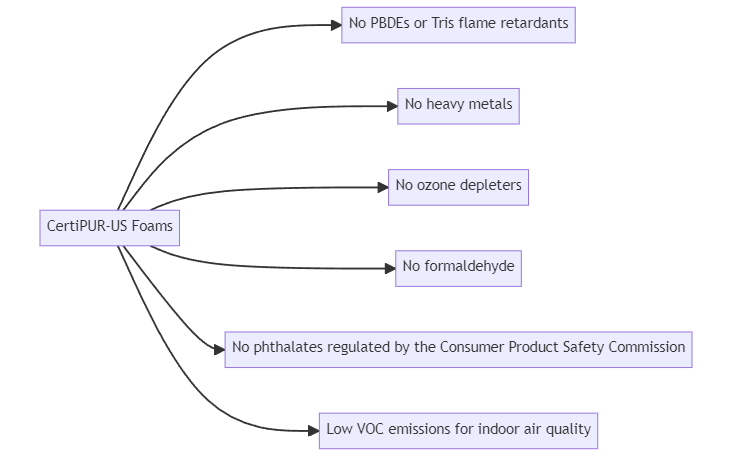
| Restricted content | Includes ozone depleters, specified flame retardants, certain heavy metals, formaldehyde and specified phthalates |
| Out of scope | Covers, quilting, fire barriers, latex, coils, adhesives used elsewhere, the finished mattress |
| Organic claim? | None. CertiPUR-US is not an organic program |
| How to verify | Ask which foam layers are certified, then check the program’s participant listing |
What the program actually covers
CertiPUR-US certifies foam, layer by layer, as submitted by the manufacturer. Certified foam is tested for restricted substances and for low emissions in a laboratory chamber, and must meet physical property criteria. That is a meaningful screen on the material that usually makes up most of a foam mattress’s volume. It is also the boundary of the claim: a brand can hold certification on its comfort foam and use an uncertified transition layer, and the logo will look identical on the product page.
Emissions testing, in plain terms
Foam is placed in a controlled chamber and the air is sampled for volatile organic compounds. Limits apply to total VOCs and to specific compounds. This is the part of the program relevant to the new-mattress smell people ask about. Low measured emissions does not mean zero odor: odor thresholds for some compounds sit far below any health-based limit, so a certified foam can still smell after unboxing. Duration varies by product, environment and the person sensing it.
What CertiPUR-US does not tell you
Three gaps matter when shopping. First, durability: the program includes physical criteria but does not predict a particular mattress’s lifespan. Foam density is one useful clue alongside formulation, layer construction and use. Second, the fire barrier: it is outside foam scope entirely, so a CertiPUR-US label is not evidence about fiberglass or barrier material. Third, organic content: no part of the program certifies organic anything — that is GOTS and GOLS.
How to verify a CertiPUR-US claim
Ask the brand which layers are certified, by name and thickness, and ask for the certificate holder. Foam is typically certified to the foam producer, not the mattress brand, so the answer may name a supplier — that is normal. Then confirm the participant is listed by the program. If a brand cannot say which layers are covered, treat the claim as unverified rather than false; that is how we record it in our own data.
A practical verification checklist
- Write down the mattress’s exact model and identify the foam layers in its construction list.
- Search the brand or supplier in the CertiPUR-US directory. The program says a company listing does not mean every product it sells contains certified foam.
- Ask the seller which specific polyurethane foam layers in your model are certified. Keep the response with the product information.
- Ask separately about the cover and fire barrier if those materials matter to you. Foam certification does not identify them.
- If you want finished-product emissions information, check the scope and current listing of a relevant program separately.
Not finding a brand in the directory is a reason to request clarification from the seller or program, not proof by itself that a particular mattress is unsafe.
What to ask the seller
Request the model’s layer list and ask which polyurethane foam layers use certified foam. A brand’s presence in the CertiPUR-US directory does not mean every product it sells contains certified foam. Ask separately about latex, the cover and the fire barrier, then keep the answer with your purchase information.
Where it fits alongside other programs
CertiPUR-US and GREENGUARD Gold overlap on the emissions question but differ in scope: one certifies foam, the other can certify a finished product. OEKO-TEX STANDARD 100 tests eligible textiles and other covered articles, which can include foams, against substance criteria; check the certificate scope. A latex or hybrid bed may hold several of them for different layers, which is why we store certifications per component rather than per mattress.
Related guides
Back to the Mattress Certifications & Safety guide.
Frequently asked questions
Is CertiPUR-US the same as organic?
No. It is a foam program with content and emissions criteria. Organic claims for textiles fall under GOTS and for latex under GOLS.
Does CertiPUR-US mean no fiberglass?
No. Fire barriers are outside the scope of a foam certification. Ask the brand about barrier material directly.
Does certified foam still off-gas?
It can still have an odor. Certification limits measured emissions under test conditions; it does not eliminate smell or establish how long an odor will last.
Is CertiPUR-US independent?
According to CertiPUR-US, eligible foam is analyzed by independent, accredited laboratories under its program. Compare each program’s scope and criteria rather than treating the labels as interchangeable.
Does it cover the whole mattress?
No — only the foam formulations submitted. Ask which layers by name.
Sources
Certification descriptions reflect each program’s published requirements at the time of writing; programs update their criteria, so verify a current certificate before purchase. Yawnder does not issue or administer any certification.