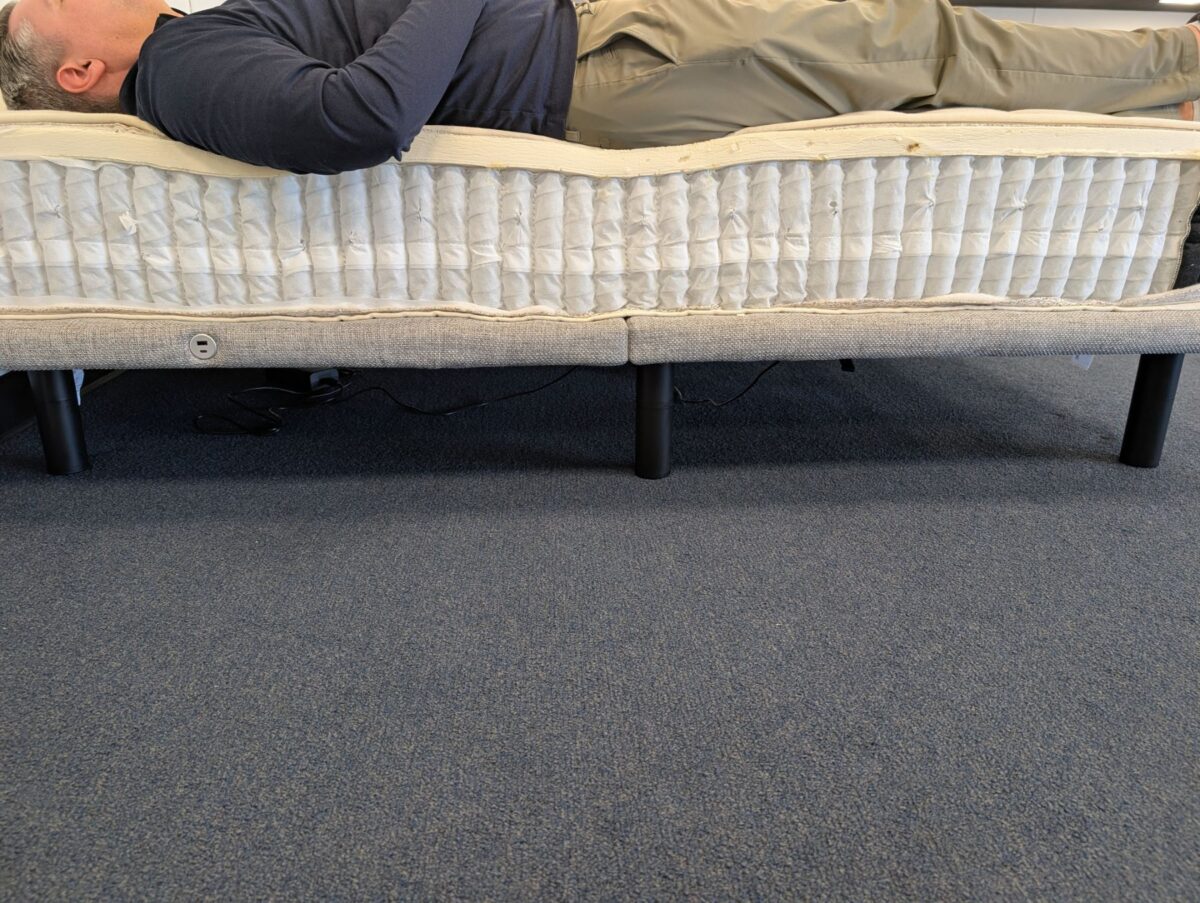
Foam-Encased vs Reinforced Coil Edge Support
How mattress edge support is built—foam encasement, higher-gauge perimeter coils, extra coil rows—and how Yawnder tests whether it works.
Edge support decides how much of a mattress you can actually use: whether you can sit on the side to dress, sleep close to the edge without feeling a roll-off, and whether a couple can spread out. Brands build it two main ways, and the marketing rarely says which. This page explains how the perimeter is built; if you want the ranked list of beds that scored best on our hands-on perimeter test, start with the picks page below.
| Construction | What it is | Typical behavior |
|---|---|---|
| Foam encasement | A firmer polyfoam rail surrounding the coil unit | Consistent perimeter; height and firmness of the rail matter |
| Reinforced perimeter coils | Thicker wire or extra coil rows at the edge | Springier edge that can stay cooler and more responsive |
| Both combined | Rail plus firmer edge coils | Usually the strongest sitting edge |
| Neither (all-foam) | Comfort and support foam to the sidewall | Edge performance depends entirely on core firmness |
Foam encasement
An encasement rail is a firmer polyfoam frame around the spring unit. It gives a predictable perimeter and keeps the coils from splaying. Two things determine whether it works: how tall the rail is relative to the coil unit, and how firm the foam is. A short or low-density rail can compress under a seated adult, which is why the rail’s density is worth asking about.
Reinforced perimeter coils
Instead of foam, some builds run thicker wire, additional turns or extra coil rows around the outside. The edge stays springy rather than dense, which some sleepers prefer for getting in and out, and it avoids adding a foam wall around the airflow path. Effectiveness depends on how many rows are reinforced and by how much.
Why all-foam beds behave differently
An all-foam mattress has no separate perimeter system, so its edge is as strong as the support foam beneath it. A firm, high-density support core can hold an edge well; a soft core with deep comfort layers usually compresses noticeably when you sit down.
What Yawnder actually checks
Edge support is part of our hands-on evaluation, not an instrument reading. We sit on the perimeter, lie within a few inches of the side, and note compression and roll-off feel, then record the score separately from construction. Read our testing methodology for the full split between instrument and hands-on scoring.
Reading an edge-support claim
“Reinforced edges” is not a specification. Useful disclosures are the encasement rail’s height and firmness, or the number of reinforced coil rows and their gauge. Where a brand publishes those, we list them in the review’s construction table and label them as manufacturer-published.
Related construction guides
- Read a construction spec sheet
- Foam density
- Coil gauge
- Quilting and comfort layers
- Construction and durability
For short definitions, use the Yawnder sleep glossary. To compare scored beds, open the mattress comparison tool.
Frequently asked questions
Is foam encasement better than edge coils?
Neither is automatically better. A tall, firm rail and a well-reinforced coil perimeter can both produce a strong edge; a thin rail or a token reinforcement row will not.
Why does edge support matter for couples?
A weak perimeter effectively narrows the usable sleeping surface, which matters most when two people share a queen.
Do all-foam mattresses have bad edges?
Not necessarily, but they rely on core firmness. Softer all-foam beds usually compress more at the side than a hybrid with a reinforced perimeter.
Does edge support affect durability?
Sitting on the same spot every day concentrates load. A perimeter built to carry it is less likely to develop a soft, collapsed side.