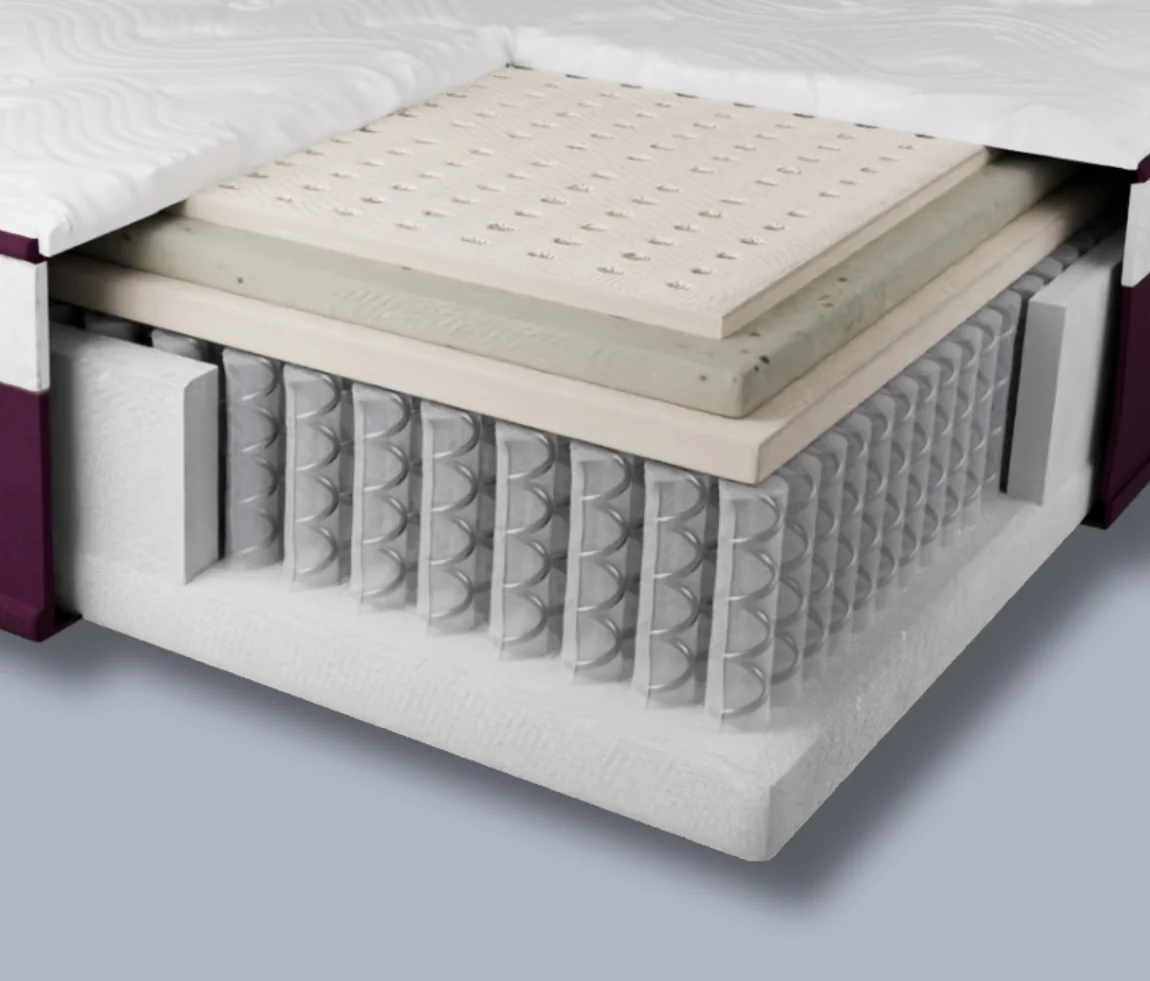
Mattress Coil Gauge Explained
A practical guide to 12, 13, 14 and 15-gauge mattress coils, including wire thickness, zoning, edge reinforcement and tradeoffs.
Coil gauge is a wire-thickness scale: lower gauge numbers mean thicker wire. That makes gauge useful, but not as a standalone quality score. Coil shape, height, turns, tempering, zoning and placement change how the finished support unit behaves.
| Gauge range | Typical role | Likely tendency |
|---|---|---|
| 12–13 | Heavy support or reinforced perimeter | Thicker, more resistant to deflection |
| 13.5–14.5 | Common support-core range | Balance of support and conformity |
| 15–17 | Comfort coils or softer zones | Thinner, more flexible wire |
| Mixed gauge | Zoned core or edge system | Performance depends on where each gauge is used |
How gauge numbering works
Wire gauge runs opposite intuition: 13-gauge steel is thicker than 15-gauge steel. A decimal such as 14.5 is common. Do not translate gauge directly into a firmness score because coil geometry and count also change resistance.
Gauge in zoned support
A manufacturer may use thicker wire under the lumbar area, thinner wire at the shoulders, or a reinforced perimeter. Ask for the zone map; “zoned coils” without location or method is not a comparable specification.
Pocket-coil gauge versus microcoil gauge
A tall support coil and a short comfort microcoil do different jobs. Microcoils often use thinner wire and many more units, so their gauge should not be judged against the main support core as if they were substitutes.
What to look for in a review
The strongest disclosure identifies gauge, coil type, unit height, zone design and edge reinforcement. Pair that construction with measured edge support and motion isolation rather than assuming the specification predicts the score.
Related construction guides
For short definitions, use the Yawnder sleep glossary. For measured performance, see how we test and score mattresses.
Frequently asked questions
Is lower gauge always better?
No. Thicker wire resists bending, but a mattress can use thinner wire deliberately for contouring or shoulder relief.
What is a good mattress coil gauge?
Many support units fall around 13–15 gauge. Suitability depends on coil geometry, zoning, body weight and the comfort layers above.
Does 12-gauge mean a firm mattress?
It may make that coil unit more resistant, but upholstery layers and coil design can still produce a softer finished bed.
Why do edges use a different gauge?
Thicker perimeter coils can reduce edge collapse while allowing the center to contour more freely.