ILD and IFD Explained: How Foam Firmness Is Measured
Learn what mattress ILD and IFD numbers measure, why test conditions matter, and why one foam number cannot predict a whole bed’s feel.
IFD and ILD describe the force required to indent foam under defined test conditions. The terms are often used interchangeably in mattress listings. The number is useful only when you know the sample thickness, compression percentage and test method.
| Reading | General signal | Important caveat |
|---|---|---|
| Lower force | Softer foam under that test | Not automatically plusher in a thin layer |
| Higher force | Firmer foam under that test | Not automatically more supportive |
| 25% IFD/ILD | Common comparison point | Sample dimensions and conditioning must match |
| 65% / 25% ratio | Support factor or compression modulus | Shows how quickly resistance increases |
What the test measures
ASTM D3574 includes indentation force deflection methods for flexible polyurethane foam. A platen compresses a conditioned sample to a specified percentage and records force. A number without the method and units is incomplete.
Why identical IFD can feel different
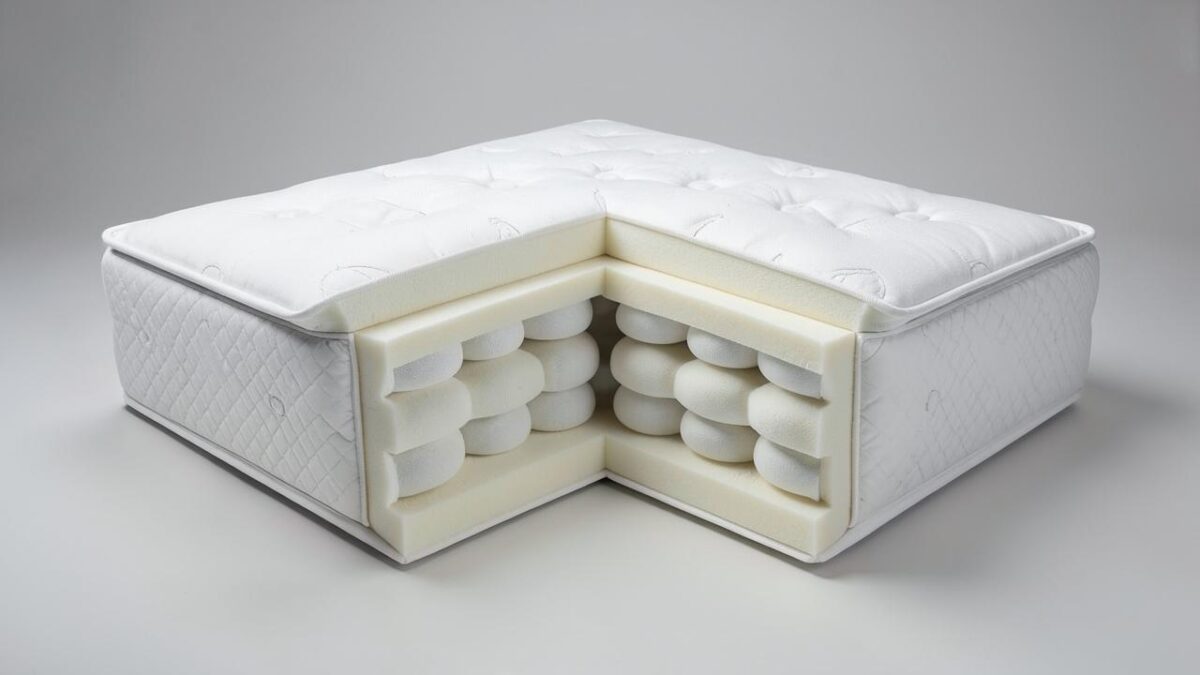
A one-inch layer bottoms into the layer below sooner than a three-inch layer. Covers, quilting, temperature-sensitive memory foam, body weight and the support core all alter perceived feel. IFD belongs to a layer, not automatically to the finished mattress.
IFD versus support
A softer top can relieve pressure while a progressively firmer transition layer and support core maintain alignment. Support is the system’s response through depth, not simply the highest IFD number in the stack.
How to compare published figures
Compare values only when the foam family and test conditions are reasonably alike. When a secondary source’s IFD conflicts with the manufacturer stack, Yawnder keeps both assertions and identifies the conflict.
Related construction guides
For short definitions, use the Yawnder sleep glossary. For measured performance, see how we test and score mattresses.
Frequently asked questions
Are ILD and IFD the same?
They are commonly used for the same indentation concept, but published methods and units can differ. Read the test details before comparing.
What ILD is medium firm?
There is no universal whole-mattress conversion. Layer thickness, material and the layers below change the finished feel.
Does higher IFD mean better quality?
No. It means greater force under a specified indentation test. Density, fatigue resistance and formulation are separate properties.
Can I compare latex ILD with polyfoam IFD?
Only cautiously. Different materials, sample thicknesses and test protocols can make a direct number-to-number comparison misleading.