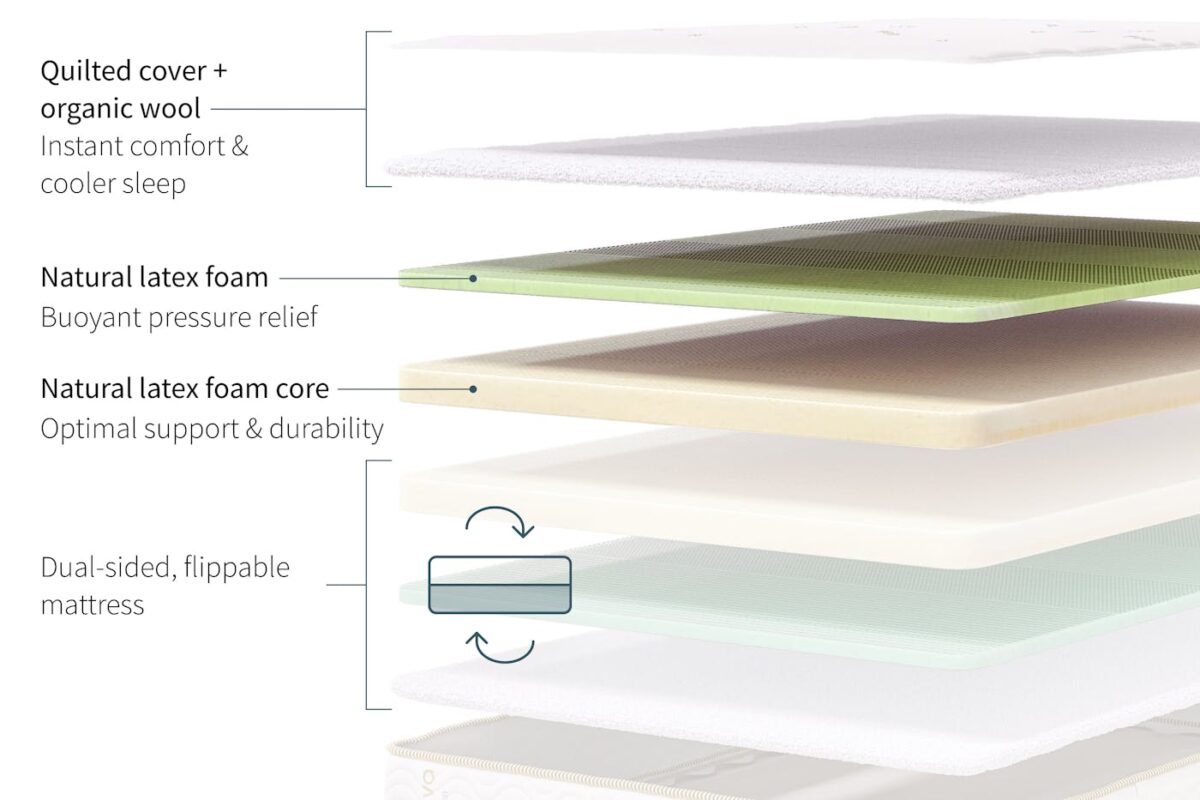
Talalay vs Dunlop Latex: What Changes in a Mattress
Compare Talalay and Dunlop latex processing, feel, consistency, weight and the mattress layers where each tends to work best.
Talalay and Dunlop are manufacturing processes, not firmness grades or certifications. Either process can use natural or synthetic latex blends, and either can be produced in multiple firmnesses. The process changes cell structure and consistency more reliably than it predicts whether you will like the bed.
| Feature | Dunlop | Talalay |
|---|---|---|
| Process | Poured and cured in the mold | Vacuum-expanded, frozen, then cured |
| Typical feel | Dense, grounded, progressively supportive | Lively, buoyant, more uniform |
| Common role | Support and comfort layers | Comfort and pressure-relief layers |
| Weight/cost | Usually heavier and less costly | Usually lighter and more costly |
How the processes differ
Dunlop latex is mixed, poured and cured; particles can settle before curing, creating a denser lower portion. Talalay uses vacuum expansion and freezing before vulcanization to stabilize a more uniform cell structure.
What process does not tell you
Process alone does not reveal natural-rubber percentage, firmness, thickness, certification or durability. Look for blend disclosure, ILD when comparable, layer thickness and certifications such as GOLS where an organic claim is made.
Where each works
Dunlop’s denser response often suits support cores and sleepers who want less surface bounce. Talalay’s uniform, buoyant response often suits comfort layers. These are tendencies; formulation and firmness can reverse a simple stereotype.
How to choose
Choose by the full stack and your pressure-relief needs, not by process prestige. A well-designed Dunlop comfort layer can be plush, and a firm Talalay layer can be highly supportive.
Related construction guides
For short definitions, use the Yawnder sleep glossary. For measured performance, see how we test and score mattresses.
Frequently asked questions
Is Talalay latex natural?
It can be natural or blended. Talalay names the process, not the rubber content.
Is Dunlop always firmer?
No. Dunlop often feels denser, but both processes are made in multiple firmnesses.
Which latex lasts longer?
Both can be durable. Formulation, layer use, load and manufacturing quality matter, so process alone is not a lifespan guarantee.
Which sleeps cooler?
Both are open-cell and responsive compared with slow memory foam. Perforation, cover, layer thickness and the rest of the bed affect temperature.
Sources and standards
Compare both beds against 142 tested mattresses
Sort all 142 mattresses we have tested by pressure relief, support, cooling, motion isolation, edge support, price, trial and warranty, then filter by how you actually sleep. Of those, 86 hold a complete standardized record and 41 a partial standardized record.