Sleep Number i10 Review: Discontinued Model Guide
Quick verdict
The i10 was a premium adjustable-air smart bed built around dual-side firmness control, a thick comfort package and SleepIQ tracking. Its adjustability can still be useful, but a used i10 comes with meaningful risks: uncertain component age, uncertain warranty coverage, expensive proprietary replacement parts and no current-model trial.
Our advice: current shoppers should start with Sleep Number’s current ComfortNext range or compare another adjustable-air bed. Existing i10 owners can use this guide to understand the design and the questions to ask before repairing or replacing one.
What the Sleep Number i10 was
The i10 sat near the top of Sleep Number’s Innovation-series lineup. Unlike a conventional foam or hybrid mattress, its support came from adjustable air chambers. Each sleeper could change the firmness setting on their side, while foam layers above the chambers supplied most of the surface cushioning.
| Product status | Discontinued legacy model |
|---|---|
| Support system | Adjustable air chambers; dual-side control on compatible two-person sizes |
| Comfort system | Thick foam comfort package; exact materials and specifications varied by production year |
| Smart features | SleepIQ-era tracking and compatible controls, depending on the bed’s hardware and account setup |
| Current equivalent | Sleep Number ComfortNext Ultra is the closest place to begin in the 2026 lineup, although it is not a part-for-part replacement |
| Yawnder score | Not scored under the current test protocol |
How the i10 feels and adjusts
The defining feature is adjustable support rather than a single fixed firmness. Lower settings allow more sink; higher settings increase air pressure and create a firmer, more buoyant surface. The thick comfort stack softens the feel compared with thinner Sleep Number models, but it can also make changes in the air setting feel less immediate.
Couples were the clearest audience because each side could be adjusted independently. That does not eliminate every tradeoff: the center transition can feel different from a one-piece conventional mattress, and the bed relies on pumps, hoses, sensors and controls that can require service as they age.
What still appeals
- Independent firmness adjustment for couples
- Substantial surface cushioning for an air bed
- Ability to change support as preferences or needs change
- Sleep tracking for compatible, functioning systems
Important drawbacks
- Discontinued hardware and model-specific parts
- Used beds do not come with a new-bed trial
- Warranty coverage depends on the original purchase and documentation
- Foam, pumps and sensors may have very different remaining life
Who should consider an i10 now?
Reasonable fit
- Current owners deciding whether a repair makes sense
- Experienced Sleep Number users who understand the system
- Secondhand buyers who can inspect, inflate and operate both sides before paying
Better to skip
- Anyone expecting current warranty or return protection
- Buyers who want simple, non-proprietary construction
- Shoppers unable to verify the pump, remote, hoses and SleepIQ connectivity
Buying a used Sleep Number i10
Do not judge a used i10 only by appearance. Inflate each chamber separately, leave it under load and confirm that it holds its setting. Test every pump port, remote or app control, sensor and adjustable-base function included in the sale. Ask for the original law tag, serial information and purchase paperwork.
Historical retail pricing varied by size, base, delivery and promotion. It should not be used as today’s value benchmark. Price a used bed around its age, verified operation, included base and the cost of any parts you may soon need.
Trial, warranty and service
The terms attached to a legacy i10 are the terms from its original purchase—not necessarily the policies advertised for Sleep Number’s current beds. Coverage may also depend on the original purchaser and proof of purchase. Before buying used, contact Sleep Number with the serial information and ask which components, if any, remain eligible for service.
What replaced the i10?
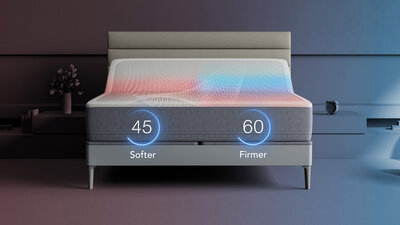
The ComfortNext Ultra is the most direct starting point for someone who liked the i10’s premium positioning and adjustable support. Sleep Number’s lineup and policies have changed, so compare the current models on their own specifications rather than treating a newer name as an identical replacement.
Compare current Sleep Number beds
Alternatives worth comparing
Sleep Number ComfortNext
Best starting point if independent air adjustment and the Sleep Number ecosystem are the priorities.
Saatva Solaire
A current adjustable-air alternative for shoppers who want to compare feel, service and ownership terms outside Sleep Number.
Final verdict
The Sleep Number i10 is best understood as a capable but aging smart bed, not a current $5,799 recommendation. Owners who still like the feel may find repair worthwhile after verifying the cost. New shoppers and most used-bed buyers will be better served by a current model with documented policies, service support and a fresh trial.
Sleep Number i10 FAQ
Is the Sleep Number i10 still sold?
No. It is a discontinued legacy model and is not part of Sleep Number’s current lineup.
What is the current replacement for the i10?
The ComfortNext Ultra is the closest starting point in Sleep Number’s current premium range, but it is not identical to the i10.
Is a used i10 covered by warranty?
Do not assume it is. Coverage depends on the original purchase terms, purchaser status, documentation and component. Verify the serial information directly with Sleep Number.
Does Yawnder give the i10 a current score?
No. We have not retested this discontinued model under our current standardized scoring method.
What should I test before buying one used?
Test both air chambers, pump ports, hoses, controls, sensors and any included adjustable base. Confirm that each side holds its setting and price in the risk of future proprietary parts.