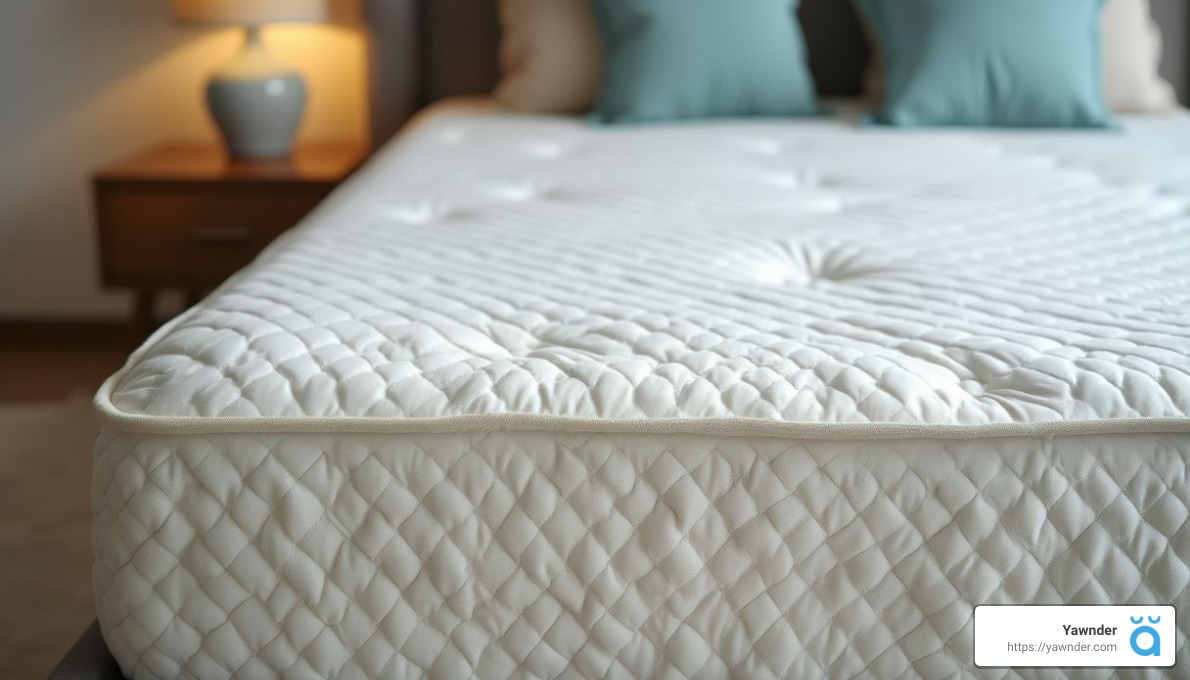
Something is wrong with your mattress—but that does not automatically mean you need a new one. The useful first step is identifying whether the problem is comfort, support, temperature, motion, the foundation, normal break-in, or actual wear. This guide routes you to the right diagnosis and the detailed Yawnder guide for fixing it.
Start here: what is your mattress doing wrong?
| What you notice | Likely issue to investigate first | Next step |
|---|---|---|
| Shoulder or hip pressure, numb arm, frequent repositioning | Surface may be too firm for your weight or sleep position | Mattress too firm: signs and fixes |
| Hips sink too deeply, hammock feeling, hard to turn over | Mattress may be too soft or the support underneath may be flexing | Mattress too soft: how to fix it |
| Visible dip or trough where you sleep | Body impression, sagging, or foundation failure | Measure mattress sagging correctly |
| Mattress feels softer in one area than another | Uneven wear | Should you rotate or flip your mattress? |
| Bed feels unsupported or sinks between slats | Foundation/slat spacing problem | Check mattress slat spacing |
| You wake with shoulder pain, especially on your side | Pressure relief and pillow/mattress interaction | Mattresses for shoulder pressure |
| You wake with lower-back discomfort | Alignment, firmness, sleep position, or an unrelated health issue | Mattress fit for lower-back comfort |
| You constantly toss and turn | Pressure, heat, restricted movement, or poor fit | Mattresses for people who toss and turn |
| You and your partner overheat | Heat retention from mattress, protector, bedding, room, or two sleepers sharing one surface | Cooling mattresses for couples |
| You and your partner need very different feels | One shared firmness may be the wrong compromise | Different firmness preferences |
1. My mattress is too firm
A mattress that is too firm usually announces itself through pressure. Side sleepers often notice it first at the shoulder and hip. A lighter sleeper may barely compress a mattress that feels perfectly comfortable to a heavier sleeper.
Do not immediately assume a new mattress is defective. New foams and covers can relax somewhat during the initial break-in period, but break-in will not transform a fundamentally wrong mattress into a completely different firmness. Check your trial rules before waiting too long. A topper can add surface cushioning when the underlying support is sound. Read the full mattress-too-firm troubleshooting guide.
2. My mattress is too soft
“Too soft” can mean two very different things: the mattress is uniformly softer than your body needs, or one area has lost support. Before buying anything, inspect the foundation. Bowed slats, excessive gaps, a weak center support, or an aging base can make a good mattress feel much softer than it should.
If the surface is flat but you sink too deeply everywhere, firmness may simply be a poor match. If there is a localized trough, skip the topper experiment and investigate sagging or wear. Use our too-soft decision guide.
3. My mattress is sagging
A visible depression is not the same thing as “this bed feels soft.” Strip the bedding, place a straight edge across the surface without anyone on the bed, and measure the deepest gap. Mattress warranties use specific indentation thresholds, so an actual measurement is more useful than a photograph that only shows rumpled bedding.
Also inspect the support underneath before blaming the mattress. Our sagging measurement guide walks through the process, while the foundation and slat-spacing guide helps rule out the base.
4. My new mattress hurts
First identify where you feel discomfort and when it happens. Pressure concentrated at the shoulder and hip often points toward insufficient surface give for a side sleeper. Excessive sinking through the pelvis can point toward insufficient support. Pillow height can also change neck and shoulder alignment enough to make a mattress seem like the culprit.
A mattress is not medical treatment. Persistent, severe, worsening, injury-related, or unexplained pain deserves medical evaluation rather than endless mattress experimentation. For mattress fit, start with our guides to shoulder pressure, shoulder and hip pressure, and lower-back mattress fit.
5. I sleep hot
Do not judge temperature by the mattress cover alone. Heat can come from thick foam around the body, a waterproof protector, low-airflow bedding, the room itself, or simply two people sharing the same sleep surface. Hybrid and innerspring designs generally provide more open space for airflow through the support core than solid foam, but the comfort layers and bedding still matter.
For couples, see our cooling mattress guide for couples. If one partner runs hot and the other cold, consider solving the temperature mismatch with separate bedding or per-side climate control rather than making the entire mattress aggressively cool.
6. My partner wakes me up
Partner disturbance can come from the mattress, frame, shared bedding, or the difference in how two bodies load the bed. Motion isolation matters, but so does edge support: a weak perimeter pushes both sleepers toward the center and reduces usable space. If the two of you also need different firmness or support, the problem may be configuration rather than motion alone.
Start with the different sleep-position guide, the different body-weight guide, or our Split King vs. split-firmness comparison.
7. I cannot turn over easily
Deep contouring can be comfortable until you need to change position. Combination sleepers and people who reposition frequently should pay attention to responsiveness as well as pressure relief. The goal is not maximum bounce; it is enough recovery that you do not feel trapped in an impression.
See our guide for tossing and turning for mattresses evaluated around easier repositioning.
8. The edge collapses when I sit on it
Weak edge support matters more than appearance. It can reduce usable sleeping width for couples and make sitting down or pushing up from bed less stable. Reinforced perimeter coils, firmer foam rails, and the overall support design all affect edge behavior. If getting in and out of bed is the main problem, compare mattresses on edge support and responsiveness—not just their advertised firmness.
Our mattress guide for seniors and older adults weights edge support heavily for exactly this reason.
9. Should I return the mattress?
Return or exchange becomes the sensible path when you have ruled out an incorrect foundation, given a new mattress the required adjustment period, tried inexpensive reversible fixes where appropriate, and the mattress still fails your basic support or pressure-relief needs. Do not spend hundreds of dollars stacking toppers onto a mattress you already know is wrong while an active trial is available.
Trial and return terms vary by seller and purchase channel. If you bought through Yawnder, use the policy that applies to your Yawnder order rather than assuming a manufacturer’s direct-to-consumer policy applies.
10. Do I actually need a new mattress?
Replace the mattress when the problem is structural and cannot reasonably be corrected by the foundation, rotation, bedding, or a modest comfort adjustment. If the mattress is still structurally sound, solve the specific problem before replacing it. That approach is cheaper and usually produces a better diagnosis for the next bed.
Use Yawnder’s test data instead of guessing
Once you know the problem, compare mattresses on the metric that actually addresses it: pressure relief, spinal alignment, cooling, motion isolation, responsiveness, or edge support. Yawnder’s mattress comparison system lets you compare tested mattresses side by side instead of treating every shopper as if they need the same generic “medium-firm” bed.
Browse all mattress buying guides →
Frequently asked questions
How can I tell if my mattress is too firm or too soft?
Too-firm complaints more often center on concentrated pressure at the shoulder, hip, or other contact points. Too-soft complaints more often involve excessive sinking, difficulty changing position, or poor alignment. A damaged or flexible foundation can mimic a too-soft mattress, so inspect the support underneath before replacing the bed.
Can a mattress topper fix a bad mattress?
A topper can change surface feel when the mattress underneath is structurally sound. It cannot restore a failed support core or permanently remove a deep sag.
How do I know whether the mattress or foundation is the problem?
Inspect for broken or bowed slats, excessive slat spacing, missing center support, and flex in the base. Follow the mattress manufacturer’s foundation requirements because they vary by construction and warranty.
Should a couple buy a Split King if they cannot agree on a mattress?
Not automatically. If the mismatch is modest, one well-chosen shared mattress may work. A Split King becomes more useful when the sleepers need meaningfully different firmness, support, or adjustable-base positions. Split firmness can preserve one continuous mattress surface when independent articulation is not required.