Google Fitbit Air Review (2026): $99 Screenless Sleep Tracker
Google Fitbit Air Review
A $99.99 screenless tracker with a week-long battery, automatic sleep tracking and no glowing smartwatch display on your wrist.
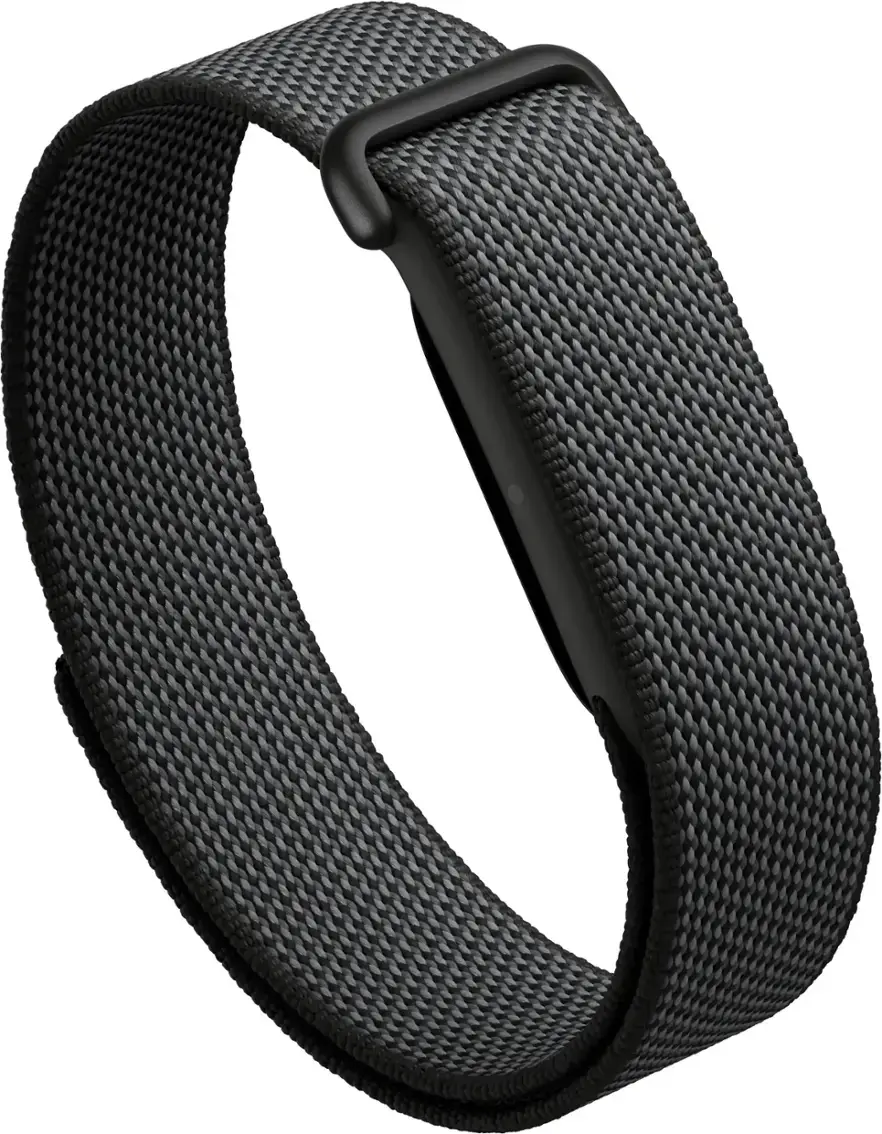
Fitbit Air quick facts
| Price | $99.99 standard model |
|---|---|
| Display | None — intentionally screenless |
| Battery | Up to 7 days; 5-minute quick charge provides about one day |
| Tracker weight | 5.2 g without the band; about 12 g with band |
| Sleep data | Automatic sleep detection, duration, stages and Sleep Score |
| Other sensors | Optical heart rate, accelerometer/gyroscope, red/infrared SpO2 sensors, device temperature sensor |
| Water resistance | 5 ATM / up to 50 m per Google specifications |
| Phones | Android 11+ and iOS 16.4+ through the Google Health app |
| Premium | 3-month trial included; Google Health Premium starts at $9.99/month or $99/year |
Why the screenless design matters for sleep
Fitbit Air behaves more like a sensor band than a smartwatch. There is no display for notifications, apps or late-night checking. Your data lives in the Google Health app on your phone, and the tracker is meant to disappear on your wrist.
That makes the product especially compelling for people who like the idea of sleep tracking but dislike wearing a full Apple Watch or Pixel Watch overnight. The small sensor unit weighs only 5.2 grams before the band, and Google designed the micro-adjustable strap for 24/7 wear.
What you get without Premium
Included with the tracker
Automatic sleep detection, sleep duration, sleep stages, Sleep Score, heart-rate trends and core activity/recovery data in Google Health.
Google Health Premium
Personalized Google Health Coach guidance, including Gemini-powered sleep and fitness coaching. Current U.S. pricing starts at $9.99/month or $99/year after the included trial.
Announced future features
Do not buy Fitbit Air today because of a feature Google labels “coming soon.” We only count functions that are actually available in the current experience.
Sleep Score and sleep stages
Fitbit Air automatically detects sleep when worn to bed. Because it has heart-rate tracking, the Google Health app can estimate sleep stages and calculate a daily Sleep Score. The useful way to read those numbers is as a trend: bedtime consistency, total sleep, interruptions and how your own score changes over time.
The stage breakdown is still an algorithmic estimate. A wrist tracker does not directly measure brain waves, so it should not be treated like a clinical sleep study.
Battery life is a real advantage
Google rates Fitbit Air for up to seven days per charge, with actual life depending on enabled features and use. Fast charging adds roughly a day of battery in five minutes. That is a meaningful sleep-tracking advantage over watches that require near-daily charging: fewer charging gaps means fewer missing nights.
Fitbit Air vs Oura Ring 5
These are both low-distraction sleep trackers, but they attack the problem differently. Oura Ring 5 is smaller on the body and puts the sensors on your finger; Fitbit Air is a soft screenless wrist band. Oura starts at $399 plus membership for its full experience. Fitbit Air starts at $99.99 and exposes core sleep metrics without requiring Premium.
Choose Oura if a ring is more comfortable for you and you want Oura’s mature sleep/recovery ecosystem. Choose Fitbit Air if price matters, you prefer a band, or you want to try passive sleep tracking without a $400 hardware commitment.
Fitbit Air vs WHOOP 5.0
For the full membership breakdown, see our WHOOP 5.0 review.
WHOOP 5.0 is the more training-focused platform with 14+ day battery life, but the hardware experience is tied to an annual membership. Fitbit Air is substantially cheaper to enter and can function as a basic sleep-and-fitness tracker without subscribing to the coaching tier.
Fitbit Air vs Apple Watch Series 12
We cover Apple’s current Sleep Score, Readiness and battery tradeoffs in our Series 12 sleep review.
Apple Watch Series 12 is the better all-purpose wearable if you want a display, apps, notifications and a broad smartwatch feature set. Fitbit Air is the opposite: no screen, much longer battery life and a lower price. For sleep-only use, that simplicity is a feature rather than a missing feature.
Who should buy Fitbit Air?
Start with the full comparison: Best Sleep Trackers 2026.
More Yawnder tracker guides
Bottom line: Fitbit Air succeeds because it is not trying to be another smartwatch. At $99.99, with up to a week of battery and core sleep metrics available without Premium, it is a strong entry point for someone who wants passive sleep tracking with minimal distraction.