Short answer: For a twin mattress, I would start the shopping process with a planning budget of roughly $250–$500 for a basic everyday mattress and $500–$900 for a more substantial foam or hybrid option. That isn’t a published market average or a promise about today’s sale prices; it is a practical way to filter the enormous range of choices. You can spend less for occasional use, or substantially more for premium materials, but comfort, support, and return terms matter more than the sticker price.
At Yawnder, I see a lot of people comparing mattresses by brand name or by whatever percentage-off promotion is flashing on the screen. I would rather compare the actual delivered price for the same size, what is inside the bed, and what happens if it doesn’t work out. Here’s how I would shop a twin mattress in 2026. — Ben Trapskin, Yawnder
Twin mattress price: quick budget breakdown
| Planning budget (twin) | What to expect | The catch to investigate |
|---|---|---|
| Under $250 | Basic foam and occasional-use choices | Check support, thickness, fire barrier, seller and return policy closely |
| $250–$500 | Entry-level everyday foam and some budget hybrids | Materials and durability can vary widely even at similar prices |
| $500–$900 | Broader hybrid choices and more substantial comfort systems | Focus on pressure relief and usable support, not marketed layer count |
| $900–$1,400 | More premium construction, latex options and enhanced covers | Ask what the additional price improves for this sleeper |
| $1,400+ | Specialty materials and luxury models | Higher price is not proof of better comfort or longer life |
Important: These are shopping-budget brackets, not a statistically sampled list of current twin prices. Manufacturers change promotions frequently, and some models aren’t made in twin at all. For live model comparisons, visit Yawnder’s mattress comparison tool; for the broader Queen-price framework, see the mattress price guide.
Twin vs Twin XL: the five inches that can change your decision
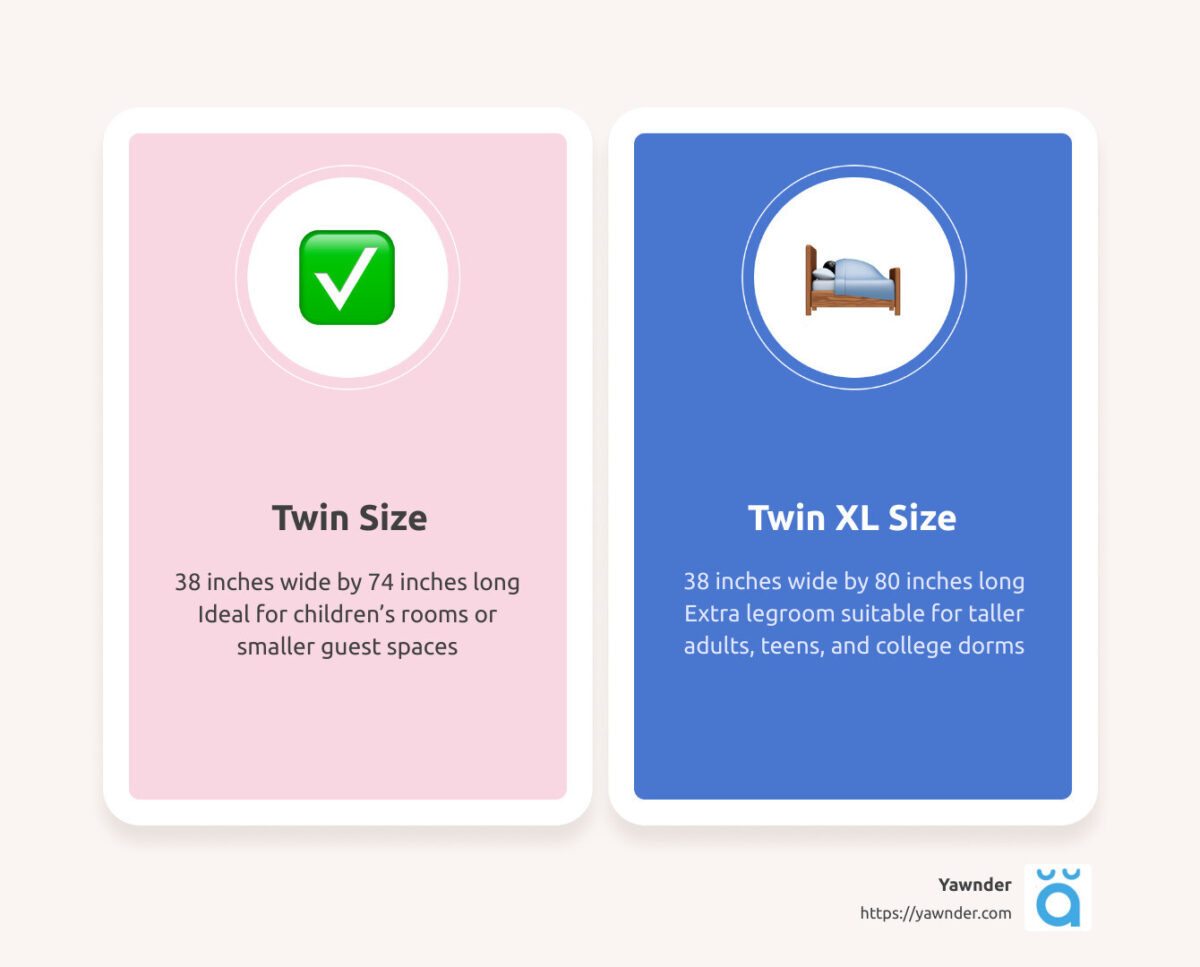
A standard U.S. twin is approximately 38 inches wide by 75 inches long. A twin XL is about 38 by 80 inches. Manufacturers can vary slightly, so verify the exact dimensions of the mattress and bed frame. The difference isn’t the width—both are narrow single-sleeper beds—but length, fit and sometimes the availability of sheets or frames.
- Choose twin for most children, smaller guest rooms, daybeds and situations where every inch of floor space counts.
- Choose twin XL for a taller teenager or adult, or when a college dorm specifically provides a twin XL frame.
- For bunk beds, check the frame manufacturer’s maximum mattress thickness and guardrail clearance; the cheapest thick mattress is not a bargain if it creates a safety problem.
- For adjustable bases, confirm the exact size the base accepts instead of assuming any single-bed mattress will fit.
Read the full twin vs twin XL guide before buying. If you’re shopping for school, the college mattress guide covers whether students should replace a dorm mattress at all.
Why two twin mattresses can cost hundreds of dollars apart
Comfort layers and material quality
A thin slab of basic foam and a multi-layer hybrid can both carry the word “twin” in their product title, but they won’t feel or perform the same way. You are buying the combination of cushioning, support and materials—not just dimensions. Ask whether the foam density and layer arrangement are disclosed, whether the top feels comfortable in your actual sleep position, and whether the support core keeps your torso from sinking too deeply.
Foam versus hybrid versus latex
Foam can keep a twin affordable and is easy to move; lower-cost foam can also vary significantly in support and longevity. A hybrid combines coils with comfort layers, often creating a more responsive feel and stronger edge structure. Latex tends to feel springier than slow-response memory foam and may carry a higher material cost. No material wins for everyone; choose around body size, comfort preference and intended years of use.
A sale tag is not a specification
A claimed 60% discount doesn’t establish value. Compare the price of the same size and construction across reputable sellers, consider shipping and delivery, and read the terms for returns. An unusually low advertised price may depend on an accessory bundle, a particular firmness, or the smallest size.
The full cost: mattress, frame, sheets, delivery and returns
| Possible cost | What to check before checkout |
|---|---|
| Foundation or bed frame | Is a new foundation required? Will the existing slats meet the warranty rules? |
| Sheets and protector | Twin XL sheets are not interchangeable with standard twin fitted sheets |
| Delivery and removal | Is room-of-choice delivery included? What happens to the old mattress? |
| Return expenses | Trial minimums, pickup or restocking fees, and non-returnable accessories |
| Warranty | The indentation threshold, support-base requirements and who pays freight |
An inexpensive mattress that needs a new foundation, specialty bedding and a paid pickup may cost more than a slightly pricier model with what you already own. This is why I recommend comparing out-the-door cost and not just the mattress line item. For an explanation of the difference between changing your mind and a defect, read sleep trials vs warranties.
What I would buy for each type of sleeper
- Child moving out of a crib or toddler bed: verify safety, comfort and materials first. Look for a size that works with the existing frame; a high luxury price makes little sense if the bed will soon be changed.
- Growing teenager: twin XL is worth considering if height may become an issue. A supportive, comfortable medium-feel option is a reasonable starting point, subject to the teenager’s preferences.
- College student: measure the dorm bed and check housing rules before purchasing. A topper and protector may be the right investment if the residence provides its own mattress.
- Guest room: medium-ish comfort that accommodates several sleeping positions is often more versatile than an extreme soft or extreme firm feel.
- Adult sleeping on a twin every night: put more weight on pressure relief, adequate mattress length and long-term fit than on the lowest possible cost.
How to evaluate a twin mattress in 15 minutes
- Lie in your usual sleep position for several minutes, not just a quick sit test.
- Notice shoulder and hip pressure on your side and lower-back support on your back.
- Roll over a few times. If moving is hard or the bed feels jarring, compare a different feel.
- Sit and lie near the edges if you’ll use the full narrow surface.
- Ask for trial terms in writing and check whether the exact twin size has the same policy as a Queen.
- Take a photo of the law tag or product model name so you can compare the exact construction later.
If you’re local to San Diego, you can try multiple styles side-by-side at Yawnder’s Encinitas showroom. You don’t need to purchase on the spot. Getting a feel for your ideal firmness can prevent a lot of expensive guesswork.
Twin mattress FAQs
Is a $200 twin mattress good enough?
It can be reasonable for infrequent use, but I would inspect the retailer, materials, bed-frame compatibility and return conditions particularly carefully. I wouldn’t assume a low-cost mattress will offer the support or durability an adult using it nightly needs.
How much more does twin XL cost?
There isn’t one reliable fixed difference across brands. Some brands price the two sizes similarly; others charge more for twin XL. Compare the same model and firmness in both sizes, and include the cost of longer sheets and frame fit.
Does a higher price mean a twin mattress lasts longer?
Not necessarily. Materials, construction, use, body weight and the foundation matter. A warranty is not a guaranteed comfortable lifespan, and brand price tiers aren’t laboratory durability data.
Should I buy twin or full?
Twin uses much less room and works for one sleeper; full adds width for someone who likes to spread out. Standard full is usually 75 inches long, so a tall adult might still prefer a twin XL or Queen. See the best twin mattress guide for specific models.
Bottom line
Start with the sleeper, the room and the foundation, then set a realistic budget. If you’re buying a twin for nightly use, paying for a comfortable, appropriately supportive mattress is worthwhile. But don’t let a luxury price tag or an exaggerated discount make the decision for you. Compare size-for-size, test the feel when possible, and know the return rules before you buy.
Editorial note: This article is buying guidance, not a laboratory price survey. Budget ranges are indicative planning tiers, not live retailer quotes; mattress dimensions may vary by manufacturer. Yawnder sells mattresses and may earn commissions on qualifying product links in related reviews. Last updated October 21, 2026.