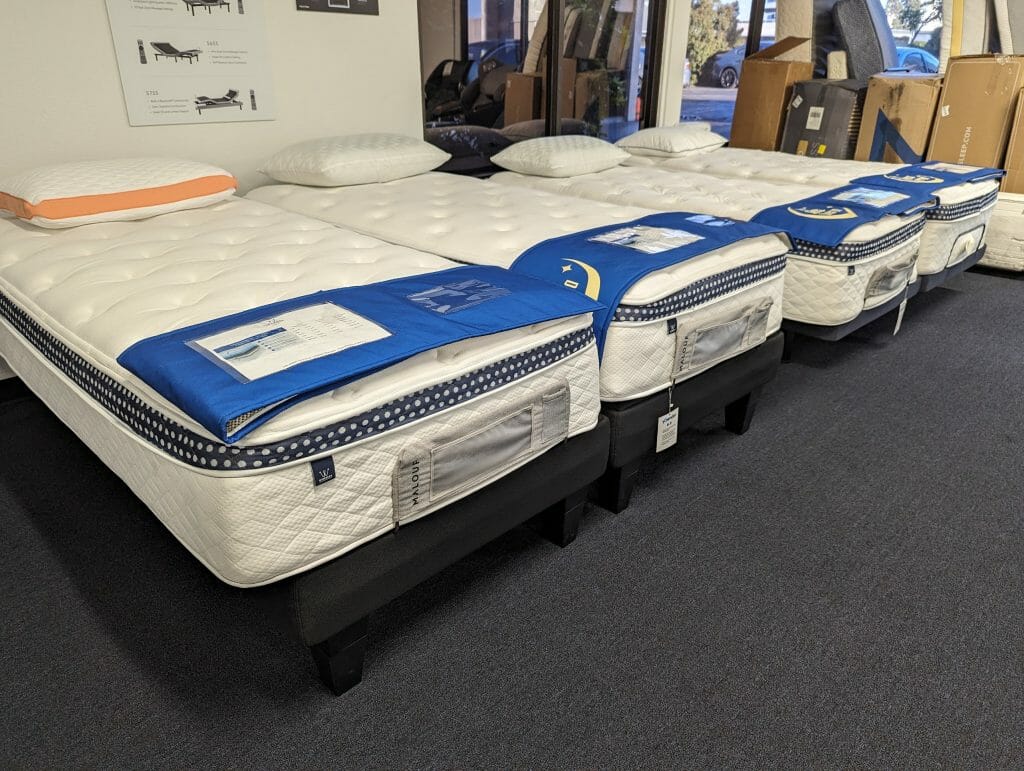
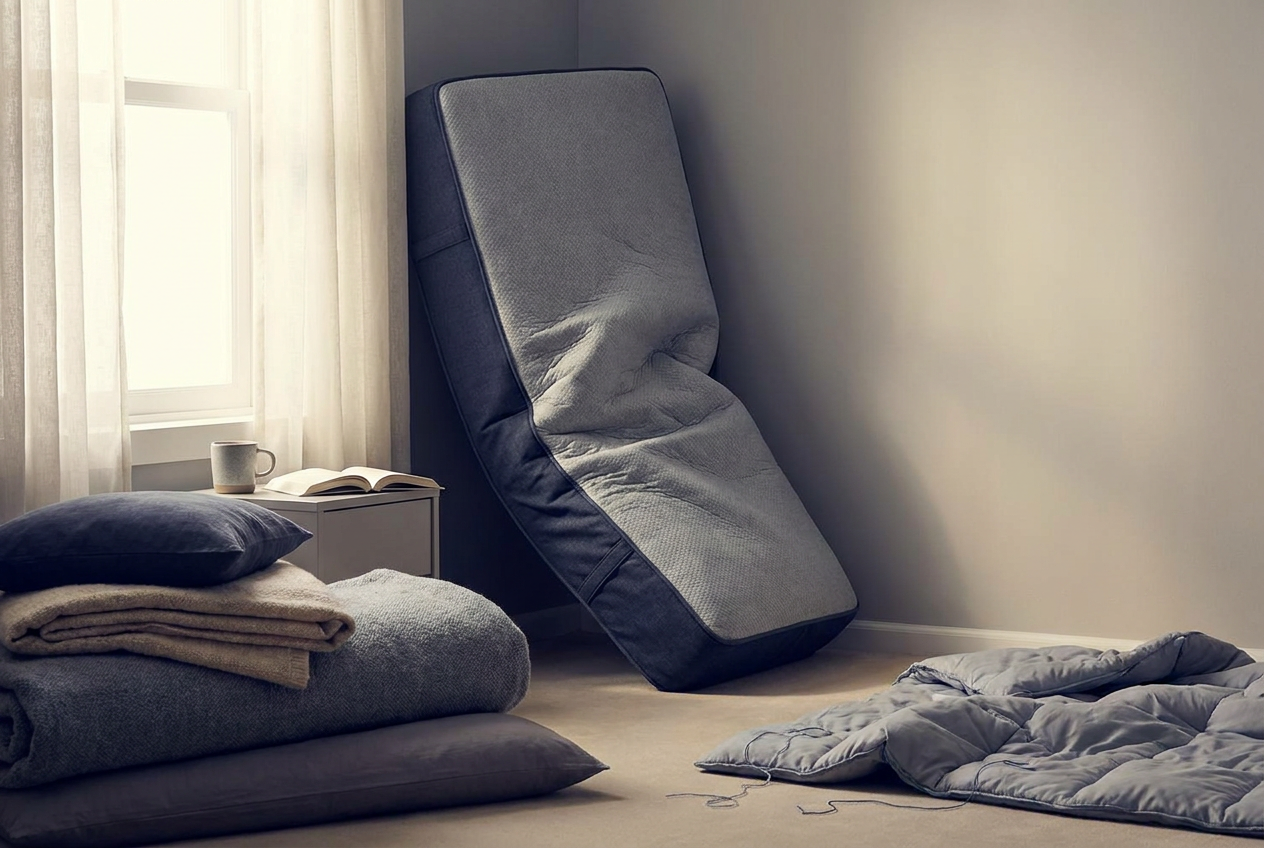
You’re renovating the guest room, your college student is home for the summer, or maybe you’re in the middle of a move. Whatever the reason, you’re faced with a common conundrum: what do you do with that spare mattress? The most convenient spot seems obvious. You eye that empty stretch of wall in the garage or spare room and think, “I’ll just lean it up there for a little while.” It seems harmless enough. But as sleep experts who have seen the unfortunate aftermath of this decision, we’re here to tell you that this simple act can cause irreversible damage to your mattress, potentially costing you hundreds or even thousands of dollars. Storing a mattress is a science, and how you do it—even for a week—determines whether it remains a comfortable bed or becomes a lumpy, unsupportive liability.
Why Your Mattress Hates Being Stored Vertically
To understand why standing a mattress on its side is a bad idea, you first need to understand what’s inside it. Think of a traditional innerspring or a modern hybrid mattress. These beds, which make up a significant portion of the market from brands like Sealy, Serta, and Simmons, are complex systems designed to provide targeted support while you lie flat. The core of this system is an intricate network of steel coils. Each coil is engineered to compress vertically under the weight of your body and spring back into shape. The entire structure—from the supportive base layer to the plush comfort layers on top—is built to function under one non-negotiable condition: a horizontal orientation.
When you stand a mattress on its side or end, you introduce a force it was never designed to handle: gravity pulling its components sideways. Here’s what happens:
- Coil Distortion and Migration: The heavy network of steel coils, no longer supported from below, begins to sag and shift downward. This can cause individual springs to bend, warp, or become permanently compressed. The fabric pockets that hold individual coils in a hybrid mattress can stretch or tear, allowing the coils to migrate from their designated zones.
- Layer Delamination: A mattress is not a single block; it’s a carefully layered sandwich of materials. You have the coil system, followed by various layers of foam, latex, batting, and fabric. Gravity can cause these layers to separate or “delaminate.” The adhesive holding them together can fail, and the foams can stretch and pull away from the spring unit.
- Permanent Lumps and Sags: The result of this internal chaos is a damaged sleeping surface. When you eventually lay the mattress flat again, the coils may not spring back correctly, and the comfort layers may be bunched up in the area that was at the bottom. This creates permanent lumps, valleys, and an uneven surface that utterly fails at providing proper spinal alignment. The mattress will feel less supportive and profoundly uncomfortable. Essentially, you’ve created a permanent sag before you’ve even slept on it.
This isn’t a minor issue. For a high-quality hybrid mattress, the kind we specialize in at Yawnder to give San Diego residents the best of both support and comfort, this type of damage is catastrophic and is never covered by a manufacturer’s warranty. Warranties cover manufacturing defects, not damage from improper use or storage.
The Foam Exception: A Temporary Reprieve
So, are all mattresses doomed if they’re not stored flat? Not necessarily. There is one major exception: all-foam mattresses. Beds made entirely of memory foam, polyurethane foam, or latex foam—like those from brands such as Tempur-Pedic or Casper—don’t have a coil system. This is a significant advantage when it comes to temporary storage.
Without the heavy, rigid structure of an innerspring unit, there are no coils to bend or migrate. The foam is more structurally homogenous, meaning gravity won’t cause the same kind of internal separation and damage. For this reason, you can store an all-foam mattress on its side against a wall for a very short period without catastrophic failure. However, this is not a permanent green light. Foam is still susceptible to long-term compression and distortion. If left on its side for months, the foam cells can begin to set in a compressed state, potentially creating a crease or a softer, less supportive section along the edge that was bearing the weight. Our official recommendation is to limit vertical storage of any foam mattress to a maximum of one to two weeks.
The Proper Protocol for Short-Term Mattress Storage
Whether you have a hybrid or an all-foam mattress, if you absolutely must store it for a short time, following the right procedure is non-negotiable. This is about protecting your investment and ensuring your bed is ready for a great night’s sleep when you need it again.
Protect Your Investment: Use a Mattress Bag
First and foremost, never store a mattress “naked.” A mattress is like a giant sponge for dust, allergens, moisture, and odors. Before moving or storing it, encase it in a heavy-duty, sealable plastic mattress bag. These are inexpensive and available at moving supply stores. A proper bag protects your bed from scuffs, dirt, moisture (which leads to mold), and even pests. Ensure you seal the bag completely with packing tape to create an airtight environment.
Location, Location, Location: Keep It Climate-Controlled
The single biggest enemy to a stored mattress aside from gravity is moisture. Storing a mattress in a damp basement, a humid garage, or a sweltering attic is a recipe for disaster. Moisture gets trapped inside the mattress, creating a breeding ground for mold and mildew. Once mildew takes hold, it’s nearly impossible to remove and will ruin the mattress. Always store your mattress in a dry, climate-controlled space, just like any other piece of fine furniture.
The Vertical vs. Horizontal Debate
As we’ve established, laying the mattress completely flat is the gold standard. This is the only way to guarantee zero stress on its internal components. Slide it under another bed or lay it down on a clean, dry floor in a spare room. If you absolutely must store it vertically (and only if it’s an all-foam mattress for less than two weeks), do so on its long side, not on the shorter top or bottom end. This distributes the weight over a larger area. Make sure it stands perfectly straight, supported evenly along its length to prevent bowing.
An ounce of prevention is worth a pound of cure, especially when that “cure” is being forced to buy a new mattress because your old one was stored improperly for just a few weeks.
Long-Term Storage and Smarter Alternatives
If your storage needs extend beyond a couple of weeks, vertical storage is completely off the table for any type of mattress. For storage lasting a month or more, you must find a way to lay the mattress flat.
What is “Long-Term”?
Anything more than two weeks should be considered long-term. Beyond this point, the risk of permanent compression in foam and gravitational damage in hybrids increases dramatically with each passing day.
Better Storage Solutions
If you don’t have the floor space to lay a mattress flat, get creative. The goal is to provide a flat, even, and supportive surface.
- Use a Storage Unit: The best option is to rent a climate-controlled storage unit where the mattress can lie flat on the floor (on top of a plastic sheet for extra protection).
- Create a Platform: Lay the mattress flat on top of a series of sturdy, evenly-spaced boxes of the same height. This keeps it off the floor while maintaining a flat profile.
- Spare Bed Frame: Disassemble a spare bed frame and lay the slats or foundation directly on the floor of the storage room, then place the mattress on top.
Your mattress is one of the most important pieces of furniture you own, directly impacting your health and well-being every single night. Treating it with care, even when it’s not in use, protects its ability to provide you with restorative sleep for years to come. If you find your old mattress has been damaged by poor storage or you’re simply ready to invest in a better night’s sleep, our team of experts is here to guide you. We can help you understand the differences in construction and find the perfect mattress for your body and your life—just promise us you’ll store it properly. To experience the difference a quality mattress makes, visit our San Diego showroom at 1441 Encinitas Blvd, Encinitas CA, and let us help you find your perfect match.
Frequently Asked Questions About How to Store a Mattress Against a Wall (Without Damage)
Can I store any mattress on its side temporarily without causing damage?
No, storing most mattresses on their side, even temporarily, is not recommended due to potential damage to internal components.
What happens if I store an innerspring or hybrid mattress vertically?
Storing these mattresses vertically can lead to coil distortion, layer delamination, and permanent lumps or sags in the sleeping surface. The heavy coil network shifts, and internal layers can separate.
Why is standing a mattress on its side such a big problem?
Mattresses are designed to function horizontally, and standing them on their side introduces forces like gravity that internal components like coils and comfort layers are not built to withstand. This can cause irreversible damage.
Will my mattress warranty cover damage from improper vertical storage?
No, manufacturer warranties typically cover manufacturing defects, not damage resulting from improper use or storage methods like standing a mattress on its side.
Are there any types of mattresses that can be stored vertically without damage?
Yes, the article mentions that all-foam mattresses are an exception and may be stored vertically temporarily without the same risk of damage.
Where can San Diego residents learn more about proper mattress care and storage?
San Diego residents can visit Yawnder’s Encinitas showroom to speak with sleep experts about mattress care and find high-quality mattresses designed for lasting comfort.
Live pricing and current promotions on the mattresses, bases, and sleep tech we recommend.
Shop mattress storage bags on Amazon
As an Amazon Associate, Yawnder earns from qualifying purchases.