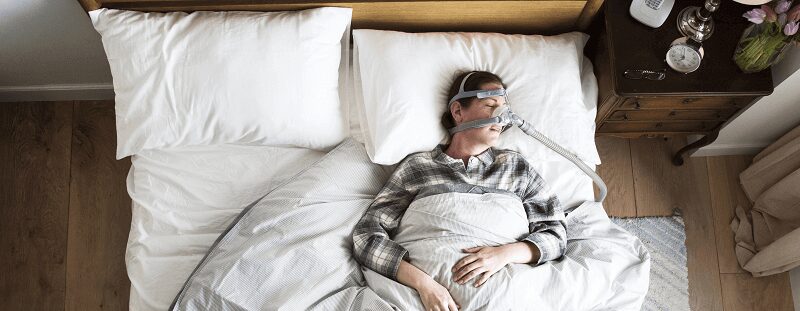
A mattress or adjustable base may affect comfort and sleep position, but neither treats obstructive sleep apnea. Use this buying guidance alongside clinician-recommended care.
See mattress & base guidesWhat a mattress can and cannot do for sleep apnea
Obstructive sleep apnea is an airway problem, and no mattress treats it. What your bed can do is make the positions that reduce airway collapse comfortable enough to hold all night, and keep CPAP therapy tolerable. If you have been diagnosed, the mattress is a support act for your prescribed therapy; if you suspect apnea — loud snoring, witnessed pauses in breathing, morning headaches, heavy daytime sleepiness — get evaluated before you shop for bedding.
Position is the lever
Back sleeping is the position most associated with airway collapse, because gravity lets the tongue and soft palate fall backward. Two setups help:
- Sleeping on your side. This requires a surface that lets the shoulder and hip sink in — generally medium to medium-firm with a real comfort layer. A too-firm bed pushes side sleepers back onto their spine within an hour.
- Elevating the head of the bed. Raising the upper body reduces the gravitational load on the airway for many people. An adjustable base is the practical way to do it, because stacking pillows bends the neck forward and often makes things worse. Head elevation of a few inches is where most people start.
For that reason, an adjustable base plus a compatible mattress is usually a better investment for an apnea household than a premium mattress alone. Confirm the mattress is base-friendly: most all-foam, latex and flexible-coil hybrids are, while rigid-perimeter innersprings often are not.
If you use CPAP
Comfort failures, not therapy failures, are what usually end CPAP use. A few bedroom fixes:
- Choose a surface with low motion transfer so a mask adjustment or hose tug does not wake your partner.
- Pick a mattress that sleeps cool. Mask leaks and heat go together, and warm foam makes both worse. Coil-based hybrids, latex, and covers with phase-change fabric move heat better than dense memory foam.
- Use a CPAP pillow or a pillow with cutouts if you side sleep in a full-face mask, so the frame is not levered off your face.
- Run the hose over the headboard or use a hose lift so it does not pull as you turn.
- Keep the humidifier below the mask level so condensation drains away from you.
Choosing feel and materials
There is no single "apnea mattress". Aim for the softest surface that still holds your spine level in the position you need: side sleepers under about 130 pounds usually want medium-soft, average weights medium, and over roughly 230 pounds a firmer hybrid with reinforced coils so the hips do not sink and rotate the torso. Reflux is common alongside apnea, and it is another argument for an adjustable base. If a partner is a light sleeper, prioritise motion isolation and a quiet base motor.
Frequently asked questions
Will an adjustable bed cure my apnea?
No. Elevation can reduce symptoms for some people and makes CPAP more comfortable, but it is not a treatment and does not replace a prescribed therapy or a clinician's follow-up.
Are wedge pillows a cheaper alternative?
They can work if the wedge is long enough to support the whole torso. Short wedges bend you at the waist or push the chin toward the chest, which can narrow the airway rather than open it.
What firmness should I buy if I have to stay off my back?
Medium to medium-soft for most side sleepers, firmer as body weight increases. The test is whether you are still on your side at 3 a.m., not how the bed feels in the first five minutes.
Does memory foam make snoring worse?
Not directly, but a deeply contouring, warm surface can encourage back sleeping and disrupt sleep through overheating. Cooler hybrids and latex are the safer default.
Can I try this setup before buying?
Yes — our Encinitas showroom has adjustable bases on the floor, so you can feel head elevation on a real mattress rather than guessing from a spec sheet.
Compare these picks against 142 tested mattresses
Sort all 142 mattresses we have tested by pressure relief, support, cooling, motion isolation, edge support, price, trial and warranty, then filter by how you actually sleep. Of those, 86 hold a complete standardized record and 41 a partial standardized record.