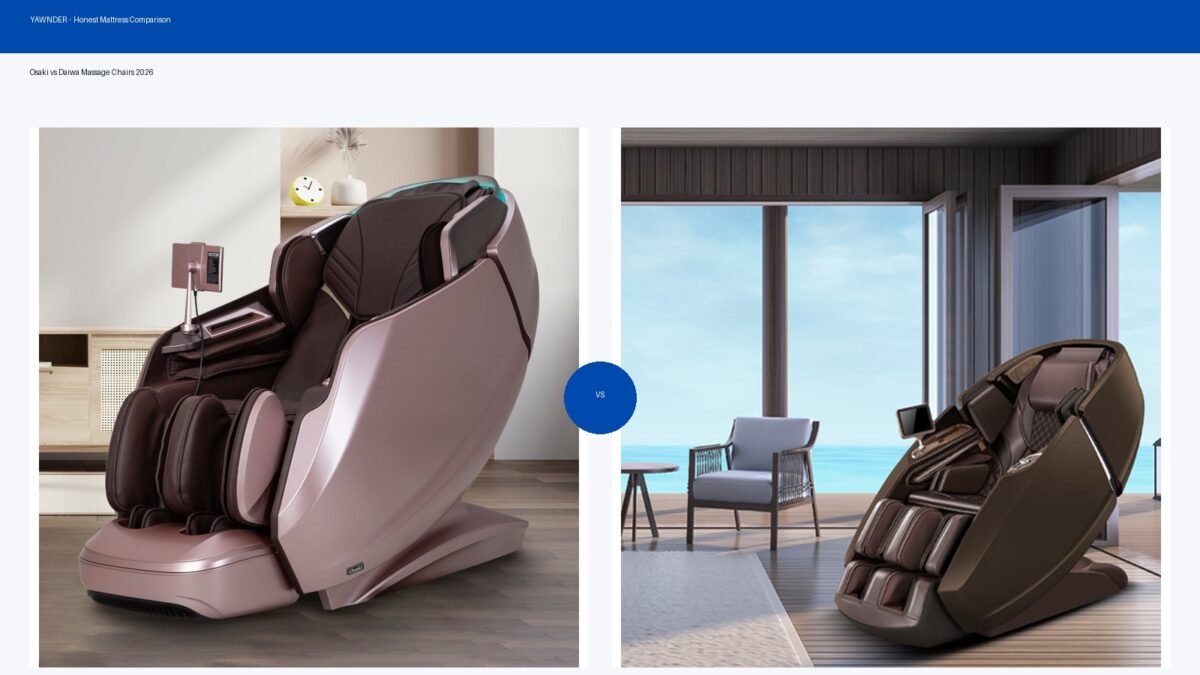
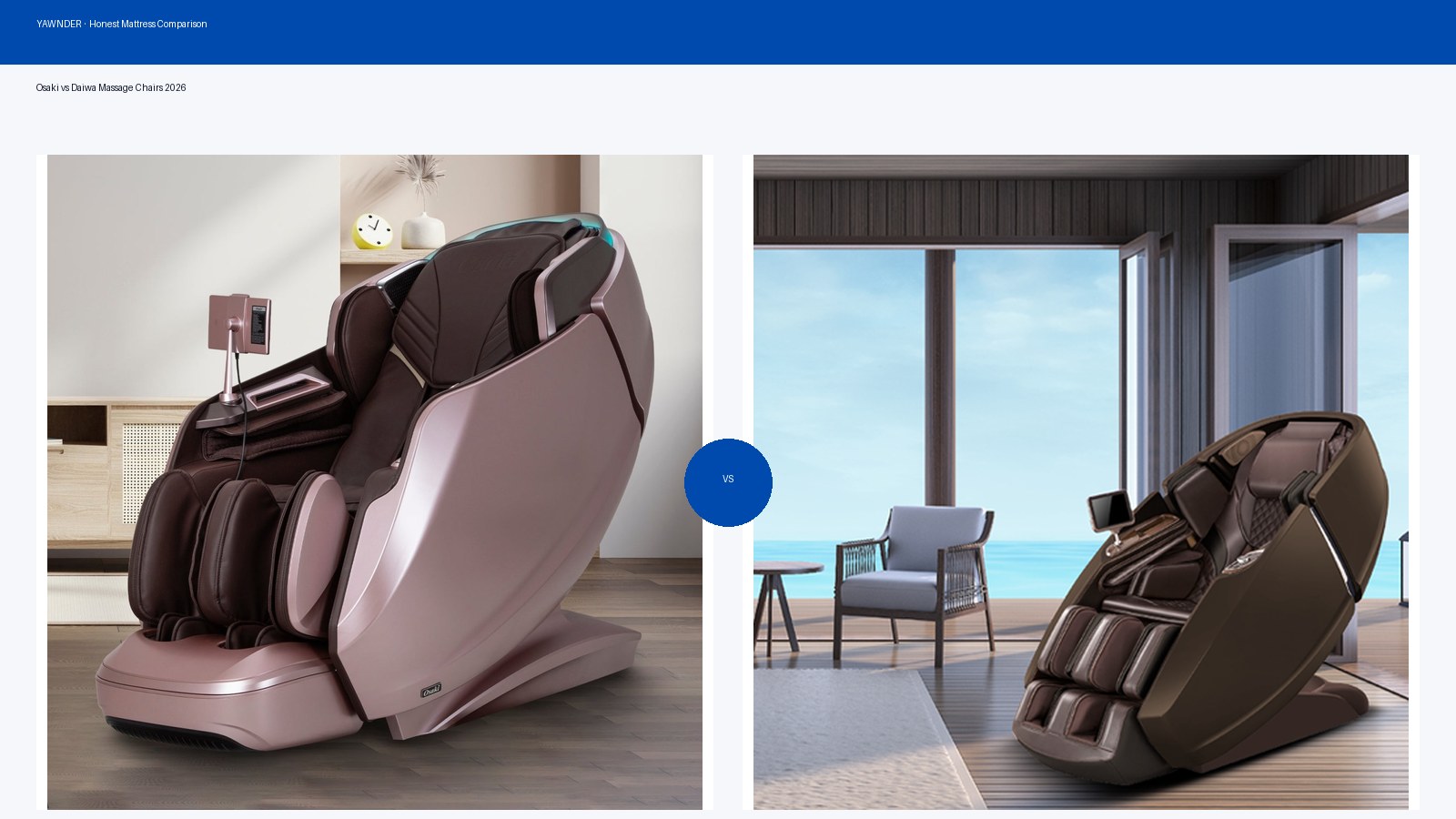
Choosing a premium massage chair is a significant investment in your daily comfort and relaxation. Two of the most respected names in the industry, Osaki and Daiwa, consistently appear at the top of any serious buyer’s list. But their approach to design, technology, and features differs in key ways. This guide cuts through the noise, comparing Osaki vs. Daiwa on the technical details and practical benefits that matter most, helping you decide which brand aligns with your budget and wellness goals.
At-a-Glance Comparison
For most people, Osaki offers a better balance of features, variety, and value. Their extensive lineup covers more price points, from entry-level relaxation models to advanced 4D chairs like the Highpointe, without sacrificing core quality. Daiwa, in contrast, focuses almost exclusively on the ultra-premium market with chairs like the Supreme Hybrid. Daiwa’s specialized features, such as their FullBodyReach™ multi-stroke rollers, are impressive but come at a significantly higher cost. Unless you want a specific high-end feature set, Osaki provides a more accessible path to a premium massage-chair experience.
Osaki vs. Daiwa Massage Chair Comparison
| Feature | Osaki | Daiwa |
|---|---|---|
| Overall Lineup | Wide range from value to premium | Primarily premium and specialty models |
| Roller Technology | 2D, 3D, and 4D options available | Mostly 3D and advanced 4D/Hybrid rollers |
| Track System | S-Track and L-Track models | L-Track and proprietary S+L Track |
| Popular Models | OS-4000T, Highpointe 4D, Maestro LE | Supreme Hybrid, Pegasus 2 Smart |
| Build & Upholstery | Durable synthetic leather, solid construction | Premium synthetic leather, refined fit and finish |
| Key Innovations | Heated rollers, broader app integration | FullBodyReach™ Rollers, advanced body scanning |
| Price Range | ~$2,500 to ~$13,000 | ~$6,000 to ~$15,000+ |
| Best For | Users seeking high value and a wide selection | Buyers prioritizing the latest tech at a premium price |
Roller Systems: 2D, 3D, and 4D Explained
The “dimensionality” of a massage chair’s rollers determines its ability to mimic the movements of a human massage therapist. This is arguably the most important feature of any chair.
- 2D Rollers: This is the base-level technology. The rollers move up and down your back and side to side. While effective for a basic massage, they cannot adjust intensity by pushing into your back. Many budget-friendly Osaki models utilize 2D rollers to provide excellent value.
- 3D Rollers: A significant step up, 3D rollers can do everything 2D rollers do, plus they can push forward into your back. This third dimension allows you to adjust the massage intensity, from a gentle touch to a deep-tissue pressure. Most mid-range to high-end chairs from both Osaki and Daiwa feature 3D rollers.
- 4D Rollers: This is the current state-of-the-art. 4D rollers add another layer of control, varying the speed and rhythm of the 3D movements. The rollers can speed up and slow down mid-stroke to better replicate the nuanced, variable motions of human hands. Premium models from both brands, like the Osaki Maestro LE and Daiwa Pegasus 2 Smart, use 4D technology for an incredibly realistic massage.
Comparison: Both brands offer 3D and 4D systems, but the mechanism design differs by model. Daiwa’s premium chairs include unusual dual-layer or hybrid roller approaches, while Osaki offers a broader range of conventional and dual-mechanism designs across more price points. Compare the exact chair rather than assuming one brand’s 4D label means more intensity or better results. audience.
Track Systems: S-Track vs. L-Track vs. S+L Track
The track is the path the rollers follow along your body. The type of track dictates how much of your body gets massaged.
- S-Track: The “S” refers to the sinusoidal shape that follows the natural curve of the human spine. An S-Track chair massages from your neck down to your lower back. This was the standard for many years, but it lacks coverage for the glutes and hamstrings.
- L-Track: The L-Track (sometimes called an SL-Track) is an extension of the S-Track. The rollers follow the same spinal curve but then extend underneath the seat to massage the glutes and the tops of the hamstrings. This provides a much more comprehensive full-body massage. The vast majority of modern chairs from both Osaki and Daiwa use an L-Track design.
- S+L Track: This is a term often associated with Daiwa. It emphasizes their focus on a track that not only extends to the glutes (L-Track) but is also expertly shaped to the spine’s curvature (S-Track). While functionally similar to the SL-Track terminology used by Osaki and others, Daiwa’s engineering here is precise, ensuring constant contact and pressure along the entire length of the track.
Comparison: Both brands offer extended track designs on many current models. Track length is only useful if the chair fits your torso and leg length; roller mechanism, body scan and seat geometry matter just as much.
Build Quality and Durability
A massage chair is a piece of furniture as well as a mechanical device. Build quality affects both its longevity and its aesthetic appeal in your home.
Osaki: Osaki chairs are built to be robust and reliable. They use high-grade synthetic leather that is engineered to withstand the friction and movement of the internal mechanics. The frames are solid, designed to handle years of use. While the aesthetics are generally sleek and modern, the focus is clearly on delivering features and performance at a competitive price. You get a very well-made product, but the fit and finish may not feel as luxurious as the most expensive competitors.
Daiwa: As a premium-focused brand, Daiwa places a heavy emphasis on luxury fit and finish. The synthetic leather often has a softer, more pliable feel, and details like stitching, cushioning, and the finish on remote controls and consoles feel a step above. Their chairs often have a more imposing, high-end presence. This is part of what you pay for with Daiwa—a superior tactile and visual experience to go along with the advanced technology.
Comparison: Daiwa emphasizes premium finishes on many models, while Osaki offers a wider range of aesthetics and prices. Upholstery feel, seat width and controls are better judged model by model.
Smart Features and Controls
Modern massage chairs are packed with technology, from touchscreens to voice commands.
Osaki has been a leader in integrating user-friendly tech. Many of their chairs feature touchscreen tablet remotes that are intuitive to navigate. They also offer robust mobile apps that allow you to control the chair from your phone and receive software updates. Voice commands are increasingly standard on their mid-range and high-end models, allowing for hands-free adjustments.
Daiwa also incorporates smart features, though sometimes with a different approach. The Daiwa Pegasus 2 Smart, for instance, includes a dedicated tablet and a secondary joystick-style control embedded in the armrest for quick, easy adjustments without needing to look at the screen. Voice controls are also crisp and responsive. Daiwa’s body-scanning technology is particularly noteworthy, mapping your specific size and shape with high accuracy to deliver a customized massage.
Comparison: Control layouts vary substantially by model. Some Osaki chairs favor tablet-style interfaces; Daiwa often combines tablet, joystick or remote controls. Try the interface if ease of use matters.
Price Tiers: What to Expect
This is where the two brands diverge most significantly.
Osaki: Osaki’s strength is its breadth. You can find quality L-Track chairs for under $4,000, feature-rich 3D models in the $5,000-$8,000 range, and state-of-the-art 4D chairs like the Maestro LE for over $10,000. This variety makes Osaki accessible to a much larger group of buyers.
Daiwa: Daiwa operates almost exclusively in the upper tiers. Their chairs typically start where mid-range Osaki models leave off, generally in the $6,000 to $15,000+ range. The price reflects their focus on specialized roller systems, luxury materials, and advanced engineering.
Comparison: Osaki generally offers more models across lower and middle price bands, while Daiwa also sells entry and mid-tier chairs in addition to luxury models. Current Daiwa standard-series MSRP spans roughly $2,000 to $7,000 before moving into premium collections.
Who is Osaki For?
Osaki may suit shoppers who want a broad model selection across many price points. If your budget is under $10,000, both brands have relevant options; compare the current mechanism, track, fit, warranty and delivered price of the exact models on your shortlist. Their wide selection ensures that whether you prioritize heated rollers, a space-saving design, or a particularly intense deep-tissue massage, there is a model built for you.
Who is Daiwa For?
Daiwa is for the buyer who is willing to pay a premium for cutting-edge technology and a luxury experience. If your budget is flexible and your top priority is experiencing the latest innovations—like hybrid roller mechanisms or advanced S+L tracks—then Daiwa is a compelling choice. The buyer who chooses Daiwa is typically paying for refined materials, more elaborate roller systems, and premium feature sets.
Frequently Asked Questions
How long is a massage chair warranty?
Most premium massage chairs from brands like Osaki and Daiwa come with a manufacturer’s warranty that typically ranges from 3 to 5 years. This usually includes a period of in-home service for labor, plus longer coverage for parts and the frame.
Do I need a special outlet for a massage chair?
No. Virtually all modern massage chairs, including those from Osaki and Daiwa, operate on a standard 110-120V household outlet. You do not need any special wiring.
What is zero gravity in a massage chair?
Zero gravity is a reclined position that elevates the legs relative to the torso. In a massage chair, it changes body position and may feel more comfortable or allow the rollers to contact the body differently; it should not be treated as spinal decompression or circulation therapy.
Can I try a massage chair before buying?
While many massage chairs are sold online, experiencing one is the best way to know if it’s right for you. At the Yawnder showroom in Encinitas, you can experience a premium massage chair to understand the feel of different roller systems and features. This can help you make a more informed decision when choosing between brands like Osaki and Daiwa.
Final Take
Both Osaki and Daiwa are masters of their craft, but they serve different customers. Daiwa pushes the absolute limits of what a massage chair can do, catering to a luxury buyer with a flexible budget. Osaki, on the other hand, excels at democratizing that high-end technology, packing incredible performance and features into chairs that offer unbeatable value. For the majority of users, Osaki provides a more logical and satisfying investment, delivering a world-class massage without the highest-end price tag.
Yawnder Reviews
Trying massage chairs in person
Yawnder’s Massage-chair feel varies dramatically by body size and roller geometry. Contact Yawnder before visiting to confirm which massage-chair models are currently available to try.