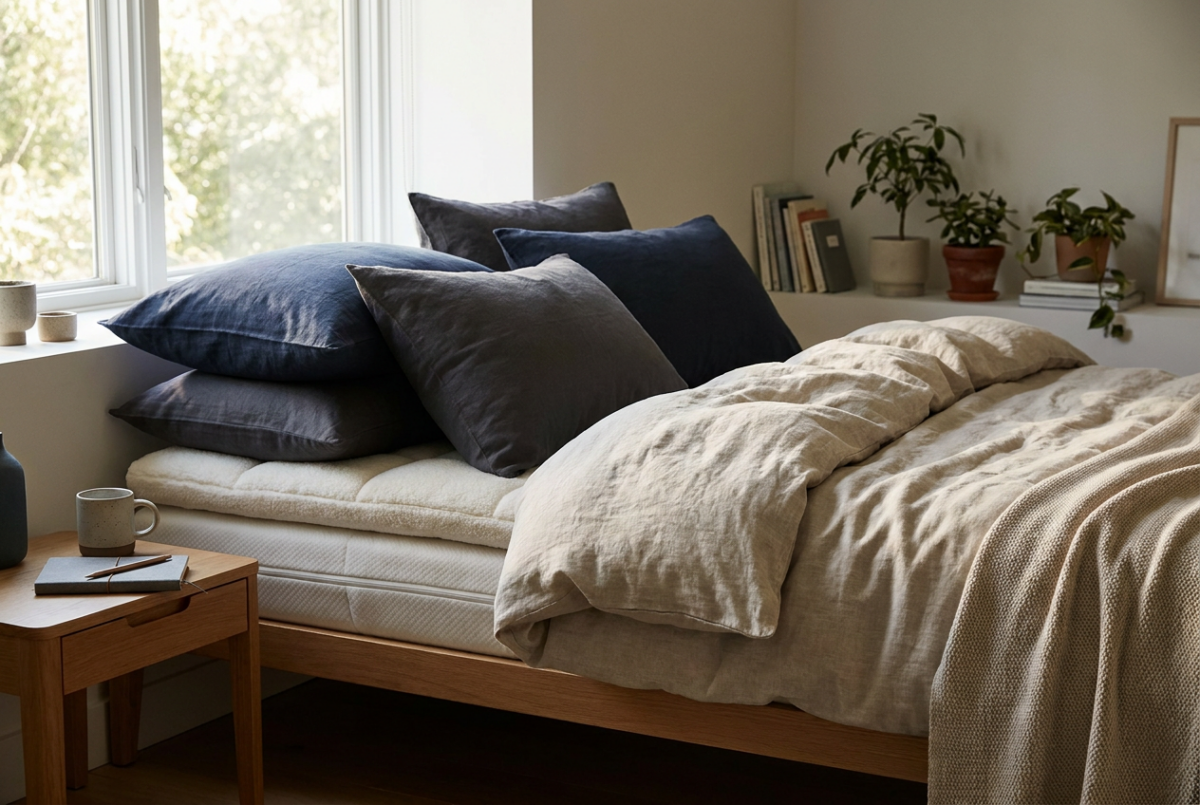
Quick answer: mattress thickness does not automatically equal quality. A well-built 10- or 12-inch mattress can outperform a poorly designed 16-inch bed. Thickness mostly changes how much room a manufacturer has for comfort layers, support layers and specialty materials.
10 vs 12 vs 14 vs 16 inches
| Thickness | Best fit | Tradeoffs |
|---|---|---|
| 10 inches | Lower-profile setups and some foam builds; bunk or wall beds only when their instructions permit it | Less room for thick comfort systems |
| 12 inches | Most adults, hybrids and balanced builds | Usually the easiest all-around thickness |
| 14 inches | Heavier sleepers, plush hybrids, deeper pressure relief | Higher bed height and heavier weight |
| 16 inches | Luxury builds with multiple comfort layers | Heavy, tall, harder to move and may require deep-pocket sheets |
How mattress thickness changes the sleep experience
Thickness changes more than appearance. A thicker mattress can create room for deeper comfort layers, taller coils, transition layers and specialty materials, but it also raises the finished bed height and adds weight. That matters for sheet fit, mobility, adjustable bases and delivery.
Finished bed height matters more than mattress height alone
Measure from the floor to the top of the surface that actually supports the mattress, then add mattress height and any topper. Some foundations sit inside a frame, so adding the full outside frame height and full foundation height can double-count the overlap. For example, if the foundation’s top is 20 inches above the floor, a 14-inch mattress makes the sleep surface about 34 inches high before a topper or bedding. Test the resulting height for both sleepers.

Sheet depth by mattress thickness
| Mattress | Sheet direction |
|---|---|
| 10–12 in. | Most standard fitted sheets work |
| 13–15 in. | Deep-pocket sheets are often safer |
| 16 in.+ | Measure carefully; many “deep pocket” sets still fit tightly |
How to choose the right thickness for your setup
- Start with the bed, not a target number. Measure from the floor to the mattress support surface and decide how high you want the finished bed. Remember to include any topper.
- Check construction and feel. Compare the thickness and materials of the comfort layers with the underlying support system. Lie in your usual sleep position; an advertised overall height does not tell you where the padding is.
- Check the fitted sheet. Measure the actual mattress plus topper and protector. Compare that total with the sheet’s stated pocket depth; brands use the term “deep pocket” differently.
- Check the base. Adjustable bases need a compatible mattress. Murphy beds, bunk beds and sleeper mechanisms have model-specific thickness, weight and clearance requirements; confirm them before buying. Wilding Wallbeds notes that wall-bed limits vary by mechanism and cabinet.
- Plan delivery. A tall mattress can also be heavy or awkward to maneuver. Check packaged dimensions and setup options, especially for stairs or tight turns. See our mattress weight guide.
Frequently asked questions
Is a 12-inch mattress better than a 10-inch mattress?
Neither is automatically better. The comfort and support layers, the sleeper’s needs and the intended base matter more than the height alone.
Can a 16-inch mattress work on an adjustable base?
Possibly, but check that both the mattress and the base manufacturers approve the combination. Mattress flexibility and the base’s weight limits matter as well as thickness.
Does a topper count toward sheet pocket depth?
Yes. Measure the mattress and topper together, including any padded protector, and compare the result with the fitted sheet’s stated pocket depth.
Thickness and body weight
Heavier sleepers often benefit from a mattress with enough comfort-layer depth to avoid bottoming out, but thickness alone does not guarantee stronger support. A 12-inch mattress with a robust coil core can outperform a 16-inch mattress built mostly from soft foam.
Does a thicker mattress support more weight?
Not necessarily. Support depends more on the coil unit or foam core, material density, zoning and overall design. Thickness can create room for stronger components, but it is not a substitute for them.
Thickness and adjustable bases
Very thick mattresses can be less flexible on an adjustable base. If you use an adjustable frame, check both mattress compatibility and total thickness.
Thickness and getting out of bed
Mattress thickness combines with foundation and frame height. A bed that is too tall can be difficult for shorter sleepers or people with limited mobility; a bed that is too low can also make standing up harder.
See our adjustable-bed mattress guide and mattress weight guide.