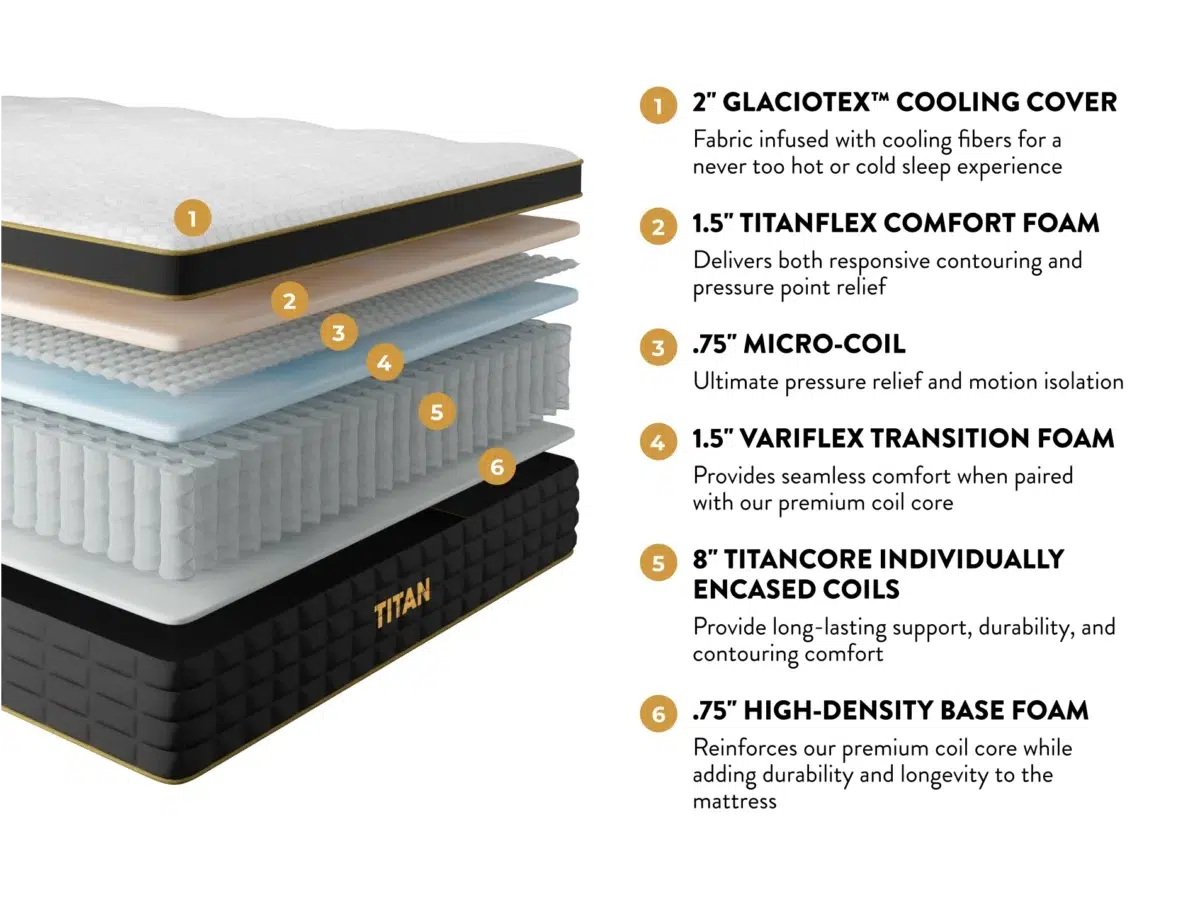
Quick answer: More coils do not automatically make a mattress better. Coil count only makes sense alongside mattress size, coil diameter, gauge, height, zoning, perimeter design and the comfort layers above the springs. A manufacturer can increase the number of smaller coils without necessarily creating a more supportive or durable mattress.
Why mattress companies advertise coil count
Coil count is an easy number to compare, which makes it attractive marketing. A mattress with 1,200 coils sounds more advanced than one with 800. But unlike a simple capacity measurement, coil count does not describe the entire support system.
Two mattresses can have very different counts and still deliver similar—or reversed—performance in support, motion isolation and edge stability.
What coil count actually means
Coil count is the number of springs in the support unit, usually quoted for a particular mattress size. Always check which size the advertised number refers to. A king naturally requires more coils than a queen when the coil layout is otherwise similar.
Pocketed coils are individually wrapped and can respond more independently than interconnected spring systems. Manufacturers can also vary coil diameter across the bed or use smaller coils to increase count.
Coil count vs coil gauge
Gauge describes the thickness of the wire. Lower gauge generally means thicker wire; higher gauge means thinner wire. Gauge affects how a spring responds, but it is not a standalone quality score either. Designers combine gauge, coil shape, turns, height, preload and zoning to create a particular response.
A mattress can intentionally use different gauges in different areas. Firmer coils may reinforce the perimeter or center third while more compliant coils allow greater contouring elsewhere.
What is a good coil count?
There is no universal minimum coil count that separates a good mattress from a bad one. The useful question is whether the complete coil unit provides the support, contouring, motion behavior and edge stability appropriate for the mattress design.
Be skeptical of shopping rules that declare a single coil-count threshold without accounting for mattress size and coil dimensions.
Can a very high coil count be meaningful?
Yes—when you know why the count is high. Some mattresses use a conventional pocketed-coil support core plus one or more layers of microcoils. Counting every microcoil can push the total dramatically higher. Microcoils can add responsiveness, airflow and targeted contouring, but the resulting large number should not be compared directly with the count of a mattress using only full-height support coils.
Does more coils mean better support?
Not by itself. Support depends on how the springs work with the comfort and transition layers. A high-count coil unit underneath overly soft or poorly matched comfort layers may still allow a sleeper’s pelvis to sink more than desired. Conversely, a thoughtfully engineered lower-count unit can provide excellent support.
Does more coils mean better motion isolation?
Individually wrapped coils generally allow more independent movement than traditional interconnected spring units, but coil count alone does not predict motion isolation. Thick foam comfort layers can absorb substantial movement, while a very responsive surface may transmit more motion despite using many coils.
Does more coils mean better edge support?
No. Edge support is often engineered separately using firmer perimeter coils, narrower coil spacing, a foam encasement or other reinforcement. If you sleep close to the perimeter, actual edge performance matters more than the total number printed on the specification sheet. See our edge-support guide for couples.
What about zoned coils?
Zoning changes spring response across different areas of the mattress. For example, a manufacturer may increase resistance around the center of the bed or alter the shoulder area. That can be more meaningful than simply adding more identical coils everywhere.
The specs that matter alongside coil count
- Mattress size used for the quoted count
- Full-size support coils versus microcoils
- Coil gauge and diameter
- Coil height and design
- Whether coils are pocketed or interconnected
- Zoning strategy
- Perimeter reinforcement
- Comfort and transition layers above the springs
- Overall firmness and responsiveness
- How the complete mattress performs for your weight and sleep position
A better way to compare hybrid mattresses
Instead of picking whichever model has the biggest coil number, compare how the finished beds perform in the categories you care about. A side sleeper may prioritize pressure relief plus support. A couple may put more weight on motion isolation and edge support. A combination sleeper may need easier movement.
Yawnder’s mattress comparison tools and buying guides are designed around those practical differences rather than a single marketing specification.
Bottom line
Coil count is a specification, not a quality grade. It can help describe how a mattress is built, but it becomes useful only in context. Do not pay more for a mattress simply because its coil count is higher.
Frequently asked questions
Is 1,000 coils better than 800?
Not necessarily. You need to know the mattress size, coil dimensions, gauge, zoning, perimeter design and whether the count includes microcoils before the numbers are meaningfully comparable.
Are pocket coils better?
Pocketed coils can move more independently than interconnected springs and are commonly used in modern hybrids. Whether the finished mattress is better still depends on the rest of its construction and how it matches the sleeper.
Do microcoils count toward mattress coil count?
They may. Some manufacturers report totals that include microcoil comfort layers. Check the construction details before comparing the total with another mattress.
Does coil gauge matter more than coil count?
Neither should be used alone as a quality score. Gauge helps describe wire thickness, while count describes quantity. The coil system’s complete engineering and the layers above it determine the finished feel and performance.