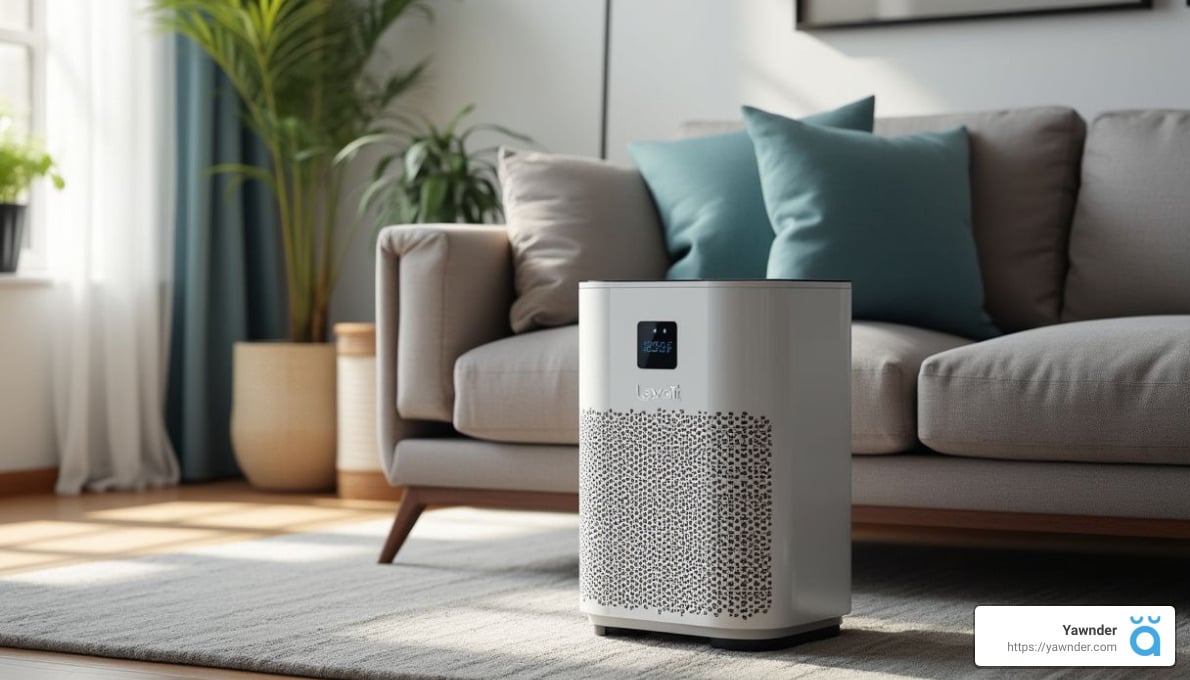
A bedroom air purifier can reduce some airborne particles, but the right size, noise level and replacement-filter costs matter as much as its features.
Levoit models to compare
| Model | Why consider it | What to check |
|---|---|---|
| Core 300S-P | Smart model with app controls; Levoit lists CADR of 141 cubic feet per minute. | Compare the room size at a stated air-change rate, noise at your preferred speed, and filter price. |
| Core 300-P | A non-smart option; Levoit lists CADR of 143 CFM. | Confirm the exact version and replacement filter availability. |
| Core 600S-P | A larger smart option to investigate for a larger space. | Check its current CADR, dimensions, operating noise and filter cost against your room. |
Specs and product versions change; confirm published figures before buying. We have not independently measured these models for this guide. For another brand, compare Blueair purifiers on CADR, noise and ongoing cost. Yawnder may earn a commission through qualifying links.
How to size a purifier
Measure the room in square feet and look for a clean air delivery rate (CADR) appropriate for the particles you want to reduce. EPA suggests a smoke CADR of at least two-thirds of the room’s area in square feet as a starting point for a typical room; ceiling height and the operating speed matter. For example, a 200-square-foot room suggests at least about 133 CFM for smoke.
Large coverage figures can assume fewer air changes per hour. Levoit lists the Core 300S-P for 219 square feet at 4.8 air changes per hour and 1,051 square feet at one air change per hour. Those are different rates, not equivalent cleaning speeds. See the EPA sizing guide.
What can a purifier remove?
A particle filter can capture airborne dust, pollen, pet dander and smoke particles passing through it. It does not remove particles settled on surfaces unless they become airborne. An activated-carbon layer can help with some odors or gases, but performance depends on the media and pollutant; a small carbon filter should not be assumed to remove every chemical.
Do not assume every Levoit model or replacement filter has the same HEPA certification or performance. Check the exact listing and certification. EPA recommends avoiding ozone-generating air cleaners and advises checking for appropriate low- or zero-ozone certification when considering ionization features.
Bedroom placement and upkeep
- Keep the intake and outlet clear and follow the placement instructions.
- Compare sound on the setting you will actually use; lower speeds usually deliver less clean air.
- Replace filters on the manufacturer’s schedule or as needed for conditions. Do not wash a disposable filter unless explicitly instructed.
- Continue source control, ventilation where appropriate and routine cleaning. A purifier does not replace medical care or eliminate all allergens.
Frequently asked questions
Is the Core 300S-P large enough for my room?
Compare its listed CADR of 141 CFM with room size, ceiling height and the operating speed you can tolerate. A larger space may need a larger unit or additional purifiers.
Does an air purifier remove pet hair and allergies?
It can capture some airborne particles, but cannot remove all allergens from furniture or guarantee symptom relief.
Can a purifier remove all smells?
No. Carbon media may reduce some odors, but effectiveness depends on the amount of media, the odor and airflow.
Sources: EPA air-cleaner guide; Levoit Core 300S-P.