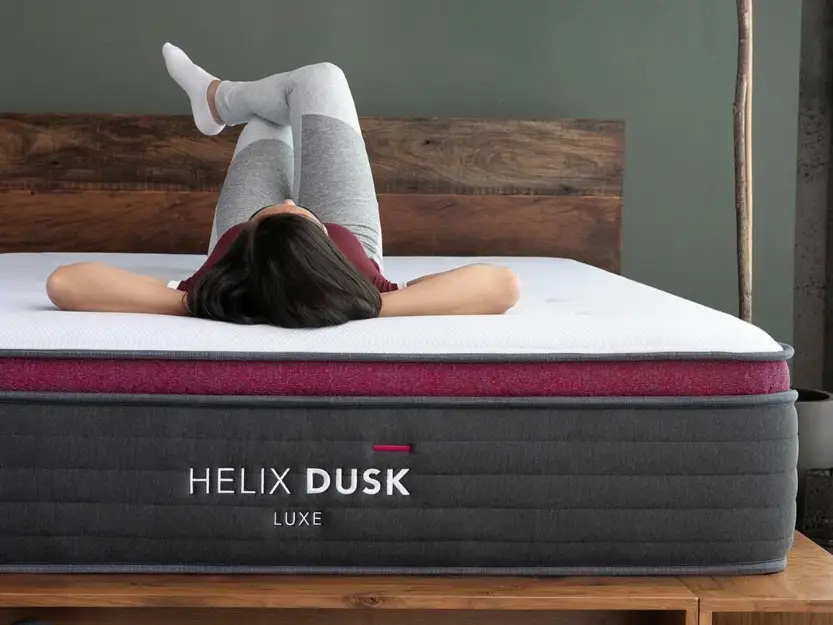
📅 Updated September 2026: Huberman Lab currently lists Helix as a sponsor. Huberman has also said in sponsor reads that he sleeps on a Helix mattress. Those comments are useful context, but they are sponsored endorsements—not independent scientific evidence that Helix improves sleep.
Huberman Lab currently lists Helix as a sponsor, and Huberman has said in sponsor reads that he sleeps on a Helix mattress. That is an endorsement and personal-use statement, not proof that Helix is scientifically validated to optimize sleep. Helix‘s personalized approach to support, temperature regulation, and spinal alignment directly addresses his criteria for high-quality, restorative sleep. It is ideal for individuals seeking a customized sleep solution informed by scientific principles.
In the expansive and often-confusing world of wellness, where every product claims to be a life-changing miracle, the endorsement of a trusted, credentialed expert cuts through the noise. When that expert is Dr. Andrew Huberman, a neuroscientist and associate professor at Stanford School of Medicine, people listen. His podcast, the Huberman Lab, has become a definitive resource for millions seeking to improve their health through science-backed protocols. So, when Dr. Huberman announced that he sleeps on a Helix mattress, it was a sponsored personal-use endorsement, which should be considered separately from independent product testing or sleep-science evidence. It prompts a crucial question: What does a world-renowned neuroscientist, who has dedicated his career to understanding the brain and body, look for in a mattress? This decision goes far beyond simple comfort, touching on the core principles of sleep quality, recovery, and overall performance.
A Neuroscientist’s Criteria for Superior Sleep
To understand why someone like Dr. Andrew Huberman would choose a Helix mattress, we first need to understand his foundational principles for sleep. Through his work at Stanford and the Huberman Lab podcast, he has consistently emphasized that high-quality sleep is not a passive state but an active biological process that requires a specific environment. He outlines several non-negotiable factors for optimizing this nightly restoration, and many of them are directly influenced by your mattress. The primary pillars include regulating core body temperature, maintaining physical comfort to minimize wakefulness, and ensuring a consistent, supportive environment for the eight hours we dedicate to slumber. For Huberman, sleep is a performance activity, and your bed is the most critical piece of equipment you own. A mattress fails if it traps heat, causes discomfort, or disrupts spinal alignment, as each of these failures sends signals to the brain to transition into a lighter, less restorative stage of sleep. Therefore, his choice is predicated on measurable, physiological benefits, not just subjective softness.
Decoding the Helix Advantage: Where Customization Meets Science
The Helix mattress brand stands out in a crowded market precisely because its entire model is built on addressing the individual variables that Dr. Huberman champions. They moved away from the archaic “one-size-fits-all” model and embraced personalization, a concept that aligns perfectly with the scientific understanding that no two bodies are the same. This tailored approach directly addresses the key criteria for a sleep-enhancing surface.
Personalized Support and the Helix Sleep Quiz
Helix’s cornerstone is its comprehensive Sleep Quiz. This isn’t a marketing gimmick; it’s a data-collection tool designed to match your unique physiology to the ideal mattress construction. The quiz asks for your height, weight, preferred sleep position (side, back, stomach, or a combination), and any issues you face, like back pain. The algorithm then recommends a specific model designed to provide optimal support and pressure relief for your body. For example, a side sleeper requires a mattress that allows the hips and shoulders to sink in slightly to maintain a straight spine, whereas a back or stomach sleeper needs firmer support to prevent the torso from sinking too low. This level of customization ensures proper spinal alignment, a critical factor for preventing pain and the micro-awakenings that fragment your sleep architecture.
Mastering Thermoregulation with Advanced Cooling
One of Dr. Huberman’s most repeated sleep protocols is the importance of a cool environment. To initiate and maintain deep sleep, your core body temperature needs to drop by one to two degrees. A mattress that traps heat actively works against this biological necessity. Helix integrates multiple technologies to facilitate cooling. Many of their mattresses, particularly in the Luxe and Elite lines, feature a GlacioTex™ Cooling Cover, which is cool to the touch and effectively pulls heat away from the body. Beneath the surface, materials like copper-infused gel memory foam add to the cooling effect, as copper is highly conductive and helps dissipate heat. This focus on thermoregulation means the mattress is an active participant in your sleep hygiene, helping your body achieve the temperature drop necessary for restorative deep and REM sleep.
The Endorsement in Context: More Than Just Comfort
A sponsor endorsement is not the same as independent product research, even when the person making it is a scientist. Dr. Huberman’s choice of Helix is a testament to the product’s ability to serve as a tool for enhancing biological recovery. His public platform is built on providing zero-cost, actionable advice, and when he does partner with a brand, it’s because the product fits seamlessly into his evidence-based framework for health. It’s a recognition that while light exposure and meal timing are crucial, the physical surface where you spend a third of your life is an equally important variable in the equation of health.
“Your sleep environment is not passive; it is an active tool. The surface you sleep on for a third of your life directly influences thermoregulation and physical recovery, two pillars of restorative sleep. Optimizing this environment is a non-negotiable for anyone serious about their health.”
This perspective reframes a mattress from a simple piece of furniture into a high-performance device. When viewed through this lens, the careful construction of a Helix mattress—with its zoned lumbar support to cradle the spine and its layers of foam and coils designed to minimize motion transfer—is clearly engineered to solve the physiological challenges of sleep. For someone whose partner, pet, or own movements might disrupt their slumber, the motion isolation offered by a hybrid mattress like Helix is a game-changer, preserving sleep continuity throughout the night.
How to Choose a Mattress Like a Neuroscientist
Inspired by Dr. Huberman’s methodical approach, you can adopt a similar mindset when selecting your next mattress. Rather than focusing solely on initial comfort in a showroom, consider the scientific function of the bed. Here are the key criteria to prioritize:
- Prioritize Personalization: Your body and sleep style are unique. Look for a brand that offers options tailored to you, rather than a single solution for everyone. A mattress that is perfect for a 120-pound side sleeper will be a disaster for a 250-pound stomach sleeper.
- Insist on Cooling Technology: Actively question how a mattress manages heat. Look for materials like phase-change fabrics, copper or gel infusions, and breathable coil layers. This is a non-negotiable for deep, uninterrupted sleep.
- De