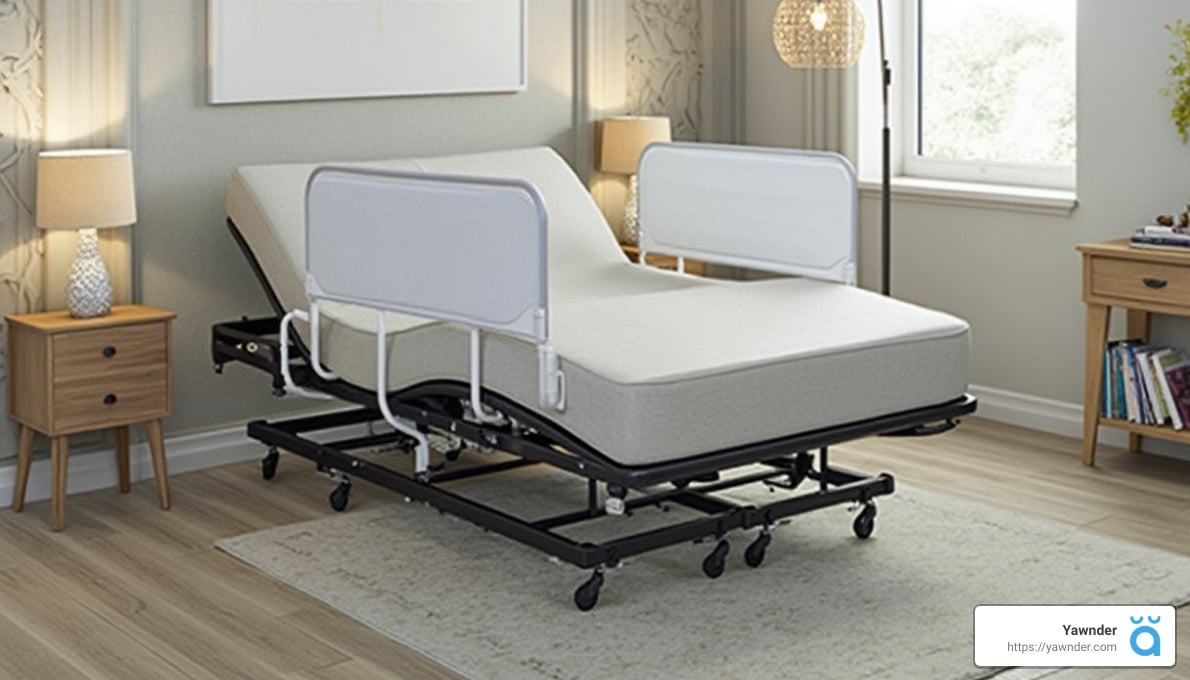
Start with safety and fit
Some portable bed rails are designed to help an adult reposition or get into and out of bed. Whether one is appropriate depends on the person, the exact adjustable base and mattress, and the rail’s instructions. Rails can cause serious injury or death from entrapment or falls, and an adjustable base can change the gaps as it moves.
Before buying, discuss the user’s needs with a clinician or occupational therapist, check the exact model against CPSC bed-rail recalls, and confirm compatibility with both manufacturers. The FDA’s consumer guidance explains who may be at increased risk and why fit matters.
Choose for the actual need
| Goal | What to discuss |
|---|---|
| Help standing or sitting | Whether a transfer handle, other assistive device or assistance is appropriate; the user must be able to operate it safely. |
| Help repositioning in bed | The person’s mobility, reach, grip strength and the way the bed articulates. |
| Concern about rolling out | Why the person is falling, whether a rail increases risk, and alternatives suited to the individual. |
A bed rail is not a restraint or a substitute for supervision. Confusion, impaired mobility or a tendency to climb over a rail can change the risk assessment. The FDA recommends considering alternatives where a rail is not appropriate.
Check adjustable-bed compatibility
- Find the base make and exact model, mattress size and thickness, and whether the base has a moving deck or is inside another bed frame. For more base-selection considerations, see our adjustable bed buying guide.
- Ask the rail maker and base maker whether the rail is approved for that combination, including split bases and all intended positions. “Fits most beds” is not enough.
- Confirm the permitted attachment method, mattress depth and weight or load limits in the rail’s manual. Do not drill, clamp or improvise an attachment unless explicitly authorized.
- Have an appropriate professional assess the installation and the user’s ability to reach and use it. Follow both manufacturers’ instructions and inspect as the bed moves.
A strap must be installed exactly as the manufacturer directs; its presence alone does not establish compatibility or eliminate entrapment risk. Soft mattresses may compress and create dangerous gaps.
Inspect for entrapment and falls
Entrapment can occur within the rail or between the rail, mattress and frame. A gap can change as the head or foot rises, the mattress shifts, or the user presses against the rail. Check the setup regularly and after adjustments, following the manufacturer’s instructions and the FDA’s safety guidance.
Do not rely on a generic gap measurement or an improvised fix as proof of safety. If there is a concerning gap, loose attachment, damaged part or uncertainty about fit, stop using the rail and obtain professional guidance.
Check recalls before purchase and use
Adult portable rails have been subject to recalls and safety warnings involving entrapment, asphyxiation and instability. Search the CPSC recall list for the exact brand and model, and review its consumer safety information.
Confirm applicable standards and documentation with the manufacturer. A retailer listing, favorable review or manufacturer claim is not a guarantee that a particular setup is safe. If your model is recalled, follow the recall notice’s instructions.
Alternatives and professional help
Depending on the person and the cause of the problem, a clinician may suggest lowering the bed, a different transfer aid, roll guard or other arrangement. Each option has its own limitations and should be assessed for that user and room.
For a medical need, ask a healthcare professional or durable medical equipment supplier about assessment, appropriate equipment and insurance coverage. Coverage depends on the plan and circumstances; do not assume a consumer adjustable base or rail is covered.
Frequently asked questions
Will a universal bed rail fit my adjustable base?
Not necessarily. Confirm compatibility for the exact rail, base, mattress and intended positions with the relevant manufacturers.
Can a bed rail prevent every fall?
No. A rail can introduce entrapment and fall hazards and is not a substitute for a person-specific assessment or monitoring.
What if the mattress shifts when the base moves?
Stop using the rail until the fit has been reassessed by the manufacturer or a qualified professional.