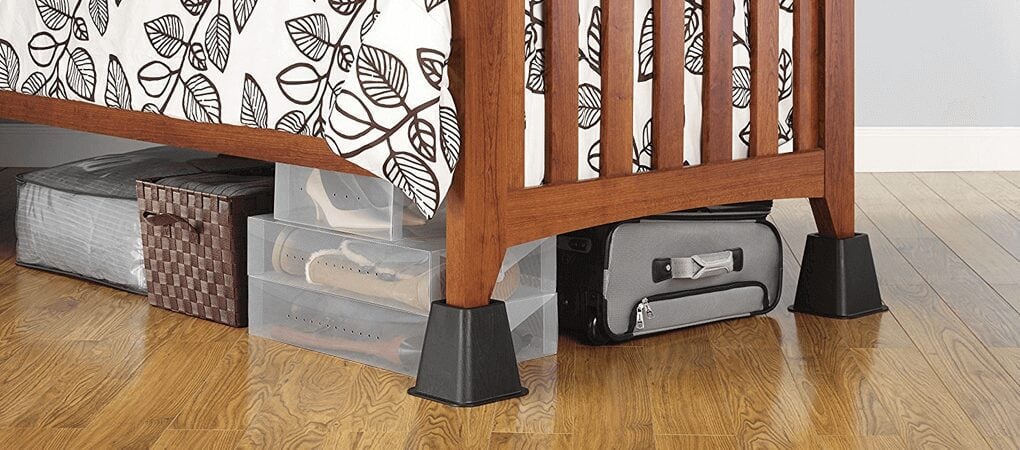
Bed risers can create storage space or raise a low bed when the frame and risers are compatible. Start with the height you need, then check every support point, the load rating and the bed manufacturer’s instructions. The best choice is a stable fit for your actual frame—not simply the tallest riser.
How much height do you need?
Measure from the floor to the lowest part of the frame, then measure the storage bin or suitcase you want to fit underneath. Include clearance to slide it in and allow for rails or center legs. The advertised riser height may differ from the actual lift after the bed leg sits in its recess.
If easier access is the goal, measure the finished height from the floor to the top of the mattress. The right height depends on the person and their mobility. A bed raised too high can make getting in and out less secure.
Will risers fit your bed?
Compare the leg’s width, shape and contact area with the riser’s recess. The leg should sit securely as instructed.
Many queen and king frames have center legs as well as corner legs. Support every load-bearing leg at the same height.
Some platform beds, upholstered frames and adjustable bases are not designed for generic risers. Use approved accessories where specified.
The base should sit flat and stable. Select floor protection compatible with the product, without adding an unstable shim.
For casters or unusual feet, confirm that the riser is specifically compatible. Do not remove or alter a caster unless the frame and riser instructions permit it.
Understand the weight rating
Add the frame, foundation, mattress, bedding, occupants and any other expected load. Check whether the stated capacity is per riser or for the complete set, and follow the maker’s required number and configuration. Loads can shift and are not necessarily distributed evenly. Choose an appropriate margin rather than planning to use a product right at its stated limit.
Material alone does not establish capacity: a properly rated plastic, wood or metal design can differ substantially from another. Confirm the rating, foot size and compatibility for the exact product.
Install and check stability
- Read both the frame and riser instructions. Clear the area and get help lifting the bed.
- Position each riser on a level surface and seat every supported leg as the maker directs.
- Use matching heights at all required supports, including center legs. Do not improvise with books or loose blocks.
- Stack risers only if the manufacturer explicitly designs and rates that configuration.
- Check that the frame is level and does not shift or rock before use; periodically recheck all supports.
Floor conditions matter. If the bed rocks, a leg does not fit or the frame maker prohibits risers, stop and choose a compatible solution.
Alternatives to bed risers
| Goal | Another option | What to check |
|---|---|---|
| Under-bed storage | Low-profile bins or a storage frame | Internal clearance and drawer access |
| Higher sleep surface | Manufacturer-approved taller legs or foundation | Compatibility, finished height and warranty |
| Adjustable base height | Approved leg extensions | Base maker’s supported parts and limits |
Frequently asked questions
Do all bed frames work with risers?
No. Check the frame instructions and whether each support foot can be seated safely.
Can risers be stacked?
Only use a stacked configuration when the product is designed and rated for it, and follow its instructions.
Do I need a riser under the center leg?
Support all load-bearing legs as the frame requires. Leaving a center support hanging can change the frame’s load path.
Will they damage the floor?
It depends on the base, floor and movement. Check the floor and riser maker’s guidance for compatible protection.
For frame sizing, see our mattress sizes guide and compare bed frames.